


Eswatini remains a staunch ally despite China’s political and economic pressure, the Ministry of Foreign Affairs said late on Sunday, after Beijing reportedly threatened to cut business ties with the African nation if it maintained diplomatic ties with Taiwan.
“Eswatini has reiterated its firm intentions to deepen its diplomatic relations with Taiwan, even in the face of pressure from China,” ministry spokeswoman Joanne Ou (歐江安) said in a statement.
The ministry wishes to express its “sincere appreciation and highest respect” to Eswatini for standing up to China’s efforts at suppression, she said, adding that Beijing was “rudely interfering in the economic activities of another nation.”
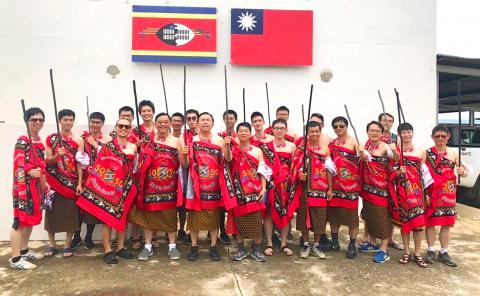
Photo: Screen grab from Twitter
The Times of Swaziland reported late last month that an undated statement reportedly issued by the Chinese embassy in Pretoria, South Africa, said that visa applications by Swazi citizens would be processed only at that embassy.
“According to the latest notification of the Chinese government, starting from January 10, 2020, visa applications of Swaziland citizens to mainland China will be processed by the Chinese embassy in South Africa,” the newspaper said on Jan. 24. “At the same time, the Chinese Visa Application Service Centre and other Chinese diplomatic missions will not accept the applications anymore.”
Citizens of Eswatini used to be able to apply for China visas at any Chinese embassy or consulate office in South Africa.
South Africa’s Daily Maverick reported that Chinese Ambassador to South Africa Lin Songtian (林松添) indicated in a statement that not only have restrictions been imposed on visa applications, but his embassy could also keep a close watch on Swazi citizens planning to travel to China.
“Such an embarrassing situation is the result of Eswatini defying the ‘one China’ principle and maintaining so-called ‘diplomatic ties’ with the Taiwan authorities, a province of the PRC,” the Daily Maverick quoted Lin as saying in the statement.
The paper also reported that China was threatening to “cripple” Eswatini economically if it did not immediately switch recognition from Taiwan to China.
“No diplomatic relations, no more business benefits,” it quoted Lin as saying. “To maintain such an immoral and abnormal relations [sic] with Taiwan authority politically disregards the Eswatini national dignity, economically disregards the interest of its country and people.”
The Times of Swaziland reported that Beijing might have convinced Chinese businesses to stop trading with Swazi companies.
The Ministry of Foreign Affairs said it is fully aware of Beijing’s actions against Eswatini and has been in close contact with Prime Minister Ambrose Mandvulo Dlamini, Minister of Foreign Affairs Thulisile Dladla and other top officials.
Taiwan would help Eswatini uphold its national dignity, the ministry said, responding to information it said it had obtained from its embassy in the African country.

UPGRADE: The Kang Ding-class frigate is replacing its Chaparall missiles with Tien Chien II and Hua Yang VLS, which would provide it with long-range, 360° air defense Taiwan plans to produce 1,200 to 1,376 Hai Chien II missiles (海劍二, Sea Sword II) — also known as TC-2N — to serve as the standard air defense system of the navy’s surface combatant fleet, a source said yesterday. Last week, the Hai Chien II, the naval version of the Tien Kung II missile (天劍二, Sky Sword II), completed a live-fire test in waters off the National Chungshan Institute of Science and Technology’s Jiupeng facility (九鵬) in Pingtung County’s Manjhou Township (滿州). The MIM72 Chaparral and other dated air defense missiles that currently arm Taiwanese ships have inadequate range to combat Chinese

REASONS FOR TRAVEL: An assistant professor said that proposed amendments to penalize drivers if they used drugs overseas would not deter people from traveling People who operate a motor vehicle under the influence of marijuana would have their driver’s license revoked, even if they used the substance while overseas, the Ministry of Transportation and Communications said yesterday, citing proposed amendments to the Road Traffic Management and Penalty Act (道路交通管理處罰條例). The amendments would also authorize the government to revoke the licenses of people determined to have used Category 1 or Category 2 narcotics, even if they were not operating a vehicle while under the influence of drugs, as well as ban them from taking the license test for three years, the ministry said. People aged 18 or

HEAVY WEATHER: Typhoon Jangmi is due to crash straight into the Ryukyus as airlines look to shift flights to larger aircraft or cancel flights to Okinawa entirely Taiwan’s international air carriers announced flight adjustments over the weekend as Typhoon Jangmi is forecast to hit the Ryukyu Islands today and tomorrow. The Central Weather Administration (CWA) upgraded Jangmi from a tropical storm to a typhoon at 8am yesterday, with the eye located 580km south of Naha city. It was moving north at 19kph. Today, China Airlines’ CI-120, CI-121, CI-122 and CI-123 flights between Taoyuan and Naha, Okinawa, have been canceled as well as CI-132 and CI-133 between Kaohsiung and Naha. EVA Air’s BR-112, BR-113, BR-186 and BR-185 flights between Taoyuan and Naha are also canceled. Low-cost carrier Tigerair Taiwan canceled IT-230,
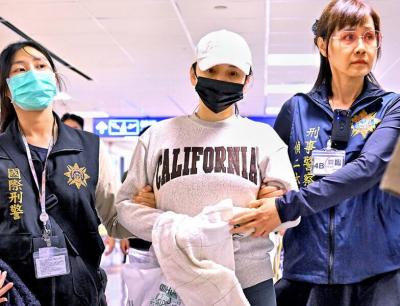
Johanne Liou (劉喬安), a Taiwanese woman who shot to unwanted fame during the Sunflower movement protests in 2014, returned to Taiwan last night after being deported from the US. She is to stand trial in Taiwan for charges involving embezzlement, fraud and drug crimes. The Criminal Investigation Bureau (CIB) said it took her into custody at Taiwan Taoyuan International Airport and would first question her before transferring her to the New Taipei District Prosecutors’ Office. She was arrested upon disembarking a flight from San Francisco that landed shortly before 7pm. Liou absconded to the US in 2019 after jumping bail


 RSS
RSS