


Former Ting Hsin International Group (頂新集團) chairman Wei Ying-chun (魏應充) was yesterday taken to Taipei Prison to resume serving a combined prison term he had been given over a tainted cooking oil scandal that erupted in 2014.
While declining to be interviewed by reporters outside the Taipei District Prosecutors’ Office, Wei recited a passage he had written to express his feelings: “Treat others with sincerity; be righteous and moral in your dealings; learn and grow from tribulations; treasure kindness and love and may all in Taiwan prosper.”
Wei was charged by the Changhua District Prosecutors’ Office in October 2014 for breaching the Act Governing Food Safety and Sanitation (食品安全衛生管理法) after investigators found the company had imported animal feed-grade material from Vietnamese oil manufacturer Dai Hanh Phuc Co, and described it in its customs declaration as fit for human consumption.
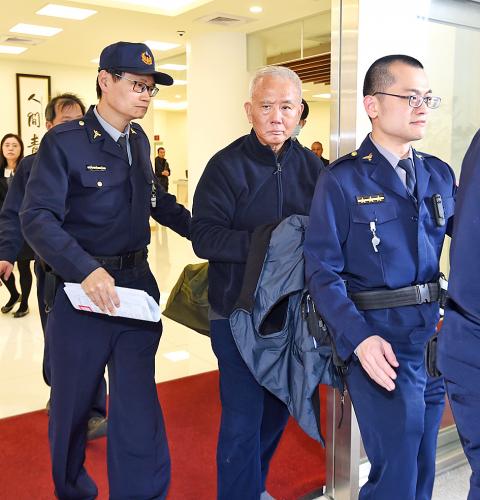
Photo: Liu Hsin-de, Taipei Times
The Supreme Court upheld a second appellate court ruling on Nov. 6 last year, which ruled that Wei was guilty of breaching the act and other offenses regarding the 2014 case, and sentenced Wei to five years and nine months in prison.
The prison term was reduced as part of it was commuted to a fine.
After the Taiwan High Court’s Taichung branch combined the prison terms from eight separate rulings that could not be commuted to fines, Wei was ordered to serve four years and eight months in prison.
He is looking at two years and nine months behind bars, as he had already been detained for 111 days and served one year and eight months in prison.
Prosecutors’ denied Wei’s appeal to delay serving his sentence due to medical reasons, on the grounds that his condition was not severe and could be treated by prison doctors, said Yu Ming-hsien (余明賢), Wei’s lawyer.
As Wei’s lawyer, it was not his place to criticize the judiciary, but the final ruling shows that there is still a long way to go until the judiciary can fully regain the public’s confidence, Yu said.
Yu said that prosecutors had not conducted a thorough investigation before charging his client and, referring to government agencies complying with investigations, alleged that administrative neutrality had been violated.
Opinions by food industry experts were dismissed by the court, causing bias against his client, Yu said.
Yu accused the court of succumbing to public pressure.
The case’s legal basis — that Dai Hanh Phuc was presumed to not have a foodstuff export license — was lost when Vietnamese media proved that Dai Hanh Phuc did not require such licenses, Yu said.
However, all was not lost and judges still had a chance to remain neutral as there are select parts of the case that have been remanded to lower appellate courts for retrial, Yu said.

The military has spotted two Chinese warships operating in waters near Penghu County in the Taiwan Strait and sent its own naval and air forces to monitor the vessels, the Ministry of National Defense (MND) said. Beijing sends warships and warplanes into the waters and skies around Taiwan on an almost daily basis, drawing condemnation from Taipei. While the ministry offers daily updates on the locations of Chinese military aircraft, it only rarely gives details of where Chinese warships are operating, generally only when it detects aircraft carriers, as happened last week. A Chinese destroyer and a frigate entered waters to the southwest

A magnitude 6.1 earthquake struck off the coast of Yilan County at 8:39pm tonight, the Central Weather Administration (CWA) said, with no immediate reports of damage or injuries. The epicenter was 38.7km east-northeast of Yilan County Hall at a focal depth of 98.3km, the CWA’s Seismological Center said. The quake’s maximum intensity, which gauges the actual physical effect of a seismic event, was a level 4 on Taiwan’s 7-tier intensity scale, the center said. That intensity level was recorded in Yilan County’s Nanao Township (南澳), Hsinchu County’s Guansi Township (關西), Nantou County’s Hehuanshan (合歡山) and Hualien County’s Yanliao (鹽寮). An intensity of 3 was

Japanese Prime Minister Sanae Takaichi’s comment last year on Tokyo’s potential reaction to a Taiwan-China conflict has forced Beijing to rewrite its invasion plans, a retired Japanese general said. Takaichi told the Diet on Nov. 7 last year that a Chinese naval blockade or military attack on Taiwan could constitute a “survival-threatening situation” for Japan, potentially allowing Tokyo to exercise its right to collective self-defense. Former Japan Ground Self-Defense Force general Kiyofumi Ogawa said in a recent speech that the remark has been interpreted as meaning Japan could intervene in the early stages of a Taiwan Strait conflict, undermining China’s previous assumptions
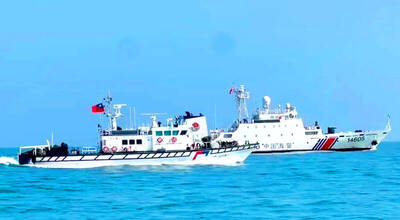
Instead of focusing solely on the threat of a full-scale military invasion, the US and its allies must prepare for a potential Chinese “quarantine” of Taiwan enforced through customs inspections, Stanford University Hoover fellow Eyck Freymann said in a Foreign Affairs article published on Wednesday. China could use various “gray zone” tactics in “reconfiguring the regional and ultimately the global economic order without a war,” said Freymann, who is also a nonresident research fellow at the US Naval War College. China might seize control of Taiwan’s links to the outside world by requiring all flights and ships entering or leaving Taiwan


 RSS
RSS