


To mark the 15th anniversary of the passage of the Gender Equity Education Act (性別平等教育法), a legislator and civic groups yesterday called on the government to work harder to achieve gender equality in schools.
They spoke at a news conference in Taipei called to raise gender awareness among students and promote the protection of the rights of young people.
This year is an important one for Taiwan, as it marks the legalization of same-sex marriage, the 15th anniversary of the act and the planned introduction of a new 12-year national education curriculum in August, Democratic Progressive Party Legislator Yu Mei-nu (尤美女) said.
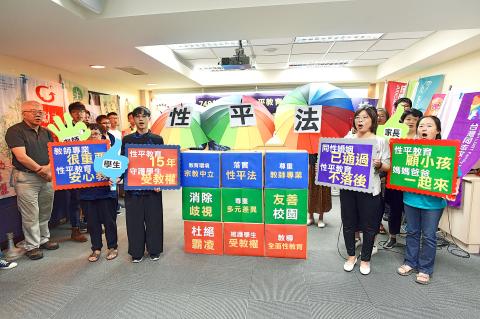
Photo: Wu Po-hsuan, Taipei Times
Despite those achievements, about 7 million Taiwanese in November last year voted for a referendum that called for a ban on same-sex-related education in elementary and junior-high schools, Yu said.
“The passage of that referendum has dealt a major blow to long-time advocates of gender equality education and has subjected children with different gender traits or sexual orientation to more pressure and difficulties,” Yu said.
National Federation of Teachers’ Unions vice secretary-general Lee Ya-ching (李雅菁) said that people should not forget about the incident that prompted the 2004 passage of the act: the April 10, 2000, death of Yeh Yung-chih (葉永鋕), a student at Gaoshu Junior High School in Pingtung County’s Gaoshu Township (高樹) whose body was found on the floor in a bathroom at his school.
Yeh had allegedly been bullied at school because of his effeminate manner, although in 2006 the Taiwan High Court’s Kaohsiung branch, in sentencing the school’s principal and two school officials to short prison sentences for “neglecting the degree of care required by their occupation,” found that his death had been the result of the 15-year-old slipping and falling in his hurry to return to class.
The act says it is to “promote substantive gender equality, eliminate gender discrimination, uphold human dignity, and improve and establish education resources and an environment of gender equality” and it requires schools to provide a gender equitable learning environment, and give respect and due consideration to students, regardless of their gender, gender disposition, gender identity or sexual orientation.
“However, the reality is that public opinion remains hostile toward teachers who try to implement gender equality education,” Lee said. “Some have been sued ... or have had their words taken out of context.”
An activist who asked to be identified only as Vivian told the news conference that the government needs to employ more teachers with awareness of gender issues.
Such teachers would be able to provide guidance and emotional support to students who are being bullied over their gender identity, Vivian said.
The Ministry of Education should establish a special fund to explore how to better include diverse family structures and same-sex topics in textbooks and to stock more gender-friendly books in school libraries, she said.

FUKUOKA SITUATION: Japanese media reported that the pathogen is expected to be identified by the summer, while the CDC downplayed the idea that it was hMPV A “mysterious cold-like illness” reported in Japan’s Fukuoka Prefecture does not seem to be a new disease, but Japanese authorities have been asked about the situation, the Centers for Disease Control (CDC) said yesterday. The Fukuoka Prefectural Medical Association on Wednesday told a news conference that a “mystery cold” that has become a hot topic on social media is “highly likely to be caused by some kind of viral infection,” Japan’s KBC News reported. “Many people are experiencing symptoms starting with a sore throat, followed by a runny nose, phlegm and a severe cough,” KBC News reported, citing association officials. Health authorities are

Nvidia Corp CEO Jensen Huang (黃仁勳) arrived in Taiwan yesterday ahead of upcoming AI and technology events, saying he plans to meet with clients and Taiwan Semiconductor Manufacturing Co Chairman C.C. Wei (魏哲家) during his visit. After landing at Taipei Songshan Airport, Huang posed for photos with fans and handed out Yakult drinks to reporters and supporters waiting at the scene, saying he has “a lot to do” during the trip. Asked about reports that Nvidia’s planned headquarters site in Taipei’s Beitou Shilin Technology Park could break ground on May 27, Huang said that if the company holds an event, he would

The Ministry of Finance this afternoon announced the winning numbers for the March-April uniform invoice lottery. The winning number for the NT$10 million (US$318,060) special prize is 19531471, and the winning number for the NT$2 million grand prize is 85941329. Three numbers were drawn for the NT$200,000 first prize: 07225810, 20231230 and 83518781. Those with receipts matching the last seven digits of any of the first-prize numbers will win the NT$40,000 second prize, while those matching the last six digits will win the NT$10,000 third prize. Those whose receipts match the last five digits of the first-prize numbers can claim the NT$4,000 fourth prize,
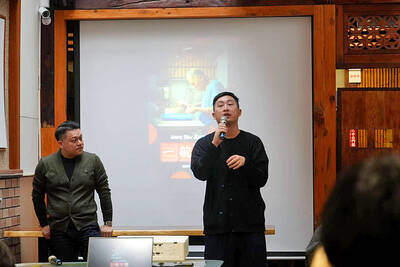
Taiwan Travelogue (臺灣漫遊錄), which earlier this week became the first Taiwanese novel to win the International Booker Prize, is to be adapted into a television series through a Taiwan-Japan coproduction, producer Chang Chen-yu (張辰漁) said yesterday. Chang, a producer at World Softest Production Film Co, wrote on Facebook that the company had been searching for projects with international appeal that retain a strong Taiwanese identity after colleagues and Japanese partners strongly recommended the novel. After reading the book, Chang said he immediately decided to pursue the screen rights. “A great story has the power to transcend time and borders, and connect countless people,”


 RSS
RSS