


Customs officers yesterday started checking the carry-on luggage of travelers arriving from South Korea for pork products after North Korea reported its first outbreak of African swine fever, the Council of Agriculture (COA) said.
There are no direct flights between Taiwan and North Korea.
While South Korea has not reported any infection, the council pre-emptively listed it as a high-risk area for transmission of the deadly disease, which is highly contagious.
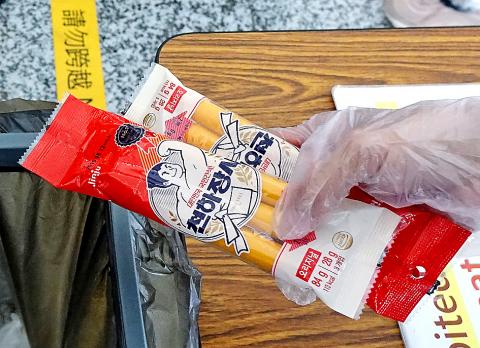
Photo: Chu Pei-hsiung, Taipei Times
North Korea on Thursday reported its first outbreak on a farm in Chagang-Do province, where 99 pigs were culled, the council said, citing information from the World Organisation for Animal Health.
Chagang-Do borders China’s Jilin and Liaoning provinces.
Liaoning was the first Chinese province to report an outbreak in August last year.
North Korea is the fifth Asian nation to report an infection, after China, Mongolia in January, Vietnam in February and Cambodia in April.
Vietnam has reported a total of 2,782 cases across 44 provinces and cities, while China has only reported 140 cases, despite having a larger area, council data as of yesterday showed.
Along with the five nations, Laos, Myanmar, Thailand and South Korea were successively listed as high-risk areas, even though they have not yet reported any infection cases.
All carry-on luggage of travelers from high-risk areas must undergo checks by X-ray scanners or airport police and sniffer dogs, the council said, adding that check-in luggage is already subject to checks.
People caught illegally carrying pork imports from areas that have reported African swine fever in the past three years would be fined NT$200,000 (US$6,327) for their first violation and NT$1 million for repeated offenses.
Foreigners who fail to pay the fine at customs would be denied entry into Taiwan.
From Dec. 18 last year to Sunday, the council had issued 293 fines of NT$200,000 each to 281 people of different nationalities carrying Chinese pork products and 12 people bringing Vietnamese pork products, while 107 foreigners were denied entry for failing to pay the fines.

Hong Kong singer Eason Chan’s (陳奕迅) concerts in Kaohsiung this weekend have been postponed after he was diagnosed with Covid-19 this morning, the organizer said today. Chan’s “FEAR and DREAMS” concert which was scheduled to be held in the coming three days at the Kaohsiung Arena would be rescheduled to May 29, 30 and 31, while the three shows scheduled over the next weekend, from May 23 to 25, would be held as usual, Universal Music said in a statement. Ticket holders can apply for a full refund or attend the postponed concerts with the same seating, the organizer said. Refund arrangements would
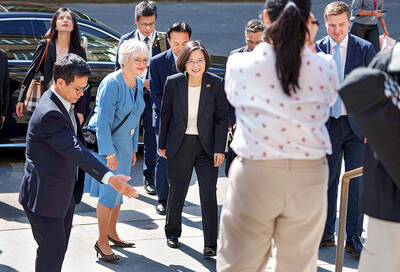
Former president Tsai Ing-wen (蔡英文) on Monday called for greater cooperation between Taiwan, Lithuania and the EU to counter threats to information security, including attacks on undersea cables and other critical infrastructure. In a speech at Vilnius University in the Lithuanian capital, Tsai highlighted recent incidents in which vital undersea cables — essential for cross-border data transmission — were severed in the Taiwan Strait and the Baltic Sea over the past year. Taiwanese authorities suspect Chinese sabotage in the incidents near Taiwan’s waters, while EU leaders have said Russia is the likely culprit behind similar breaches in the Baltic. “Taiwan and our European
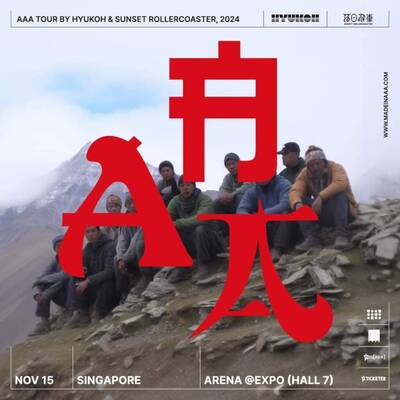
Taiwanese indie band Sunset Rollercoaster and South Korean outfit Hyukoh collectively received the most nominations at this year’s Golden Melody Awards, earning a total of seven nods from the jury on Wednesday. The bands collaborated on their 2024 album AAA, which received nominations for best band, best album producer, best album design and best vocal album recording. “Young Man,” a single from the album, earned nominations for song of the year and best music video, while another track, “Antenna,” also received a best music video nomination. Late Hong Kong-American singer Khalil Fong (方大同) was named the jury award winner for his 2024 album
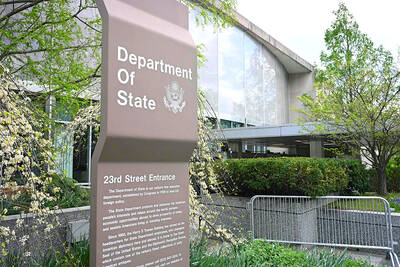
The US Department of State on Monday reaffirmed that US policy on Taiwan remains unchanged, following US President Donald Trump’s use of the term “unification” while commenting on recent trade talks with China. Speaking at a wide-ranging press conference, Trump described what he viewed as progress in trade negotiations with China held in Geneva, Switzerland, over the weekend. “They’ve agreed to open China — fully open China, and I think it’s going to be fantastic for China. I think it’s going to be fantastic for us,” Trump said. “I think it’s going to be great for unification and peace.” Trump’s use of the


 RSS
RSS