


The National Taiwan Museum of Fine Arts in Taichung is hosting an exhibition of works by artist Li Chun-shan (李仲生) and his students through Sunday.
Born in 1912, Li studied with Japanese-French painter Tsuguharu Foujita, a member of the Paris School, in Japan.
Foujita encouraged students by deciphering the essence and style of their works from their worst paintings. He strongly opposed works that were uncreative and mere imitations of earlier works.
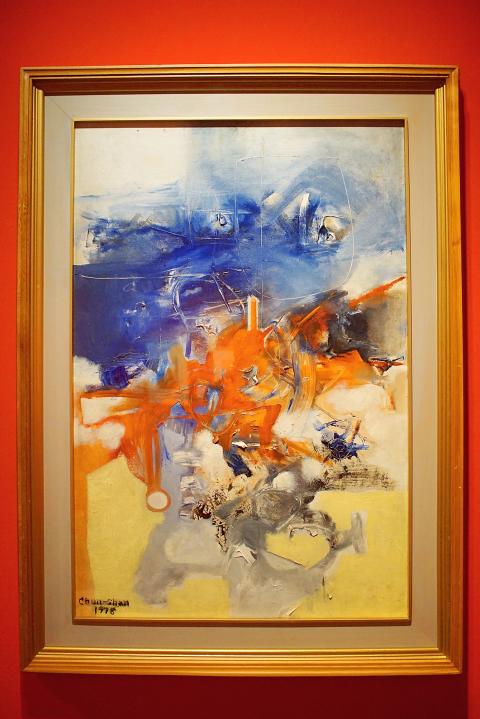
Photo: Ho Tsung-han, Taipei Times
His teaching influenced Li’s own experimental teaching, which was free, open, bold and anti-academic.
In 1951, Li opened a studio on Andong Street in Taipei and took on Oyan Wen-yuen (歐陽文苑), Ho Kan (霍剛), Hsiao Chin (蕭勤), Li Yuan-chia (李元佳), Tommy Chen (陳道明), Wu Hao (吳昊), Hsia Yan (夏陽) and Hsiao Ming-hsien (蕭明賢) as students.
These eight students would in 1956 go on to create the East Painting Association (東方畫會), one of the earliest avant-garde art groups in Taiwan.
Although Li never participated in the group’s planning and exhibitions, he was seen as its spiritual leader.
Artist Chung Chun-hsiung (鍾俊雄), who quit school as a second-year student at Taichung First Senior High School to study with Li and joined the association in 1964, said Li would ask his students to turn in 100 sketches a week.
Li did not want his students to draw what they saw, but rather the subjects as seen through their hearts, with emotion, Chung said.
Half a year went by and he still did not understand Li’s instructions, so one day, he and his classmates snuck into Li’s dorm to steal a few of his sketches, Chung said.
They took about 20 sketches from the thousands underneath his bed and only later discovered that each was worth NT$120,000, he said, adding that when they returned for more, they were gone.
Li did not want his students to see his paintings, because if they did, they would imitate his work, he said.
Li forced all of his students to find themselves, and when they hit a wall and could not do so, eight out of 10 students would quit, Chung said.
In the remaining class time, Li would talk about art history, he said, adding that Li wanted them to be open-minded and have foresight.
Chung said that only in the end, when Li’s students finally discovered themselves did they realize how great a teacher Li was.
Back then, the gathering of two people was enough to make the Taiwan Garrison Command suspicious of communist ties, he said.
China-born woodcut artist Huang Rongcan (黃榮燦), who belonged to the same art group as Li and was his former roommate, was executed during the White Terror era, Chung said.
Subsequently, when his students were planning to form the East Painting Association in 1956, Li packed his bags and hid in Changhua County’s Yuanlin Township (員林), he said.
However, the museum said Li moved to Changhua in 1955 due to his rheumatism.
His students found him teaching in Changhua a year later, Chung said.
Thankfully, then-secret police chief Chiang Ching-kuo (蔣經國) had heard that abstract art was trending worldwide and allowed the East Painting Association to be established.
Chung said he suspects that the incident might be a reason why Li seems to have post-traumatic stress disorder.
Li would often spend long periods of time washing his hands in the hallway, and half an hour washing his paint brushes, he said.
He was also afraid to eat the mooncakes his students gave him for Mid-Autumn Festival, leaving them around until mold grew on them, he said.
When Li passed away in 1984, 69 students were on his funeral committee.
Although Li only held two exhibitions in his lifetime, in his 34 years of teaching, he gave rise to many important artists of the post-World War II modern art period.
The exhibition “Pioneers of the Avant-Garde Movement in Taiwan: From Li Chun-Shan to His Disciples” is divided into three themes: works from the Andong Street studio, works from Li’s time in Changhua and works by Li’s students.
Li’s art incorporates concepts of the Freudian unconscious, surrealism, automatism and abstract art to transfer his inner emotions onto the canvas, exhibition curator Tao Wen-yueh (陶文岳) said.
He taught one-on-one, adjusted his teaching based on the qualities of each individual student and was a pioneer of modern art in Taiwan, Tao added.
This story has been updated since it was first published to correct the English name of the East Painting Association.

Yangmingshan National Park authorities yesterday urged visitors to respect public spaces and obey the law after a couple was caught on a camera livestream having sex at the park’s Qingtiangang (擎天崗) earlier in the day. The Shilin Police Precinct in Taipei said it has identified a suspect and his vehicle registration number, and would summon him for questioning. The case would be handled in accordance with public indecency charges, it added. The couple entered the park at about 11pm on Thursday and began fooling around by 1am yesterday, the police said, adding that the two were unaware of the park’s all-day live

A former soldier and an active-duty army officer were yesterday indicted for allegedly selling classified military training materials to a Chinese intelligence operative for a total of NT$79,440. The Taipei District Prosecutors’ Office indicted Chen Tai-yin (陳泰尹) and Lee Chun-ta (李俊達) for contravening the National Security Act (國家安全法) and the Anti-Corruption Act (貪污治罪條例). Chen left the military in September 2013 after serving alongside then-staff sergeant Lee, now an army lieutenant, at the 21st Artillery Command of the army’s Sixth Corps from 2011 to 2013, according to the indictment. Chen met a Chinese intelligence operative identified as “Wang” (王) through a friend in November

Minister of Digital Affairs Lin Yi-ching (林宜敬) yesterday cited regulatory issues and national security concerns as an expert said that Taiwan is among the few Asian regions without Starlink. Lin made the remarks on Facebook after funP Innovation Group chief executive officer Nathan Chiu (邱繼弘) on Friday said Taiwan and four other countries in Asia — China, North Korea, Afghanistan and Syria — have no access to Starlink. Starlink has become available in 166 countries worldwide, including Ukraine, Malaysia, the Philippines and Vietnam, in the six years since it became commercial, he said. While China and North Korea block Starlink, Syria is not
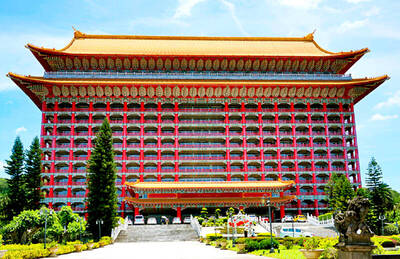
The Grand Hotel Taipei has rejected media reports claiming that the hotel had prevented CBS from broadcasting coverage of the Beijing summit between U.S. President Donald Trump and Chinese President Xi Jinping (習近平) on its premises. Media reports alleging that the hotel owner, dissatisfied with CBS’s coverage, prohibited the network from broadcasting political content on the hotel premises, are not true, the hotel said in a statement issued last night. The reports were “inconsistent with how the hotel actually handled the matter,” it said. The hotel said it received a refund request from a


 RSS
RSS