


Aborigines yesterday supported Executive Yuan spokeswoman Kolas Yotaka for her comments on the government not being involved in a ceremony dedicated to Cheng Cheng-kung (鄭成功) and called on members of the Cheng family to respect others’ historical views.
Cheng, also known as Koxinga, was a Ming Dynasty general who drove Dutch colonists out of Taiwan in 1662.
Kolas on Sunday said on Facebook that the government should not be involved in the ceremony to honor Cheng as such worship legitimizes “colonial thought and behavior.”
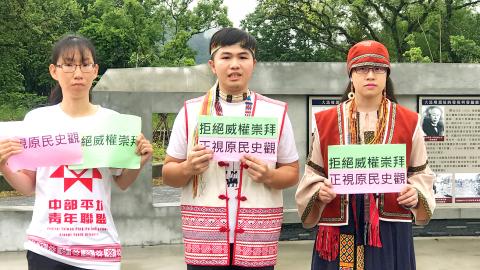
Photo: Tung Chen-kuo, Taipei Times
Cheng was, to Aborigines, no better than Columbus because he killed and pillaged the local population, Kolas said, adding that such practices should never again be repeated.
President Tsai Ing-wen (蔡英文) canceled the practice of government officials attending the ceremony when she took office in 2016, turning the duties over to the Tainan City Government.
Kolas said in the post that she was speaking for herself and not for the government.
The Cheng family had protested Kolas’ comments as inappropriate and demanded her resignation.
The Central Taiwan Pingpu Indigenous Groups Youth Alliance yesterday held a news conference to support Kolas’ comments.
Alliance director-general Kaisanan Ahuan said the government should not take the lead in worshiping Cheng, who was a symbol of authoritarian power; that it should give Aborigines’ version of history due attention; and implement Aboriginal transitional justice.
The Cheng family’s protest is akin to rubbing salt in the wounds of the descendants of Cheng’s victims, Kaisanan said, adding that his people, the Taokas, were such victims.
Representative of the Papora people As Li-i Mali said it was well-documented in historian Lien Heng’s (連橫) The General History of Taiwan (台灣通史) that Cheng invaded and slaughtered the ancestors of the Pingpu, driving them off their land and into the mountains.
One incident almost wiped out the entire village of Shalu (沙轆) and there were only six survivors, As Li-i said.
Taiwan should be accepting of diverse opinions and all of its people should face up to history together, she added.

Yangmingshan National Park authorities yesterday urged visitors to respect public spaces and obey the law after a couple was caught on a camera livestream having sex at the park’s Qingtiangang (擎天崗) earlier in the day. The Shilin Police Precinct in Taipei said it has identified a suspect and his vehicle registration number, and would summon him for questioning. The case would be handled in accordance with public indecency charges, it added. The couple entered the park at about 11pm on Thursday and began fooling around by 1am yesterday, the police said, adding that the two were unaware of the park’s all-day live

Yangmingshan National Park’s Qingtiangang (擎天崗) nature area has gone viral after a park livestream camera observed a couple in the throes of intimate congress, which was broadcast live on YouTube, drawing large late-night crowds and sparking a backlash over noise, bright lights and disruption to wildlife habitat. The area’s livestream footage appeared to show a couple engaging in sexual activity on a picnic table in the park on Friday last week, with the uncensored footage streamed publicly online. The footage quickly spread across social media, prompting a tide of visitors to travel to the site to “check in” and recreate the

Fast food chain McDonald's is to raise prices by up to NT$5 on some products at its restaurants across Taiwan, starting on Wednesday next week, the company announced today. The prices of all extra value meals and sharing boxes are to increase by NT$5, while breakfast combos and creamy corn soup would go up by NT$3, the company said in a statement. The price of the main items of those meals, if ordered individually, would remain the same. Meanwhile, the price of a medium-sized lemon iced tea and hot cappuccino would rise by NT$3, extra dipping sauces for chicken nuggets would go up

Minister of Digital Affairs Lin Yi-ching (林宜敬) yesterday cited regulatory issues and national security concerns as an expert said that Taiwan is among the few Asian regions without Starlink. Lin made the remarks on Facebook after funP Innovation Group chief executive officer Nathan Chiu (邱繼弘) on Friday said Taiwan and four other countries in Asia — China, North Korea, Afghanistan and Syria — have no access to Starlink. Starlink has become available in 166 countries worldwide, including Ukraine, Malaysia, the Philippines and Vietnam, in the six years since it became commercial, he said. While China and North Korea block Starlink, Syria is not


 RSS
RSS