


Raw pork products should be disposed of in regular garbage bins for incineration, the Environmental Protection Administration (EPA) said yesterday, after media reports questioned whether the agency’s policy contradicts that of the Council of Agriculture (COA).
Raw leftovers were previously used to make compost, but in light of the African swine fever threat, the agency earlier this year began encouraging people to treat unwanted pig products as general garbage to be incinerated, EPA Deputy Minister Shen Chih-hsiu (沈志修) said.
The agency has required local environmental bureaus to advertise the policy on garbage truck loudspeakers, he said.
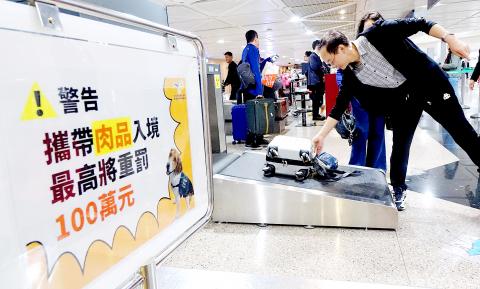
Photo: Chu Pei-hsiung, Taipei Times
However, the Chinese-language United Daily News yesterday reported that COA Deputy Minister Huang Chin-cheng (黃金城) disapproved of the EPA’s policy.
Wild animals might eat discarded pork from garbage cans and transmit the virus if African swine fever enters the nation, the report cited Huang as saying.
Shen and Huang later told a news conference in Taipei that their policies did not differ and hugged each other for media photographs.
Unwanted pig products that originated in Taiwan should be disposed of in garbage bins, while Chinese pig products should be sent to the council for disposal, Shen said.
Hog farmers who still use leftovers to feed pigs should apply for EPA approval by Thursday next week, or else switch to fodder or stop raising pigs, he added.
As the disease has not yet spread to Taiwan, there is no problem with incinerating unwanted pork products, Huang said.
If the disease enters the nation, the council would fully compensate hog farmers who report infections and whose pigs are culled, he said, adding that farmers who conceal information would not be compensated.
The council on Thursday announced that four more pork products seized at airports were confirmed to contain the African swine fever virus, with the number of infected products reaching 18 as of yesterday.
To ensure that every piece of luggage is checked, the council is to install 16 additional X-ray scanners at Taiwan Taoyuan International Airport before the Lunar New Year holiday begins, Bureau of Animal and Plant Health Inspection and Quarantine Director-General Feng Hai-tung (馮海東) said.
Separately yesterday, Premier Su Tseng-chang (蘇貞昌) said that visitors should not be importing pork products in the first place, and that no country at risk of an African swine fever outbreak is concerned with how a culprit would pay the fine.
Su made the remarks in response to media queries on how to deal with visitors who bring pork products through customs, but do not have enough cash with them to pay the fine, as people are only allowed to bring cash totaling NT$100,000 into the nation.
To maintain national security, concerted efforts and stringent law enforcement are needed, Su said.
Additional reporting by Sean Lin

FUKUOKA SITUATION: Japanese media reported that the pathogen is expected to be identified by the summer, while the CDC downplayed the idea that it was hMPV A “mysterious cold-like illness” reported in Japan’s Fukuoka Prefecture does not seem to be a new disease, but Japanese authorities have been asked about the situation, the Centers for Disease Control (CDC) said yesterday. The Fukuoka Prefectural Medical Association on Wednesday told a news conference that a “mystery cold” that has become a hot topic on social media is “highly likely to be caused by some kind of viral infection,” Japan’s KBC News reported. “Many people are experiencing symptoms starting with a sore throat, followed by a runny nose, phlegm and a severe cough,” KBC News reported, citing association officials. Health authorities are

Nvidia Corp CEO Jensen Huang (黃仁勳) arrived in Taiwan yesterday ahead of upcoming AI and technology events, saying he plans to meet with clients and Taiwan Semiconductor Manufacturing Co Chairman C.C. Wei (魏哲家) during his visit. After landing at Taipei Songshan Airport, Huang posed for photos with fans and handed out Yakult drinks to reporters and supporters waiting at the scene, saying he has “a lot to do” during the trip. Asked about reports that Nvidia’s planned headquarters site in Taipei’s Beitou Shilin Technology Park could break ground on May 27, Huang said that if the company holds an event, he would

The Ministry of Finance this afternoon announced the winning numbers for the March-April uniform invoice lottery. The winning number for the NT$10 million (US$318,060) special prize is 19531471, and the winning number for the NT$2 million grand prize is 85941329. Three numbers were drawn for the NT$200,000 first prize: 07225810, 20231230 and 83518781. Those with receipts matching the last seven digits of any of the first-prize numbers will win the NT$40,000 second prize, while those matching the last six digits will win the NT$10,000 third prize. Those whose receipts match the last five digits of the first-prize numbers can claim the NT$4,000 fourth prize,
Taiwan Travelogue (臺灣漫遊錄), which earlier this week became the first Taiwanese novel to win the International Booker Prize, is to be adapted into a television series through a Taiwan-Japan coproduction, producer Chang Chen-yu (張辰漁) said yesterday. Chang, a producer at World Softest Production Film Co, wrote on Facebook that the company had been searching for projects with international appeal that retain a strong Taiwanese identity after colleagues and Japanese partners strongly recommended the novel. After reading the book, Chang said he immediately decided to pursue the screen rights. “A great story has the power to transcend time and borders, and connect countless people,”


 RSS
RSS