

More than 280 law practitioners yesterday launched a petition against a referendum to scrap the policy for a nuclear-free homeland by 2025, a gesture echoing another petition organized last week by more than 500 academics.
The referendum, initiated by Nuclear Myth Busters founder Huang Shih-hsiu (黃士修), asks if people agree to abolish Article 95-1 of the Electricity Act (電業法), which stipulates that all nuclear power generation facilities should stop operations by 2025.
It is one of 10 referendums to be held alongside the nine-in-one local elections on Saturday.
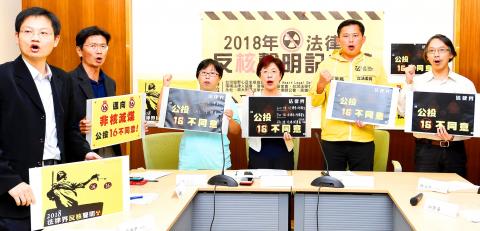
Photo: Chu Pei-hsiung, Taipei Times
As of yesterday morning, the petition had gathered 283 signatures from 121 lawyers, 46 law academics and more than 100 law students and law practitioners, the Wild at Heart Legal Defense Association said.
The 2002 Basic Environment Act (環境基本法) stipulates that the government must propose plans to make Taiwan nuclear-free, but the 2025 timeframe was last year written into the Electricity Act, association lawyer Tsai Ya-yin (蔡雅瀅) said, adding that no delay should be allowed.
New Power Party Executive Chairman Huang Kuo-chang (黃國昌); Democratic Progressive Party lawmakers Yu Mei-nu (尤美女) and Chou Chun-mi (周春米); as well as members of the Environmental Rights Foundation, the Taiwan Law Society and National Taiwan University’s Policy and Law Center for Environmental Sustainability also signed the petition.
Huang, who on Friday last week represented opponents in a televised debate with referendum advocate Liao Yen-peng (廖彥朋), said that voters should first answer the question: Where should nuclear waste — especially highly radioactive waste — be stored?
Scientists raised the question more than four decades ago when more nuclear power plants were being constructed, but even the groups trusted by nuclear power supporters — Taiwan Power Co (Taipower) and the Atomic Energy Council — have yet to propose any waste disposal solutions, he said.
Even if the referendum is passed, the Fourth Nuclear Power Plant in New Taipei City’s Gongliao District (貢寮), which was again mothballed in 2015 before construction was complete, could not be immediately started, Huang added.
According to council regulations, a proposal to update a nuclear power generator’s operating permit should be filed five to 15 years before the permit expires, Environmental Jurists Association chairman Chang Yu-yin (張譽尹) said.
Of the nation’s six nuclear power generators at three operating plants, only the permits for the two units at Pingtung County’s Ma-anshan Nuclear Power Plant could be extended within the given timeframe, as they expire on July 26, 2024, and May 17, 2025, Chang said, adding that it was too late to extend the permits for New Taipei City’s Jinshan plant in Shihmen District (石門) and the Guosheng plant in Wanli District (萬里).
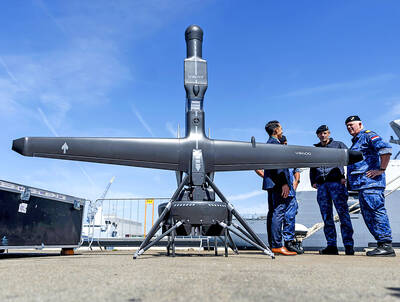
DEFENSE PROCUREMENT: Taiwan could become the largest operator of V-BAT drones outside the US once they are delivered, the Ministry of National Defense said The navy and the coast guard are acquiring 292 units of MQ-35A V-BAT vertical takeoff and landing (VTOL) surveillance drones manufactured by US-based defense technology company Shield AI, making Taiwan one of the largest buyers of the drone. The Coast Guard Administration budgeted NT$1.2 billion (US$37.1 million) to buy 12 drones, which have been delivered, Shield AI said in a report on Oct 13. The navy is planning to spend NT$36 billion under a four-year program code-named Project Yuan Xiao (遠鴞) to acquire 280 V-BAT drones, the Ministry of National Defense’s fiscal 2027 report showed. The combined procurement is expected
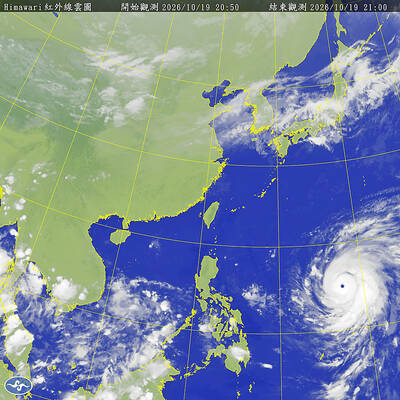
Typhoon Champi will turn northward earlier than previously forecast, sparing Taiwan a direct hit but still bringing heavy rain to the north of the country on Friday and Saturday, according to the Central Weather Administration (CWA). CWA forecaster Cheng Chieh-jen (鄭傑仁) said Typhoon Champi had strengthened and increased in size over the past 12 hours, and as of yesterday afternoon was packing sustained winds of 198 kilometers per hour near its center. Due to the weakening of a Pacific high-pressure system, however, the storm is now expected to turn northward earlier than initially

MAYORAL RACE: Su Chiao-hui made gains by persuading undecided voters and winning over voters in KMT-leaning districts, a pollster said Legislator Su Chiao-hui (蘇巧慧), the Democratic Progressive Party’s (DPP) candidate for New Taipei City mayor, has a 13.1 percentage point lead over her Chinese Nationalist Party (KMT) rival Lee Shu-chuan (李四川), a poll released yesterday showed. The poll, commissioned by the Taipei Trust in Democracy Association, showed that 43.1 percent of respondents said they would vote for Su, up 7.9 percentage points from a poll conducted in late August, while support for Lee was at 30 percent, down 4.7 percentage points. It showed that 48.6 percent of respondents thought Su would make a suitable mayor, compared with 35.9 percent for Lee. Independent candidate
A Chinese People's Liberation Army (PLA) Navy aircraft carrier group was being monitored after entering the western Pacific, the Ministry of National Defense said today, after Beijing yesterday criticized Taiwan for using a water cannon against a Chinese fishing boat near the Pratas Islands (Dongsha Islands, 東沙群島). A Chinese naval task group led by the aircraft carrier Liaoning (遼寧) yesterday sailed to the western Pacific for training, Chinese state-run Xinhua news agency quoted the PLA Navy as saying. “The drill is part of the annual routine training plan aimed at testing and improving the troops’ combat readiness and enhancing their ability to


 RSS
RSS