


Starting next month, people taking the motorcycle license test for the first time will be required to attend a two-hour traffic safety lecture before they are allowed to take the test, the Directorate-General of Highways (DGH) said yesterday.
First-time motorcycle license test takers are already required to attend a 90-minute safety lecture before receiving their license.
However, from next month, the safety lecture is to feature a new defensive driving component, adding 30 minutes, the highway authority said.
National Police Agency statistics showed that 79.22 percent of people killed in traffic accidents involving motorcycles last year were aged 18 to 19.
The same age group also has the highest fatality rate in A1 category accidents of 10.7 deaths per 100,000 people, the data showed.
A1 traffic accidents are those where a victim dies within 24 hours of an accident.
“This means that young motorcyclists receiving their first license remain high-risk riders,” the agency said. “We hope to instill the concept of defensive driving before they hit the road after the new policy is implemented.”
However, netizens questioned whether a longer traffic safety lecture would improve road safety.
Netizen “Chen Chen” said that driving on the wrong side of the road, failure to keep a safe following distance and speeding are the three most common risky behaviors among motorcyclists.
“I am not sure that the new policy can prevent motorcyclists from engaging in these behaviors and change their concept of driving,” Chen Chen wrote. “It would be better if the DGH raised the difficulty of the license test.”
“Motorcyclists should be given a point for each traffic violation committed and be barred from taking the test if they have accumulated a certain number of points,” the netizen wrote. “Only by so doing can the nation take unfit motorcyclists off the road.”
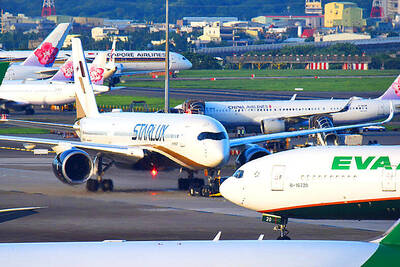
Trips for more than 100,000 international and domestic air travelers could be disrupted as China launches a military exercise around Taiwan today, Taiwan’s Civil Aviation Administration (CAA) said yesterday. The exercise could affect nearly 900 flights scheduled to enter the Taipei Flight Information Region (FIR) during the exercise window, it added. A notice issued by the Chinese Civil Aviation Administration showed there would be seven temporary zones around the Taiwan Strait which would be used for live-fire exercises, lasting from 8am to 6pm today. All aircraft are prohibited from entering during exercise, it says. Taipei FIR has 14 international air routes and
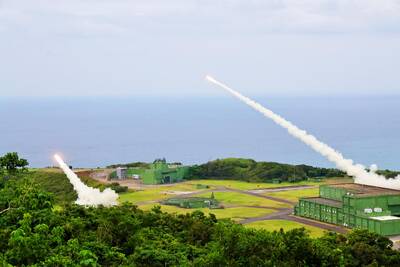
Taiwan lacks effective and cost-efficient armaments to intercept rockets, making the planned “T-Dome” interception system necessary, two experts said on Tuesday. The concerns were raised after China’s military fired two waves of rockets during live-fire drills around Taiwan on Tuesday, part of two-day exercises code-named “Justice Mission 2025.” The first wave involved 17 rockets launched at 9am from Pingtan in China’s Fujian Province, according to Lieutenant General Hsieh Jih-sheng (謝日升) of the Office of the Deputy Chief of the General Staff for Intelligence at the Ministry of National Defense. Those rockets landed 70 nautical miles (129.6km) northeast of Keelung without flying over Taiwan,
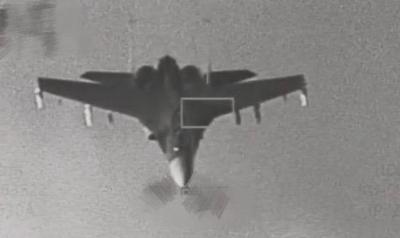
The Ministry of National Defense (MND) today released images of the military tracking China’s People's Liberation Army (PLA) movements during the latest round of Chinese drills around Taiwan. The PLA began "Justice Mission 2025" drills today, carrying out live-fire drills, simulated strikes on land and maritime targets, and exercises to blockade the nation's main ports. The exercises are to continue tomorrow, with the PLA announcing sea and air space restrictions for five zones around Taiwan for 10 hours starting from 8:30am. The ministry today released images showing a Chinese J-16 fighter jet tracked by a F-16V Block 20 jet and the
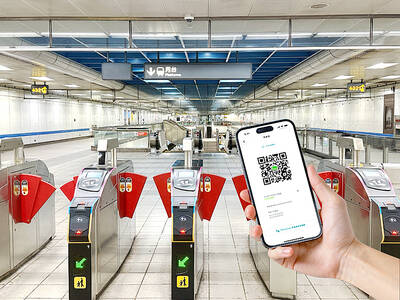
City buses in Taipei and New Taipei City, as well as the Taipei MRT, would on Saturday begin accepting QR code payments from five electronic payment providers, the Taipei Department of Transportation said yesterday. The new option would allow passengers to use the “transportation QR code” feature from EasyWallet, iPass Money, iCash Pay, Jkopay or PXPay Plus. Passengers should open their preferred electronic payment app, select the “transportation code” — not the regular payment code — unlock it, and scan the code at ticket readers or gates, General Planning Division Director-General Liu Kuo-chu (劉國著) said. People should move through the


 RSS
RSS