

Lawmakers yesterday elected nine members of the Democratic Progressive Party (DPP), six members of the Chinese Nationalist Party (KMT) and one member of the Non-Partisan Solidarity Union (NPSU) as conveners of the eight legislative committees.
Under the Legislative Committee Organization Act (立法院各委員會組織法), each committee must elect two conveners.
NPSU Legislator May Chin (高金素梅) — who often cooperates with the People First Party and KMT caucuses — was elected convener of the Education and Culture Committee after securing the KMT caucus’ support and winning four votes in the committee election.
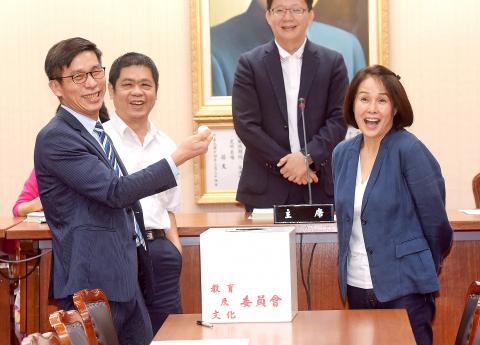
Photo: Huang Yao-cheng, Taipei Times
She is to cochair the committee with DPP Legislator Chen Ting-fei (陳亭妃).
Chin was originally tied with DPP Legislator Chung Chia-pin (鍾佳濱) after the vote, but emerged the victor after winning in a draw.
It was the first time a member outside the KMT and DPP caucuses was elected as a committee convener since the nation’s ninth batch of legislators assumed office in February 2016.
DPP Legislator Chou Chun-mi (周春米) and KMT Legislator Lin Wei-chou (林為洲) are to cochair the Judiciary and Organic Laws and Statutes Committee, which is in charge of reviewing budget requests from the Presidential Office and the Transitional Justice Commission.
DPP Legislator Shih Yi-fang (施義芳) was ousted by KMT Legislator Lai Shyh-bao (賴士葆) in the Finance Committee election by only one vote after DPP Legislator Karen Yu (余宛如) selected the wrong candidate — herself.
Her error was due to her carelessness, for which she apologized to her colleagues, Yu said, adding that she would accept any disciplinary measures by the DPP caucus.
Lai is to cochair the Finance Committee with DPP Legislator Wang Jung-chang (王榮璋).
The DPP caucus dominated the Transportation Committee after DPP legislators Chen Ming-wen and Lin Chun-hsien (林俊憲) beat KMT Legislator Chen Hsueh-shen (陳雪生).
The Foreign Affairs and National Defense Committee Committee is to be headed by DPP Legislator Chiu Chih-wei (邱志偉) and KMT Legislator Ma Wen-chun (馬文君).
The Social Welfare and Environmental Hygiene Committee is to be cochaired by DPP Legislator Wu Kuen-yuh (吳崑裕) and KMT Legislator Arthur Chen (陳宜民), who was tied with DPP Legislator Chen Man-li (陳曼麗), but was selected via a draw.
The Internal Administration Committee is to be cochaired by DPP Legislator Kuan Bi-ling (管碧玲) and KMT Legislator Huang Chao-shun (黃昭順).
The Economics Committee is to be coconvened by DPP Legislator Su Chen-ching (蘇震清) and KMT Legislator Chen Chao-ming (陳超明).
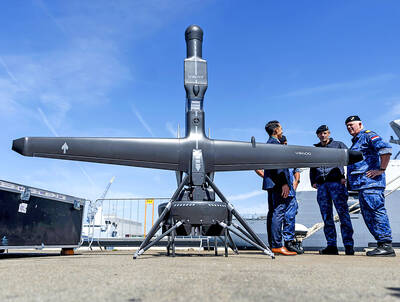
DEFENSE PROCUREMENT: Taiwan could become the largest operator of V-BAT drones outside the US once they are delivered, the Ministry of National Defense said The navy and the coast guard are acquiring 292 units of MQ-35A V-BAT vertical takeoff and landing (VTOL) surveillance drones manufactured by US-based defense technology company Shield AI, making Taiwan one of the largest buyers of the drone. The Coast Guard Administration budgeted NT$1.2 billion (US$37.1 million) to buy 12 drones, which have been delivered, Shield AI said in a report on Oct 13. The navy is planning to spend NT$36 billion under a four-year program code-named Project Yuan Xiao (遠鴞) to acquire 280 V-BAT drones, the Ministry of National Defense’s fiscal 2027 report showed. The combined procurement is expected

MAYORAL RACE: Su Chiao-hui made gains by persuading undecided voters and winning over voters in KMT-leaning districts, a pollster said Legislator Su Chiao-hui (蘇巧慧), the Democratic Progressive Party’s (DPP) candidate for New Taipei City mayor, has a 13.1 percentage point lead over her Chinese Nationalist Party (KMT) rival Lee Shu-chuan (李四川), a poll released yesterday showed. The poll, commissioned by the Taipei Trust in Democracy Association, showed that 43.1 percent of respondents said they would vote for Su, up 7.9 percentage points from a poll conducted in late August, while support for Lee was at 30 percent, down 4.7 percentage points. It showed that 48.6 percent of respondents thought Su would make a suitable mayor, compared with 35.9 percent for Lee. Independent candidate
A Chinese People's Liberation Army (PLA) Navy aircraft carrier group was being monitored after entering the western Pacific, the Ministry of National Defense said today, after Beijing yesterday criticized Taiwan for using a water cannon against a Chinese fishing boat near the Pratas Islands (Dongsha Islands, 東沙群島). A Chinese naval task group led by the aircraft carrier Liaoning (遼寧) yesterday sailed to the western Pacific for training, Chinese state-run Xinhua news agency quoted the PLA Navy as saying. “The drill is part of the annual routine training plan aimed at testing and improving the troops’ combat readiness and enhancing their ability to

Pulled aside onto the balcony of an empty hotel room by Chinese state security officers, a Taiwanese tourist on a trip to Tibet described facing an unnerving barrage of questions about his military background and political loyalties. The man surnamed Lin (林) reported his experience in a viral post on Threads before accepting an interview with the Central News Agency (CNA) yesterday. Lin, who works as a nurse, told CNA that he knew some Taiwanese had run afoul of Chinese law enforcement, but he thought he would be safe, as he did not post much about his personal political views online. It came


 RSS
RSS