


The nation’s first experimental high school with a focus on teaching Aboriginal music opened in New Taipei City yesterday.
Vox Nativa, the organization behind the school’s development, said it hopes the school will help elevate the status of Aboriginal music and bring new opportunities to people in or around Nantou County’s Sinyi Township (信義), where the group originated.
The organization in 2008 opened its first music school for young Aborigines.
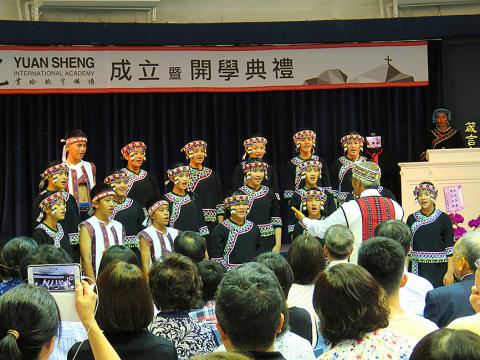
Photo: Chen Hsin-yu, Taipei Times
Vox Nativa was born out of a project to provide music education to the county’s Aboriginal youth envisioned by Sinyi Elementary School principal Bukut Tasualuam of the Bunun people and retired teacher Liao A-kuan (廖阿貫).
The group started by forming a youth choir with students at the elementary school.
They aimed to “let the world hear Jade Mountain sing,” Liao said.
The choir practiced on weekends and used dormitories at Luona and Tumpu elementary schools in Sinyi to house students, who were chosen from among the township’s more outstanding students, she said.
In addition to providing music education, the choir assisted students with Chinese, English, mathematics and social science studies.
Ten years after its founding, the group has been dubbed “Taiwan’s Vienna choir” and has received international recognition.
However, members of the original choir are now at university and many have moved away, some even turning their backs on their community, Liao said.
The establishment of an experimental high school will give the organization more flexibility and help with resources, she said.
After Christ’s College Taipei agreed to lend dormitories to Vox Nativa — also a Christian organization — the group finalized plans to establish the high school in New Taipei City, near the college, Liao said, adding that they rushed to have the school open in time to accept graduating junior-high school students.
The school on Monday last week received permission to operate.
Vox Nativa president Chiu Yuan-mei (邱媛美) said its first 10 students are from Nantou and they pay NT$5,000 in tuition per quarter. That fee covers textbooks and dormitory accommodation, Chiu said.
The school has so far hired nearly as many teachers as students, she said, citing regulations that high schools must offer Chinese, English and math, on top of its own requirements for music theory teachers.
The majority of funding comes from donations, Chiu said.
The school hopes to one day accept Aboriginal students from other countries and plans to produce a national-level choir, she said.
However, ultimately the school aims to foster confidence among young Aborigines, encourage them to serve their communities, and help end alcoholism and other problems that plague their communities, she said.

Considering that most countries issue more than five denominations of banknotes, the central bank has decided to redesign all five denominations, the bank said as it prepares for the first major overhaul of the banknotes in more than 24 years. Central bank Governor Yang Chin-lung (楊金龍) is expected to report to the Legislative Yuan today on the bank’s operations and the redesign’s progress. The bank in a report sent to the legislature ahead of today’s meeting said it had commissioned a survey on the public’s preferences. Survey results showed that NT$100 and NT$1,000 banknotes are the most commonly used, while NT$200 and NT$2,000

The Centers for Disease Control (CDC) yesterday reported the first case of a new COVID-19 subvariant — BA.3.2 — in a 10-year-old Singaporean girl who had a fever upon arrival in Taiwan and tested positive for the disease. The girl left Taiwan on March 20 and the case did not have a direct impact on the local community, it said. The WHO added the BA.3.2 strain to its list of Variants Under Monitoring in December last year, but this was the first imported case of the COVID-19 variant in Taiwan, CDC Deputy Director-General Lin Ming-cheng (林明誠) said. The girl arrived in Taiwan on

South Korea is planning to revise its controversial electronic arrival card, a step Taiwanese officials said prompted them to hold off on planned retaliatory measures, a South Korean media report said yesterday. A Yonhap News Agency report said that the South Korean Ministry of Foreign Affairs is planning to remove the “previous departure place” and “next destination” fields from its e-arrival card system. The plan, reached after interagency consultations, is under review and aims to simplify entry procedures and align the electronic form with the paper version, a South Korean ministry official said. The fields — which appeared only on the electronic form

The Ministry of Foreign Affairs (MOFA) is suspending retaliation measures against South Korea that were set to take effect tomorrow, after Seoul said it is updating its e-arrival system, MOFA said today. The measures were to be a new round of retaliation after Taiwan on March 1 changed South Korea's designation on government-issued alien resident certificates held by South Korean nationals to "South Korea” from the "Republic of Korea," the country’s official name. The move came after months of protests to Seoul over its listing of Taiwan as "China (Taiwan)" in dropdown menus on its new online immigration entry system. MOFA last week


 RSS
RSS