


Taiwan is responding to China’s arms buildup by developing missiles and interceptors of its own that could reduce Beijing’s military advantage over the self-ruled nation, defense experts say.
Since President Tsai Ing-wen (蔡英文) took office in 2016, Taiwan has deployed one set of missiles, perfected another and sped production of a third in the latest sign of how it is handling a Chinese military threat, the analysts say.
Chinese President Xi Jinping (習近平) has taken a hard line against advocates of Taiwanese independence and has sent warships, bombers and fighter planes on training missions circling the nation in a show of strength.
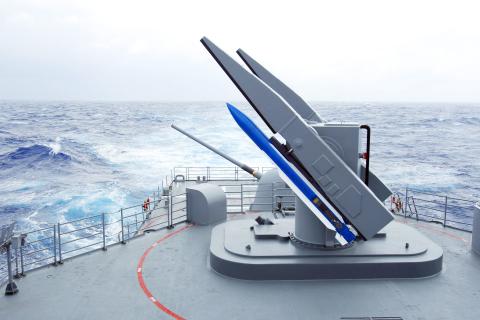
Photo: AP
While Beijing has an increasingly overwhelming military advantage, Taiwan’s missile systems advance its odds of holding off China in asymmetrical warfare, said Alexander Huang (黃介正), a strategic studies professor at Tamkang University in Taiwan.
The term asymmetrical warfare refers to effective resistance of an enemy with targeted firepower rather than overwhelming force.
“Taiwan with limited resources can only invest in the area that would create some kind of asymmetrical advantage, which would dissuade the Chinese from taking actions,” Huang said. “Tsai has committed more or at least expressed willingness to invest more in the asymmetrical capability.”
Hsiung Feng IIE missiles built in Taiwan have been deployed to hit military bases in China up to 1,500km away, said David An (安大維), a senior research fellow with the Washington-based policy incubator Global Taiwan Institute.
Those missiles also underwent a “substantial upgrade” last year to increase their effectiveness against ships, An said.
Meanwhile, Taiwan has stepped up production of its indigenous Wan Chien air-to-ground cruise missiles by about 100, An added.
Backing up those improvements, the locally developed Tien Kung system can now intercept Chinese missiles at ranges of up to 200km, An said.
PAVE PAWS, a US long-range early warning radar system located in Taiwan’s central mountain range, would track incoming missiles or aircraft.
Ministry of National Defense spokesman Major General Chen Chung-chi (陳中吉) declined to confirm deployment of the Hsiung Feng IIE missiles after military news Web site Kanwa Defense Review posted photos indicating they were situated about 50km west of Taipei.
Kanwa did not answer requests for comment.
The Chinese Ministry of national Defense did not immediately respond to requests for comments on Taiwan’s missile program.
They are looking more at building their land-based military capabilities,” said Collin Koh, a maritime security research fellow at Nanyang Technological University in Singapore.
To pressure Tsai into meeting its demands, the Chinese communist leadership has flown military aircraft near the island a dozen times and sent China’s only functioning aircraft carrier through the 160km Taiwan Strait separating them.
China has a powerful arsenal of missiles targeting Taiwan and raised its military budget by 8.1 percent this year, compared with Taiwan’s increase of about 2 percent from last year to this year. 2017-2018. China is rapidly building warships, while also developing stealth fighters and bomb delivering vehicles that travel at up to six times the speed of sound.
Military experts say the deployment of the Taiwan’s Hsiung Feng IIE missiles is likely.
“It has been successfully developed,” said Andrew Yang (楊念祖), a former Taiwan defense minister and secretary general of the Chinese Council of Advanced Policy Studies think tank. “They’ve test fired many times and called it successful.”
China and Taiwan have never fought a full-scale war, although in the late 1950s China shelled outlying islands controlled by Taiwan without taking them.
Success in an asymmetric war would hinge on Taiwan’s budget, the ability of its hardware and China’s attack strategy, military analysts say.
The nation’s current crop of missiles can probably hit ships and sink transport vessels, An said.
It should also focus on resisting an amphibious landing, which the People’s Liberation Army Navy “has not demonstrated the ability to do without significant cost,” he said.
Taiwan still lags in submarines and stealth aircraft, An said. It looks to the US for much of its air force fleet and hopes Washington will license it diesel-electric submarine technology.
China routinely denounces defense cooperation between Taiwan and the US, but has been unable to prevent what limited arms sales and exchanges have occurred.
US President Donald Trump on Monday last week signed the John S. McCain National Defense Authorization Act for fiscal year 2019, which among its clauses calls for a “comprehensive assessment of Taiwan’s military forces” with an eye to helping the nation.
“Taiwan’s greatest promise is the hope that the United States and its allies could decide to assist Taiwan if and when Taiwan is under threat,” An said.

Yangmingshan National Park authorities yesterday urged visitors to respect public spaces and obey the law after a couple was caught on a camera livestream having sex at the park’s Qingtiangang (擎天崗) earlier in the day. The Shilin Police Precinct in Taipei said it has identified a suspect and his vehicle registration number, and would summon him for questioning. The case would be handled in accordance with public indecency charges, it added. The couple entered the park at about 11pm on Thursday and began fooling around by 1am yesterday, the police said, adding that the two were unaware of the park’s all-day live
Fast food chain McDonald's is to raise prices by up to NT$5 on some products at its restaurants across Taiwan, starting on Wednesday next week, the company announced today. The prices of all extra value meals and sharing boxes are to increase by NT$5, while breakfast combos and creamy corn soup would go up by NT$3, the company said in a statement. The price of the main items of those meals, if ordered individually, would remain the same. Meanwhile, the price of a medium-sized lemon iced tea and hot cappuccino would rise by NT$3, extra dipping sauces for chicken nuggets would go up
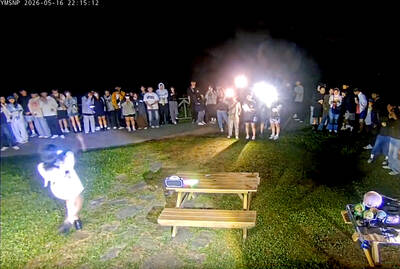
Yangmingshan National Park’s Qingtiangang (擎天崗) nature area has gone viral after a park livestream camera observed a couple in the throes of intimate congress, which was broadcast live on YouTube, drawing large late-night crowds and sparking a backlash over noise, bright lights and disruption to wildlife habitat. The area’s livestream footage appeared to show a couple engaging in sexual activity on a picnic table in the park on Friday last week, with the uncensored footage streamed publicly online. The footage quickly spread across social media, prompting a tide of visitors to travel to the site to “check in” and recreate the

Minister of Digital Affairs Lin Yi-ching (林宜敬) yesterday cited regulatory issues and national security concerns as an expert said that Taiwan is among the few Asian regions without Starlink. Lin made the remarks on Facebook after funP Innovation Group chief executive officer Nathan Chiu (邱繼弘) on Friday said Taiwan and four other countries in Asia — China, North Korea, Afghanistan and Syria — have no access to Starlink. Starlink has become available in 166 countries worldwide, including Ukraine, Malaysia, the Philippines and Vietnam, in the six years since it became commercial, he said. While China and North Korea block Starlink, Syria is not


 RSS
RSS