


Separate collections at both private and local government-run museums have shown that Koji pottery, or items from “the Chiayi Kiln,” have moved beyond traditional platforms of expression and become pieces of art in their own right, Chiayi Department of Cultural Affairs Acting Director Jao Chia-po (饒嘉博) said.
Chiayi is the proud home of Taiwanese Koji pottery, which can be traced back to the 19th century when the works of artisan Ye Wang (葉王) were displayed at a world fair in Paris by the Japanese, Jao said.
Considered by the Japanese to be the premier Taiwanese artisan for Koji pottery, Ye was born in now-Minsyong Township (民雄) and learned his trade from his father before taking an apprenticeship under Liu Shigou (劉詩構), Jao said.
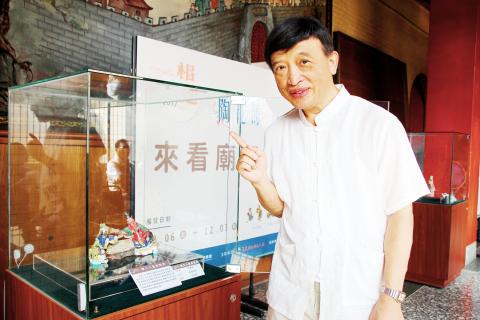
Photo: CNA
Ye took what he learned and combined it with his own ingenuity.
Koji pottery is commonly thought to have originated from the sancai (三彩) pottery prevalent in the Tang Dynasty and was adopted by local artisans after it was introduced to Taiwan during the Qing Dynasty, Jao said.
Wang Fu-yuan (王福源) said he founded a private museum for Koji pottery in Chiayi because he had found it so mesmerizing and beautiful when he first laid eyes on it when he visited the City God Temple as a child.
The Koji statuettes in temples usually represented minor heavenly court officials and functionaries attending feasts or represented festive cheer. They also symbolized the reverence paid to deities by mortals.
It was quite a disappointment that many of the statuettes, the results of friendly competition between artisans of the Chaozhou and Chuanzhou schools, were said to have been destroyed when the temple was expanded in 1980, Wang said.
However, in 1991 he discovered otherwise when he happened upon a batch of Koji pottery statuettes from the temple in a pawnshop in Chiayi County’s Dalin Township (大林).
Wang immediately sold NT$2 million (US$68,552) of stock, purchased the Koji statuettes and took them home.
After that Wang and his wife, Wei Li-chuan (魏麗嫥), began searching for other items of Koji pottery both at home and abroad, including bidding for pieces at internationally renowned auctioneers Christie’s and Sotheby’s.
In 2003, he established the Hosanna Museum to house his collection, with the statuettes from the temple dubbed the museum’s “treasures.”
The collection includes works by renowned artisans such as Ye, Ko Hsun (柯訓), Hung Kun-fun (洪坤福), Su Yang-shui (蘇陽水), Chen Chuan-yu (陳專友), Chen Tien-chi (陳天乞) and Hung Hua (洪華).
You can see the spirit and the beauty of the colors that early Taiwanese artisans employed in Koji pottery, Wang said, adding that seeing the completed works is like seeing the artisans breathing life into the pottery.
The museum also features carvings and ancient pottery pieces from China.
In addition to the Hosanna Museum, the Chiayi Koji Pottery Museum also has a wonderful Koji pottery collection, Jao said.
The collection also shows how Koji pottery developed in Taiwan, Jao said.
It continued to evolve, especially in terms of the colors used, as well as the style and technique, Jao said, adding that Lin Tien-mu (林添木) had many apprentices, most of them in Chiayi City, which became the creative hub of Taiwanese Koji pottery.

FUKUOKA SITUATION: Japanese media reported that the pathogen is expected to be identified by the summer, while the CDC downplayed the idea that it was hMPV A “mysterious cold-like illness” reported in Japan’s Fukuoka Prefecture does not seem to be a new disease, but Japanese authorities have been asked about the situation, the Centers for Disease Control (CDC) said yesterday. The Fukuoka Prefectural Medical Association on Wednesday told a news conference that a “mystery cold” that has become a hot topic on social media is “highly likely to be caused by some kind of viral infection,” Japan’s KBC News reported. “Many people are experiencing symptoms starting with a sore throat, followed by a runny nose, phlegm and a severe cough,” KBC News reported, citing association officials. Health authorities are

Nvidia Corp CEO Jensen Huang (黃仁勳) arrived in Taiwan yesterday ahead of upcoming AI and technology events, saying he plans to meet with clients and Taiwan Semiconductor Manufacturing Co Chairman C.C. Wei (魏哲家) during his visit. After landing at Taipei Songshan Airport, Huang posed for photos with fans and handed out Yakult drinks to reporters and supporters waiting at the scene, saying he has “a lot to do” during the trip. Asked about reports that Nvidia’s planned headquarters site in Taipei’s Beitou Shilin Technology Park could break ground on May 27, Huang said that if the company holds an event, he would

The Ministry of Finance this afternoon announced the winning numbers for the March-April uniform invoice lottery. The winning number for the NT$10 million (US$318,060) special prize is 19531471, and the winning number for the NT$2 million grand prize is 85941329. Three numbers were drawn for the NT$200,000 first prize: 07225810, 20231230 and 83518781. Those with receipts matching the last seven digits of any of the first-prize numbers will win the NT$40,000 second prize, while those matching the last six digits will win the NT$10,000 third prize. Those whose receipts match the last five digits of the first-prize numbers can claim the NT$4,000 fourth prize,
Taiwan Travelogue (臺灣漫遊錄), which earlier this week became the first Taiwanese novel to win the International Booker Prize, is to be adapted into a television series through a Taiwan-Japan coproduction, producer Chang Chen-yu (張辰漁) said yesterday. Chang, a producer at World Softest Production Film Co, wrote on Facebook that the company had been searching for projects with international appeal that retain a strong Taiwanese identity after colleagues and Japanese partners strongly recommended the novel. After reading the book, Chang said he immediately decided to pursue the screen rights. “A great story has the power to transcend time and borders, and connect countless people,”


 RSS
RSS