


Taipei Times (TT): What prompted you to shoot “Self-censorship” (并:控制) in the first place?
Kevin Lee (李惠仁): I got the idea for the film after I attended the Taipei Film Festival’s award ceremony on July 16, 2016. That month had been eventful in East Asia. Earlier that month, the Permanent Court of Arbitration in The Hague, Netherlands, in a ruling invalidated Chinese claims in the South China Sea.
Unhappy with the ruling, Chinese netizens began circulating a map of China that included Taiwan, alongside a message that read: “China cannot be one bit less” (中國,一點都不能少). Taiwanese actress Ruby Lin’s (林心如) studio also reposted the map, which Lin later said reflected her personal stance as well.
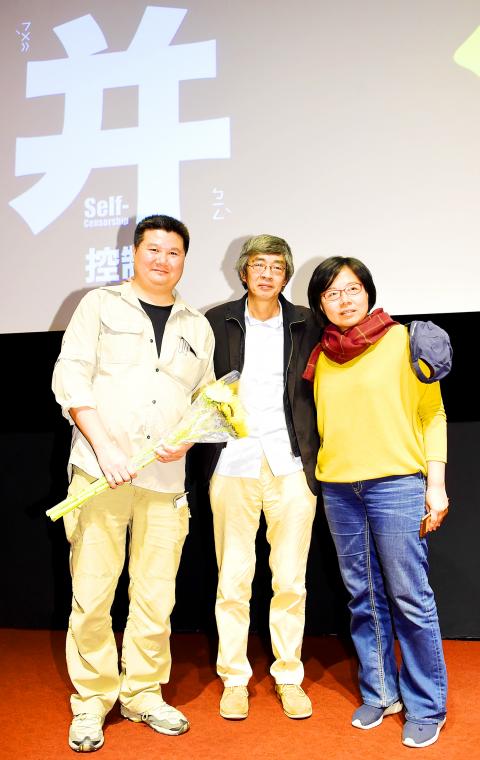
Photo: Pan Shao-tang, Taipei Times
Then, there was an incident involving [Taiwanese actor/director] Leon Dai (戴立忍), who was allegedly a supporter of Taiwanese independence. In response to demands that he clarify his political stance, he issued a 3,000-word statement saying that he did not support Taiwanese independence; nevertheless, he was replaced in a movie by the film’s Chinese production team.
I was quite saddened by the whole incident, because supposedly in cinema, creative freedom is what we strive for, but what we witnessed was [an artist] being treated so brutally.
Incidentally the award ceremony took place one day after the announcement of Dai’s replacement and I thought that given what happened to him, people in a democratic country would lend support to him at occasions such as the ceremony. However, that was not what I encountered. Media even reported afterwards that many artists refused to comment on the incident backstage.
So when I was called on stage to accept the award for my film The Taste of Apples (蘋果的滋味), I voiced support for Dai and also expressed appreciation for Taiwan’s democracy, which allows us to dive into creative work in a free environment. A Hong Kong-based TV station owner saw what I did on stage and sought contact with an idea to shoot an anti-communist film.
I recall asking him: “why me of all directors in Taiwan?”
He said that shortly after the Democratic Progressive Party assumed power in 2016, he had sought cooperation with two other Taiwanese directors, who he each quoted as having asked him whether cooperating with him on such a film would affect their career outlooks in China.
I accepted the Hong Kong company’s offer on the condition that there must be no interference in the process. Two months later we handed in the proposal for Self-censorship and they were happy with it, so we began shooting.
In June last year, when we were about to head to Hong Kong to document the 20th anniversary of the UK’s handover of Hong Kong to China, the TV station owner was in Taiwan and so we met. However, as I updated him on the film’s progress, he began voicing objection over some content we had shot. I then realized that he wanted to infuse the film with his opinion, which was totally unacceptable to me, because that would mean crossing a red line. So, after our return from the scheduled Hong Kong trip, we ended the cooperation contract with him.
Some friends asked me why we terminated the contract when otherwise I could have continued to receive financial backing from the company. My answer was: “Yes, but it also means that the company can then decide not to release the film after it is finished.”
There are many companies in Hong Kong now buying up films and documentaries produced by independent filmmakers in China. Because they are independent, they cannot be shown in China, but why are these Hong Kong companies interested in buying copyrights for outside China? Is it because they want to promote those films? No, it is because they want to keep those films from ever being shown in public. It is their way of “showing sincerity” [to the Beijing authorities].
We were in the last stages of shooting Self-censorship when we ended the contract with the station owner and began raising money for production through crowdfunding platform FlyingV.
TT: Is it not slightly ironic that the film is titled “Self-censorship” and yet in its end-credits, many backers appear as “anonymous sponsors”?
Lee: There were three China-based Taiwanese businesspeople who have since retired in Taiwan after leaving their Chinese businesses in the hands of their children.
We initially wanted to interview them for the film, asking how China uses such means as probing firms for tax evasion to control Taiwanese businesspeople in China. They rejected our invitation, even when we said we could modify their voices and only show their silhouettes; they said that even then, Chinese authorities could still tell who they were based on what they said.
Judging by their response, the sense of fear that has taken root in the hearts of these Taiwanese businesspeople is no different than the effect that the Taiwan Garrison Command had on Taiwanese during the White Terror era.
Even some young academics who we wished to interview for the film told us that it would be inappropriate for them to do so, because many saw the Chinese market as a good research subject and feared that they would not be able to enter the country if they appeared in our film. Some even told us frankly that they planned to land a teaching job in China after working in Taiwan, so they wished not to get on China’s wrong side.
Now back to the question as to why there are many “anonymous sponsors” in the end-credits: It is another manifestation of “self-censorship.” Why? Because they are being controlled, and how are they being controlled? They are being controlled by fear.
In a system of fear, there are indeed people who rat on others for China and people who help China intimidate fellow Taiwanese artists, so that is part of the reason; another major reason is that our democracy is not yet sufficiently consolidated, which leaves room for fear.
TT: China no doubt is the main intimidator. However, should Taiwanese, having experienced authoritarianism in the past, not be even more sensitive to and therefore more on guard against any attempt at restraining their rights?
Lee: I feel that Taiwan has not been entirely weaned of the poisonous residue of its authoritarian past — that it has not been totally “detoxed,” so to speak. During the authoritarian days, people were taught to see dictators as heroes and such views have been held by some to this day, however absurd that might sound.
In a democracy, if we wish to change society, what we need is not heroes, but more courageous regular people. This concept is understood in mature democracies. However, that is not the stage that Taiwan is in now: Deepening the nation’s democracy means teaching people that they are the bosses, and democracy does not mean that all they have to do is just casting their votes and they can leave it to elected officials to solve problems.
TT: Having witnessed and documented so many cases of self-censorship, are you disheartened by the performance of Taiwanese in defending their democratic values or pessimistic about Taiwan’s democracy?
Lee: No, I do not feel that way. Taiwan’s democratic achievement is a step-by-step process, a relay of sorts that has progressed through continuous efforts to the stage it is in today. If we do not protest [to defend] this democracy, it is still possible that it could turn into a dictatorship.
That is why the film is open source, why we chose to leave it online (https://www.youtube.com/watch?v=ozlVdidEH_I), where the public can view it for free and why we are willing to screen the film anywhere, however far we need go, because we want as many people to watch the film as possible, and from there, to engage in introspection on the value of democracy, and begin discussion and dialogue.
We see shooting the film as something similar to starting a movement; it is like education, you do not know when the seed you sow will sprout, but it is a certainty that it will eventually sprout.
We all love this land that we call Taiwan, and this film is the least we can do [to safeguard our democracy] within our capabilities and expertise, given our profession.
If everyone could grasp the meaning of democracy, what supports democracy’s worth, then we would all know what is it that we should safeguard. So we really have no reason to be pessimistic, we really do not.

Considering that most countries issue more than five denominations of banknotes, the central bank has decided to redesign all five denominations, the bank said as it prepares for the first major overhaul of the banknotes in more than 24 years. Central bank Governor Yang Chin-lung (楊金龍) is expected to report to the Legislative Yuan today on the bank’s operations and the redesign’s progress. The bank in a report sent to the legislature ahead of today’s meeting said it had commissioned a survey on the public’s preferences. Survey results showed that NT$100 and NT$1,000 banknotes are the most commonly used, while NT$200 and NT$2,000

The Centers for Disease Control (CDC) yesterday reported the first case of a new COVID-19 subvariant — BA.3.2 — in a 10-year-old Singaporean girl who had a fever upon arrival in Taiwan and tested positive for the disease. The girl left Taiwan on March 20 and the case did not have a direct impact on the local community, it said. The WHO added the BA.3.2 strain to its list of Variants Under Monitoring in December last year, but this was the first imported case of the COVID-19 variant in Taiwan, CDC Deputy Director-General Lin Ming-cheng (林明誠) said. The girl arrived in Taiwan on

ANNUAL EVENT: Two massive Pokemon balloons are to be set up in Daan Park, with an event zone operating from 10am to 6pm This year’s Taipei Floral Picnic is to be held at Daan Park today and tomorrow, featuring an exclusive Pokemon Go event, a themed food market, a coffee rave picnic area and stage performances, the Taipei Department of Information and Tourism said yesterday. Two massive Pokemon balloons are to be set up in the park as attractions, with an exclusive event zone operating from 10am to 6pm, it said. Participants who complete designated tasks on-site would have a chance to receive limited-edition souvenirs, it added. People could also try the newly launched game Pokemon Pokopia in the trial area, the department said. Three PokeStops are
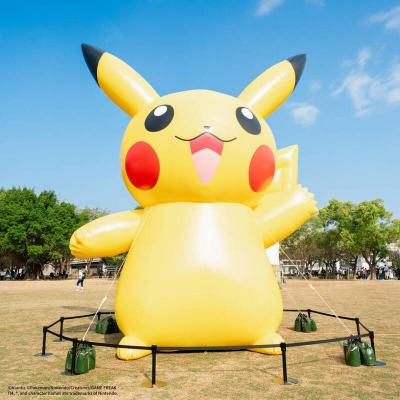
This year’s Taipei Floral Picnic is to be held at Daan Park this weekend, featuring an exclusive Pokemon Go event, a theme food market, a coffee rave picnic area and stage performances. Pokemon Go Two massive Pokemon balloons are to be set up in the park as photo attractions, with an exclusive event zone operating from 10am to 6pm. Participants who complete designated tasks on-site would have a chance to receive limited-edition souvenirs. Pokemon trainers could also experience the newly launched game Pokemon Pokopia in the trial area. Three PokeStops are to be set up in the park. Trainers are invited to take


 RSS
RSS