


About 20 Asia-Pacific Institute of Creativity (APIC) teachers and students yesterday urged the Ministry of Education to dismiss the school’s board at a protest outside the ministry, citing evidence of graft that they had collected since 2016.
Huang Ping-chang (黃平璋), chairman of Yi-shen Group — a corporation best known for its security service — became the school’s chairman in August 2016.
Since he took office, the school board has illegally cut teachers’ research allowance, forced students to transfer or drop out, and used the school’s budget to pay for products and services offered by companies under Yi-shen, said teachers who traveled from Miaoli County to protest yesterday.
In 2016, the school board fired the original school guards and hired a security company under Yi-shen, APIC associate professor Tang Jen-chung (湯仁忠) said.
While the previous security service cost only NT$100,000 per month, the new service is 40 percent more expensive, but of poorer quality, he said.
The board also held many meetings at a restaurant owned by Yi-shen, Tang said.
“You would expect a meeting of a 12-member board to cost between NT$30,000 and NT$50,000, but they spent NT$100,000 at just one meeting held at the restaurant,” he said.
The board also purchased nearly 90 boxes of moon cakes from the restaurant for more than NT$85,000, he said.
The pricey moon cakes were never distributed to faculty members and the purchase records show that they had not been approved by the school, he added.
The board also held training camps for new employees at Yi-shen’s security company on the school campus without paying it any fees, an APIC teacher surnamed Huang (黃) said.
“About four or five new teachers were also required to attend, but they said the training was all about security,” she said, adding that the school nevertheless had to pay the company about NT$15,000 for training the teachers.
Since 2016, Huang Ping-chang has founded two for-profit companies and registered them at the same address as the school, Tang said, but added that “he has never paid any rent to the school or signed any contract with it.”
“The school has clearly violated Article 81 of the Private School Act (私立學校法), which requires school boards to avoid conflicts of interest,” Taiwan Higher Education Union organization department director Lin Po-yi (林柏儀) said.
APIC teachers and students prepared receipts and financial records from the school as proof of their claims and demanded that the ministry dismiss the board and make the school pay their full salaries.
Ministry Department of Technological and Vocational Education Director Yang Yu-hui (楊玉惠) said: “Cutting the teachers’ research allowance without their consent violated Article 17 of the Act Governing Teachers’ Salaries (教師待遇條例).”

The military has spotted two Chinese warships operating in waters near Penghu County in the Taiwan Strait and sent its own naval and air forces to monitor the vessels, the Ministry of National Defense (MND) said. Beijing sends warships and warplanes into the waters and skies around Taiwan on an almost daily basis, drawing condemnation from Taipei. While the ministry offers daily updates on the locations of Chinese military aircraft, it only rarely gives details of where Chinese warships are operating, generally only when it detects aircraft carriers, as happened last week. A Chinese destroyer and a frigate entered waters to the southwest
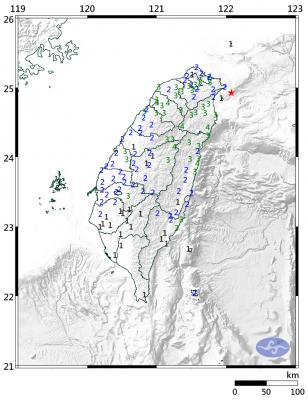
A magnitude 6.1 earthquake struck off the coast of Yilan County at 8:39pm tonight, the Central Weather Administration (CWA) said, with no immediate reports of damage or injuries. The epicenter was 38.7km east-northeast of Yilan County Hall at a focal depth of 98.3km, the CWA’s Seismological Center said. The quake’s maximum intensity, which gauges the actual physical effect of a seismic event, was a level 4 on Taiwan’s 7-tier intensity scale, the center said. That intensity level was recorded in Yilan County’s Nanao Township (南澳), Hsinchu County’s Guansi Township (關西), Nantou County’s Hehuanshan (合歡山) and Hualien County’s Yanliao (鹽寮). An intensity of 3 was

Japanese Prime Minister Sanae Takaichi’s comment last year on Tokyo’s potential reaction to a Taiwan-China conflict has forced Beijing to rewrite its invasion plans, a retired Japanese general said. Takaichi told the Diet on Nov. 7 last year that a Chinese naval blockade or military attack on Taiwan could constitute a “survival-threatening situation” for Japan, potentially allowing Tokyo to exercise its right to collective self-defense. Former Japan Ground Self-Defense Force general Kiyofumi Ogawa said in a recent speech that the remark has been interpreted as meaning Japan could intervene in the early stages of a Taiwan Strait conflict, undermining China’s previous assumptions
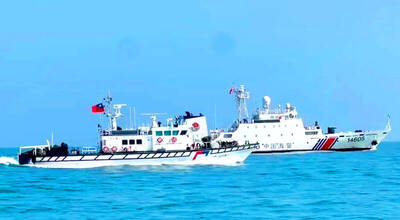
Instead of focusing solely on the threat of a full-scale military invasion, the US and its allies must prepare for a potential Chinese “quarantine” of Taiwan enforced through customs inspections, Stanford University Hoover fellow Eyck Freymann said in a Foreign Affairs article published on Wednesday. China could use various “gray zone” tactics in “reconfiguring the regional and ultimately the global economic order without a war,” said Freymann, who is also a nonresident research fellow at the US Naval War College. China might seize control of Taiwan’s links to the outside world by requiring all flights and ships entering or leaving Taiwan


 RSS
RSS