


As per tradition, many of the nation’s companies, factories and banks have ordered customized wall and desk calendars to usher in the new year, as well as to thank their long-time clients for their patronage in the past year.
Demand from factories wishing to express their thanks with wall calendars — both daily and monthly — has been declining, but more businesses are ordering customized desk calendars.
The company Integrated Services Technology (IST) has for the third year ordered desk calendars. Departing from past practice, the company has invited its clients to place orders, the proceeds of which are to be given to disadvantaged youths and families.
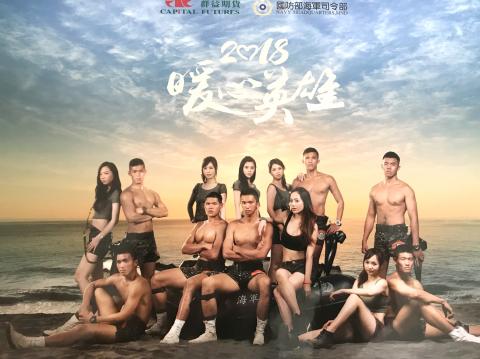
Photo: Lo Chien-yi, Taipei Times
“We want it to be more than a simple calendar; one that will bring warmth and hope to others,” the company said.
Each IST calender is being sold for NT$299 (US$10.02), the company said, adding that it will be printing 1,000 calendars and expects to make NT$284,000 from sales.
IST is to provide an additional NT$216,000 to make an even NT$500,000 donation, which is to be divided between five organizations helping disadvantaged families, the company said.
The calendar sale is to be in lieu of a celebratory event for the company’s relocation to the Hsinchu Science Park, it added.
Far Eastern International Bank’s wall and desk calendars have received much acclaim since their launch in 2005, with their focus on history, geography and literature.
The bank’s 2018 calendar is centered on the libraries of Taiwan, featuring 12 libraries, including those influenced by “green” architecture.
Due to technological advances, physical calendars are mostly used by those from an previous generation or businesses, the bank said, adding that it wants its calendars to be practical, available to elderly people and able to bring tradition into the modern world.
Meanwhile, the China Airlines calendar features six of the nation’s well-known scenic sites.
“Just as we are dedicated to flying, there are painters who have dedicated their lives to showing Taiwan as it had been in their time,” the airline said, adding that it wants to show the world the different sides of Taiwan.
Moving away from its customary images of bridges or steel structures, China Steel has collaborated with the Council of Agricultural Affairs to produce its calendar, featuring Taiwan’s threatened fauna.
The company said 40,000 copies of its calendars have already been sold and have been well-received by clients.
The photograph of a fairy pitta featured in the calender was taken by an employee at the Siaogang (小港) plant in Kaohsiung, China Steel said.
While Capital Futures’ calendars used to feature its female employees, it has collaborated with the marines and the navy for this year’s calendar.
The central theme for the calendar is public welfare, Capital Futures President Sun Tien-shan (孫天山) said, adding that the company is donating NT$1 million to the Consortium Foundation in Support of the Armed Forces Members and Dependents and the Taiwan Foundation for rare Disorders.
While there has been some criticism of the calendar, because of the way military attire has been modeled, it has largely been successful, Capital Futures said.
The calendar features the Republic of China national flag, so we have not informed our Chinese clients of the calendar, Sun said, adding that many have still inquired about its availability.
Additional reporting by Wang Yi-hung, Chen Yung-chi and Lee Ching-hui
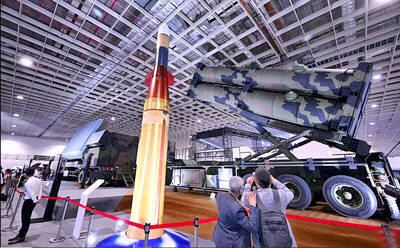
Taiwan is to commence mass production of the Tien Kung (天弓, “Sky Bow”) III, IV and V missiles by the second quarter of this year if the legislature approves the government’s NT$1.25 trillion (US$39.78 billion) special defense budget, an official said yesterday. Commenting on condition of anonymity, a defense official with knowledge of the matter said that the advanced systems are expected to provide crucial capabilities against ballistic and cruise missiles for the proposed “T-Dome,” an advanced, multi-layered air defense network. The Tien Kung III is an air defense missile with a maximum interception altitude of 35km. The Tien Kung IV and V
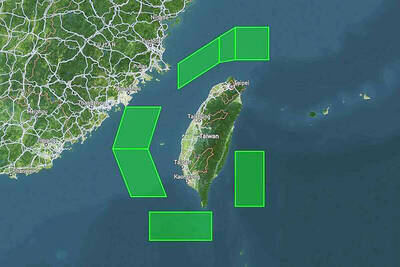
The disruption of 941 flights in and out of Taiwan due to China’s large-scale military exercises was no accident, but rather the result of a “quasi-blockade” used to simulate creating the air and sea routes needed for an amphibious landing, a military expert said. The disruptions occurred on Tuesday and lasted about 10 hours as China conducted live-fire drills in the Taiwan Strait. The Civil Aviation Administration (CAA) said the exercises affected 857 international flights and 84 domestic flights, affecting more than 100,000 travelers. Su Tzu-yun (蘇紫雲), a research fellow at the government-sponsored Institute for National Defense and Security Research, said the air
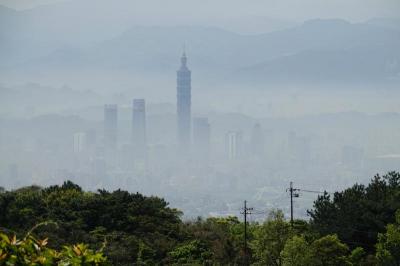
A strong continental cold air mass is to bring pollutants to Taiwan from tomorrow, the Ministry of Environment said today, as it issued an “orange” air quality alert for most of the country. All of Taiwan except for Hualien and Taitung counties is to be under an “orange” air quality alert tomorrow, indicating air quality that is unhealthy for sensitive groups. In China, areas from Shandong to Shanghai have been enveloped in haze since Saturday, the ministry said in a news release. Yesterday, hourly concentrations of PM2.5 in these areas ranged from 65 to 160 micrograms per cubic meter (mg/m³), and pollutants were
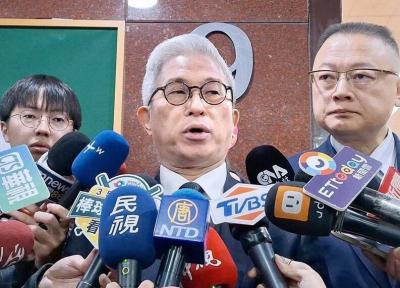
Taiwan’s armed forces have established response protocols for a wide range of sudden contingencies, including the “Wan Chun Plan” to protect the head of state, the Ministry of Defense (MND) said today. After US President Donald Trump on Saturday launched a series of airstrikes in Venezuela and kidnapped Venezuelan President Nicolas Maduro, concerns have been raised as to whether China would launch a similar “decapitation strike” on Taiwan. The armed forces regularly coordinate with relevant agencies and practice drills to ensure preparedness for a wide range of scenarios, Vice Minister of National Defense Hsu Szu-chien (徐斯儉) told reporters before a


 RSS
RSS