


Taiwan Taoyuan International Airport has launched a trial run of a color-coded baggage management system to improve ground crew efficiency in delivering luggage to arriving passengers, with plans to launch the full system in the second quarter of next year.
The system scans bar codes on luggage and groups bags from the same airplane under a corresponding color that airline companies will choose themselves, the airport said.
The luggage are then transferred onto a conveyor belt and LEDs placed along the carousel light up in the corresponding color, the airport said, adding that it spent NT$5 million (US$165,415) for the test system.
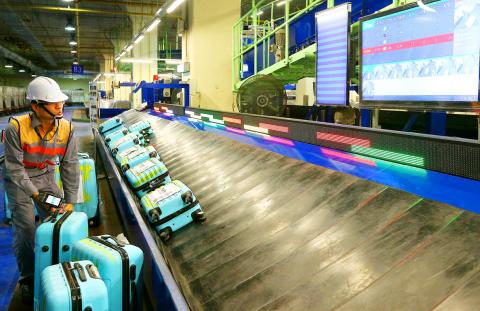
Photo: Tony Yao, Taipei Times
Compared with the traditional method in which ground crew manually check luggage tags and place the bags on conveyor belts, the system will hopefully expedite the sorting process, as ground crew will be able to recognize flights by their color, the airport said.
Currently, ground crew can sort luggage coming from up to three airplanes, it said.
The new system can sort luggage coming from up to six airplanes at a time, the airport said.
The system can process luggage during peak hours at a considerable speed, the airport said.
Peak arrival time at Terminal 2 is between 6am and 9am, and comprises 40 percent of daily baggage handling, the airport said, adding that every luggage carousel services two to three airplanes during the period.
The system has been installed on a carousel in Terminal 2 for a trial run, the airport said, adding that a entire system for the entire airport, including the lights, would cost NT$100 million.
The system would be able to indicate misplaced baggage using a red light and notify ground crew by displaying a picture of the misplaced baggage, so they can respond immediately, the airport said.
The trial phase has been smooth so far, but whether the system would be able to process baggage at full capacity would be determined on the day it is implemented, the airport said.
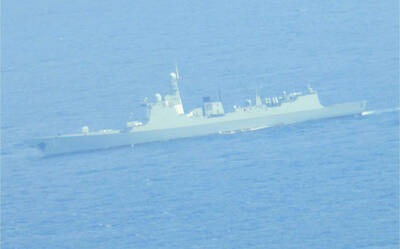
The military has spotted two Chinese warships operating in waters near Penghu County in the Taiwan Strait and sent its own naval and air forces to monitor the vessels, the Ministry of National Defense (MND) said. Beijing sends warships and warplanes into the waters and skies around Taiwan on an almost daily basis, drawing condemnation from Taipei. While the ministry offers daily updates on the locations of Chinese military aircraft, it only rarely gives details of where Chinese warships are operating, generally only when it detects aircraft carriers, as happened last week. A Chinese destroyer and a frigate entered waters to the southwest
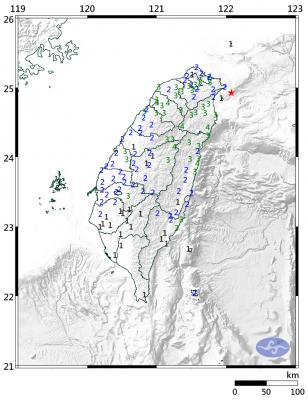
A magnitude 6.1 earthquake struck off the coast of Yilan County at 8:39pm tonight, the Central Weather Administration (CWA) said, with no immediate reports of damage or injuries. The epicenter was 38.7km east-northeast of Yilan County Hall at a focal depth of 98.3km, the CWA’s Seismological Center said. The quake’s maximum intensity, which gauges the actual physical effect of a seismic event, was a level 4 on Taiwan’s 7-tier intensity scale, the center said. That intensity level was recorded in Yilan County’s Nanao Township (南澳), Hsinchu County’s Guansi Township (關西), Nantou County’s Hehuanshan (合歡山) and Hualien County’s Yanliao (鹽寮). An intensity of 3 was
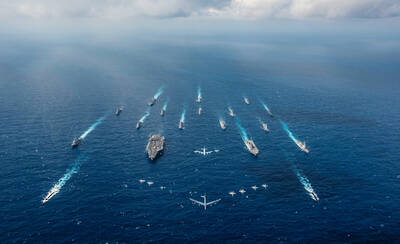
Japanese Prime Minister Sanae Takaichi’s comment last year on Tokyo’s potential reaction to a Taiwan-China conflict has forced Beijing to rewrite its invasion plans, a retired Japanese general said. Takaichi told the Diet on Nov. 7 last year that a Chinese naval blockade or military attack on Taiwan could constitute a “survival-threatening situation” for Japan, potentially allowing Tokyo to exercise its right to collective self-defense. Former Japan Ground Self-Defense Force general Kiyofumi Ogawa said in a recent speech that the remark has been interpreted as meaning Japan could intervene in the early stages of a Taiwan Strait conflict, undermining China’s previous assumptions
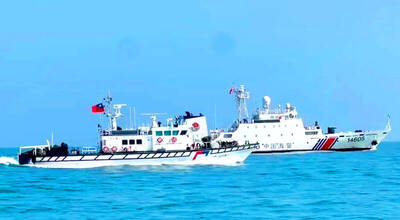
Instead of focusing solely on the threat of a full-scale military invasion, the US and its allies must prepare for a potential Chinese “quarantine” of Taiwan enforced through customs inspections, Stanford University Hoover fellow Eyck Freymann said in a Foreign Affairs article published on Wednesday. China could use various “gray zone” tactics in “reconfiguring the regional and ultimately the global economic order without a war,” said Freymann, who is also a nonresident research fellow at the US Naval War College. China might seize control of Taiwan’s links to the outside world by requiring all flights and ships entering or leaving Taiwan


 RSS
RSS