


The Executive Yuan has named the CTBC Anti-drug Educational Foundation an “exemplary anti-drug organization” for this year.
The foundation is the only anti-drug group to have been funded and established by a business and is also the youngest such charity to receive the award.
Vice President Chen Chien-jen (陳建仁) presented foundation chairman Jeffrey Koo Jr (辜仲諒) with the award at a ceremony in Taipei on Saturday.
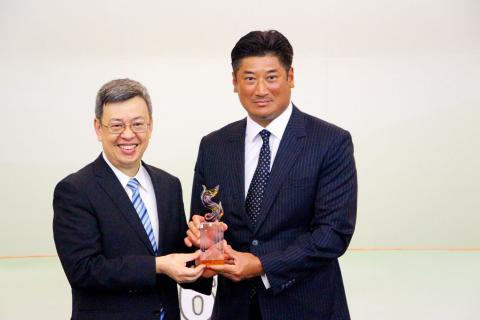
Photo courtesy of the CTBC Anti-drug Educational Foundation
Koo said that although the foundation’s work is extremely challenging, it is essential that it is carried out today to ensure a better tomorrow.
He is dedicated to becoming a “life-long anti-drug volunteer,” Koo said.
The Taipei Department of Education, which nominated the foundation for the award, said that the organization funded by CTBC Bank has thrown itself into anti-drug campaigning and preventative education, becoming an important front-line force in the war against illegal drug use.
Koo said that although the trophy is not heavy, he feels that the weight on his shoulders is even heavier now.
“Ever since I became general manager of the bank 18 years ago, I have had a dream that CTBC should not just donate money, but also find a fishing rod with which to extend greater help to society. The foundation is just such a fishing rod,” said Koo, who is also chairman of the CTBC Charity Foundation.
There are three legs to the fight against drugs: education, detection and correction, which involves getting people off drugs, he said.
Starting from the fundamental aspect of public information and education, Koo enlisted volunteers from inside and outside the company to foster a “seed force” of anti-drug campaigners.
The hope is that the company’s innovative anti-drug projects, in collaboration with government’s detection and correctional work, can build a finely tuned anti-drug social safety net that will safeguard future generations, he said.
Liu Hao (劉昊), chief executive of the Flying Life Association of Christ — which works to prevent substance abuse by children and adolescents — said that by using business management methods, the foundation’s campaign and education activities have helped set a new milestone in anti-drug education.
Founded in August 2015, the foundation is devoted to promoting anti-drug education. It works with local governments to organize anti-drug exhibitions to increase awareness of drug abuse. The exhibitions incorporate a variety of interactive technologies and include features such as simulated drug smells and pictures of drug users to help people understand the dangers of illegal drug use. More than 70,000 people have attended exhibitions, which have been held in 12 counties and cities across Taiwan.
The foundation has worked with other non-governmental organizations to promote anti-drug education in schools and created skits and 3D movies that have been shown to more than 30,000 students to teach about the irreversible health effects of substance abuse.
The foundation has also recruited experts to create teaching materials to help students learn about drug abuse and learn how to “say no” to drugs.
Since 2012, Koo has been supporting research on drug abuse prevention by National Taiwan University’s Children and Family Research Center.
An investigation into drug abuse among teenagers by the research center and the foundation found that every NT$1 devoted to education to prevent drug abuse can help save NT$64 in social costs.
That is why the foundation has been focusing on anti-drug campaigns and education programs to effectively use every penny available to fight drug abuse.
The foundation has collaborated with the Investigation Bureau, the Ministry of Justice and the US Drug Enforcement Administration’s Educational Foundation to integrate international official and non-governmental resources to promote innovative anti-drug advocacy.
In the past two years, the foundation has invested more than NT$50 million (US$1.66 million) to promote anti-drug advocacy using interactive technologies and 3D movies, as well as collaborating with documentary filmmaker Kevin Lee (李惠仁) to create a documentary on drug addicts called Sisyphus.exe.
Additionally, the foundation has put together experience-led anti-drug teaching material to bring education closer to the public and ensure that students become part of the anti-drug social security net.
“As drugs become more diversified, anti-drug work should also diversify,” Chen said at the National Anti-drug Review Conference.

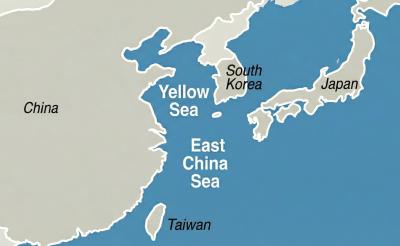
China has reserved offshore airspace in the Yellow Sea and East China Sea from March 27 to May 6, issuing alerts usually used to warn of military exercises, although no such exercises have been announced, the Wall Street Journal (WSJ) reported yesterday. Reserving such a large area for 40 days without explanation is an “unusual step,” as military exercises normally only last a few days, the paper said. These alerts, known as Notice to Air Missions (Notams), “are intended to inform pilots and aviation authorities of temporary airspace hazards or restrictions,” the article said. The airspace reserved in the alert is
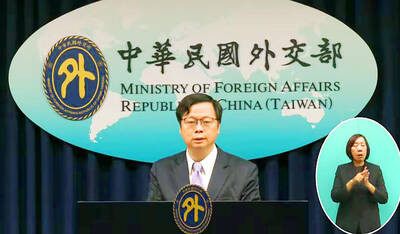
NAMING SPAT: The foreign ministry called on Denmark to propose an acceptable solution to the erroneous nationality used for Taiwanese on residence permits Taiwan has revoked some privileges for Danish diplomatic staff over a Danish permit that lists “Taiwan” as “China,” Eric Huang (黃鈞耀), head of the Ministry of Foreign Affairs’ Department of European Affairs, told a news conference in Taipei yesterday. Reporters asked Huang whether the Danish government had responded to the ministry’s request that it correct the nationality on Danish residence permits of Taiwanese, which has been listed as “China” since 2024. Taiwan’s representative office in Denmark continues to communicate with the Danish government, and the ministry has revoked some privileges previously granted to Danish representatives in Taiwan and would continue to review
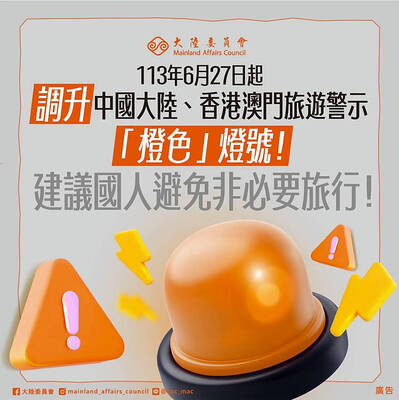
More than 6,000 Taiwanese students have participated in exchange programs in China over the past two years, despite the Mainland Affairs Council’s (MAC) “orange light” travel advisory, government records showed. The MAC’s publicly available registry showed that Taiwanese college and university students who went on exchange programs across the Strait numbered 3,592 and 2,966 people respectively. The National Immigration Agency data revealed that 2,296 and 2,551 Chinese students visited Taiwan for study in the same two years. A review of the Web sites of publicly-run universities and colleges showed that Taiwanese higher education institutions continued to recruit students for Chinese educational programs without

A bipartisan group of US senators has introduced a bill to enhance cooperation with Taiwan on drone development and to reduce reliance on supply chains linked to China. The proposed Blue Skies for Taiwan Act of 2026 was introduced by Republican US senators Ted Cruz and John Curtis, and Democratic US senators Jeff Merkley and Andy Kim. The legislation seeks to ease constraints on Taiwan-US cooperation in uncrewed aerial systems (UAS), including dependence on China-sourced components, limited access to capital and regulatory barriers under US export controls, a news release issued by Cruz on Wednesday said. The bill would establish a "Blue UAS


 RSS
RSS