


The first national exam for optometrists is to be held next month, a critical step to ensure the quality of eyeglass technicians outside of medical institutions, Democratic Progressive Party (DPP) Legislator Liu Chien-kuo (劉建國) said yesterday.
The proportion of short-sighted Taiwanese is the highest in the world, but a professional institution for optometrists has not been established, Liu said.
The national exam would enable licensed optometrists to work with eye doctors, reducing the number of myopia cases and the overall cost of health insurance, he said.

Photo: CNA
The junior and senior exams for optometrists, scheduled to take place next month and in July respectively, have attracted 15,498 applicants, Ministry of Examination’s statistics showed.
Liu credited the exam and last year’s Optometry Act (驗光人員法) to Wang Man-tang (王滿堂), the “father” of ophthalmological education in Taiwan.
After earning a master’s degree in healthcare from the University of Iowa, Wang worked in the Taipei Veterans’ General Hospital and taught at Chung Shan Medical University in Kaohsiung.
Despite being diagnosed with cancer in 2000, he continued to promote optometric institutionalization until his death in 2006.
He wrote 11 monographs about optometry and optical physiology.
The Optometry Act was essentially drafted by Wang, who “finely integrated the merits of foreign institutions and domestic customs in the bill,” former Chinese Nationalist Party (KMT) legislator Joanna Lei (雷倩) said, recalling her first time seeing the draft optometry act in 2005 after it was introduced by the Chou Ta-Kuan Foundation.
During the decade-long legalization process, Lei said she had encountered opposition from eye doctors who were afraid that their prescriptive authority might be dampened once optometrists become available in eyeglass stores.
Lei said she also faced resistance from lawmakers on the Social Welfare and Environmental Hygiene Committee who had connections with doctors.
Reviews of the bill lasted from 2012 to 2015, but it was Liu Chien-kuo who pushed for its final legalization last year, she said.
The act stipulates that people without an optometrist’s certificate cannot conduct eyesight tests and make eyeglasses, with violators liable to fines of NT$30,000 to NT$150,000.
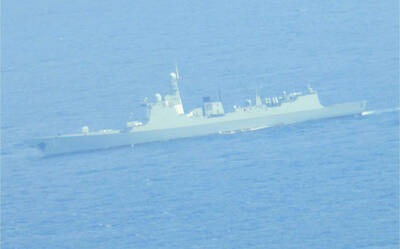
The military has spotted two Chinese warships operating in waters near Penghu County in the Taiwan Strait and sent its own naval and air forces to monitor the vessels, the Ministry of National Defense (MND) said. Beijing sends warships and warplanes into the waters and skies around Taiwan on an almost daily basis, drawing condemnation from Taipei. While the ministry offers daily updates on the locations of Chinese military aircraft, it only rarely gives details of where Chinese warships are operating, generally only when it detects aircraft carriers, as happened last week. A Chinese destroyer and a frigate entered waters to the southwest
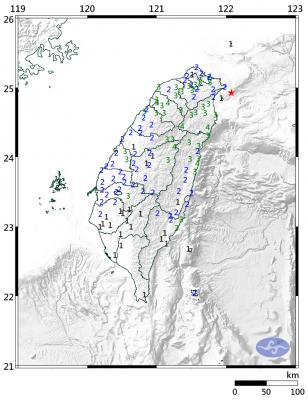
A magnitude 6.1 earthquake struck off the coast of Yilan County at 8:39pm tonight, the Central Weather Administration (CWA) said, with no immediate reports of damage or injuries. The epicenter was 38.7km east-northeast of Yilan County Hall at a focal depth of 98.3km, the CWA’s Seismological Center said. The quake’s maximum intensity, which gauges the actual physical effect of a seismic event, was a level 4 on Taiwan’s 7-tier intensity scale, the center said. That intensity level was recorded in Yilan County’s Nanao Township (南澳), Hsinchu County’s Guansi Township (關西), Nantou County’s Hehuanshan (合歡山) and Hualien County’s Yanliao (鹽寮). An intensity of 3 was
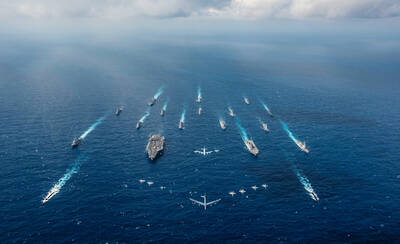
Japanese Prime Minister Sanae Takaichi’s comment last year on Tokyo’s potential reaction to a Taiwan-China conflict has forced Beijing to rewrite its invasion plans, a retired Japanese general said. Takaichi told the Diet on Nov. 7 last year that a Chinese naval blockade or military attack on Taiwan could constitute a “survival-threatening situation” for Japan, potentially allowing Tokyo to exercise its right to collective self-defense. Former Japan Ground Self-Defense Force general Kiyofumi Ogawa said in a recent speech that the remark has been interpreted as meaning Japan could intervene in the early stages of a Taiwan Strait conflict, undermining China’s previous assumptions
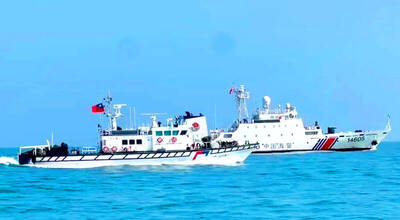
Instead of focusing solely on the threat of a full-scale military invasion, the US and its allies must prepare for a potential Chinese “quarantine” of Taiwan enforced through customs inspections, Stanford University Hoover fellow Eyck Freymann said in a Foreign Affairs article published on Wednesday. China could use various “gray zone” tactics in “reconfiguring the regional and ultimately the global economic order without a war,” said Freymann, who is also a nonresident research fellow at the US Naval War College. China might seize control of Taiwan’s links to the outside world by requiring all flights and ships entering or leaving Taiwan


 RSS
RSS