


The Chinese Nationalist Party (KMT) caucus yesterday again obstructed the legislative general assembly meeting to protest against the government’s Forward-looking Infrastructure Development Program bill and also released poll results saying that 43.3 percent of respondents view the plan as “unhelpful.”
The general assembly meeting yesterday stalled after the Democratic Progressive Party (DPP) and KMT caucuses blocked each other’s proposals to send the review back to committee.
The KMT caucus slowed down the meeting by repeatedly asking for floor votes, but when the DPP caucus did not oppose the return of a DPP lawmaker’s motion to the Procedure Committee for next week’s agenda-setting — a move proposed by the KMT caucus — KMT lawmakers in the main chamber voiced dissent to its own caucus’ proposal to return the motion.
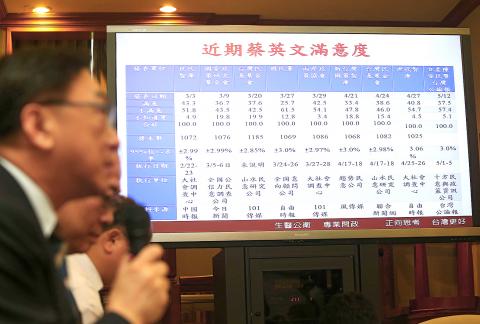
Photo: CNA
The aim was apparently to slow down proceedings by conducting as many votes as possible.
Deputy Legislative Speaker Tsai Chi-chang (蔡其昌), who presided over the meeting yesterday and had on Friday last week already complained about the stalling tactics, asked the KMT caucus to “first discuss among [themselves]” before making such moves as they look “awfully bad.”
Amid the back-and-forth between Tsai and KMT lawmakers, KMT Legislator Alicia Wang (王育敏) said that the KMT is a “democratic and diverse” party in an attempt to explain why some KMT lawmakers disagreed with its caucus’ decision.
Tsai then called for an early noon break for the KMT caucus to “sort things out,” but the meeting never resumed.
Separately yesterday, KMT Legislator Arthur Chen (陳宜民), with the pro-KMT Taiwan People Power News, published the results of a poll conducted by All Dimensions Public Research Inc.
Of those polled, 41.2 percent believe that the plan is helpful, while 43.3 percent disagreed.
People from the region comprised of Yunlin, Chiayi and Tainan were the most supportive of the plan, with 55.7 percent considering it helpful, while people from central Taiwan (Taichung, Changhua and Nantou) had the most doubts, with 48.8 percent saying it is not helpful.
The poll also reported high disapproval ratings of President Tsai Ing-wen (蔡英文) and Premier Lin Chuan (林全).
Tsai’s disapproval rating was 55.6 percent and approval rating was 40.4 percent, while Lin’s disapproval rating was 60.7 percent and only 32 percent of respondents approved of his performance.
DPP lawmakers from central Taiwan also held a news conference yesterday calling on KMT lawmakers from the region not to block the infrastructure plan.
Legislator Chang Liao Wan-chien (張廖萬堅) from Taichung, presenting a petition initiated by Taichung Mayor Lin Chia-lung (林佳龍) asking for support for local infrastructure construction, said that KMT legislators based in the city — including Johnny Chiang (江啟臣), Yen Kuan-heng (顏寬恆) and Lu Yen-hsiu (盧燕秀) — have all signed the petition.
Changhua Legislators Hung Tsung-yi (洪宗熠) and Chen Su-yueh (陳素月) also criticized KMT Legislator Wang Hui-mei (王惠美) for blocking the plan in the legislature when they supported local development projects during the president’s visit to the county last month.
Additional reporting by Tseng Wei-chen

NATIONAL SECURITY: Authorities are working to confirm the identities of the military personnel involved and investigating possible illegal conduct and regulatory violations Authorities are probing possible national security implications after Kinmen police and immigration officers on Sunday found a Chinese woman allegedly posing as a tourist while engaging in prostitution involving more than 10 military personnel. The woman, surnamed Chen (陳), has since been deported, authorities said, adding that investigators are still working to confirm the identities of those implicated, as the records only listed code names and aliases. The case stemmed from a report received by the Kinmen District Prosecutors’ Office on Friday last week from the Jinhu Precinct of the Kinmen County Police Bureau. On Sunday, police, along with the National Immigration

GLOBALGIVING: ‘ Caving to external pressure is not acceptable for an organization that has cultivated justice reform and human rights for 30 years,’ one NGO said A slew of non-government organizations (NGOs) have withdrawn from the GlobalGiving fundraising platform after it announced it would use “Chinese Taipei” instead of “Taiwan” from next month. The Taiwan Good Rice Association wrote on Facebook on Friday that it was informed on April 28 via a teleconference call of the change, which was made because the platform wanted to operate in China. Taiwan Good Rice is to terminate all cooperative relationships with GlobalGiving in response to the platform’s “unilateral and non-negotiable” decision to remove references to Taiwan, the NGO said. “Taiwan is in the official name of Taiwan Good Rice Association and the

HEAVY WEATHER: Typhoon Jangmi is due to crash straight into the Ryukyus as airlines look to shift flights to larger aircraft or cancel flights to Okinawa entirely Taiwan’s international air carriers announced flight adjustments over the weekend as Typhoon Jangmi is forecast to hit the Ryukyu Islands today and tomorrow. The Central Weather Administration (CWA) upgraded Jangmi from a tropical storm to a typhoon at 8am yesterday, with the eye located 580km south of Naha city. It was moving north at 19kph. Today, China Airlines’ CI-120, CI-121, CI-122 and CI-123 flights between Taoyuan and Naha, Okinawa, have been canceled as well as CI-132 and CI-133 between Kaohsiung and Naha. EVA Air’s BR-112, BR-113, BR-186 and BR-185 flights between Taoyuan and Naha are also canceled. Low-cost carrier Tigerair Taiwan canceled IT-230,

Chinese Nationalist Party (KMT) Chairwoman Cheng Li-wun (鄭麗文) yesterday briefed her party’s Central Standing Committee regarding her scheduled visit to the US between Monday next week and June 16, saying that her purpose would be to persuade the US that the Republic of China (ROC) Constitution was a “one China” constitution that would foster stable and peaceful cross-strait relations. The ROC Constitution is the most important defense for all Taiwanese citizens, as it upholds our democracy and has contributed to our robust economy, which aligns with international and US interests, she said. “We would not be troublemakers and drag the US under,”


 RSS
RSS