


The Legislative Yuan’s plenary session hit a snag yesterday as Chinese Nationalist Party (KMT) lawmakers disrupted the meeting to protest against the Forward-looking Infrastructure Development Plan.
The plenary session was scheduled to review hundreds of proposed bills and amendments, but KMT lawmakers filed numerous objections to paralyze the proceedings.
As Deputy Legislative Speaker Tsai Chi-chang (蔡其昌) read out the agenda, KMT Legislator Alicia Wang (王育敏) raised an objection to an amendment to the Road Traffic Management and Penalty Act (道路交通管理處罰條例), which sent the proposal back to the Procedure Committee.
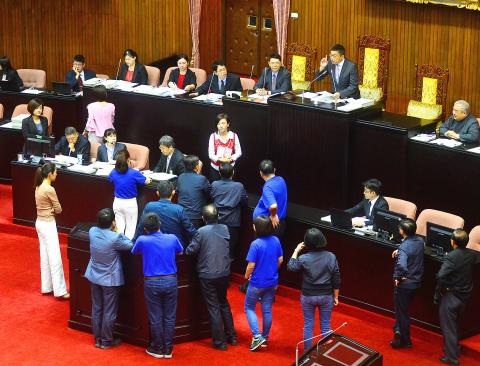
Photo: Wang Yi-sung, Taipei Times
KMT lawmakers even objected to an objection the party caucus had filed.
Tsai adjourned the session after it became apparent that the KMT would continue to disrupt the proceedings, saying the party was “going too far” in objecting its own motion.
The aim of the KMT’s tactics was to force the Cabinet to withdraw the infrastructure plan, which is being reviewed by the Economics Committee.
The eight-year NT$882.4 billion (US$29.2 billion) plan to develop rail lines, water infrastructure, renewable energy, digital infrastructure and urban development has been criticized for hasty decisionmaking and unnecessary railway projects.
Citing a report that had been submitted to the legislature by the National Development Council in March — which outlined a four-year development project that bears a striking resemblance to the Forward-looking plan — KMT caucus convener Sufin Siluko (廖國棟) asked how a four-year project turned into an eight-year one in such a short time and demanded that the plan be sent back to the Executive Yuan.
The Democratic Progressive Party (DPP) caucus accused the KMT of inconsistency in opposing the plan.
Even as the KMT caucus was trying to boycott the infrastructure plan, New Taipei City Mayor Eric Chu (朱立倫) was meeting with local lawmakers to seek their support in securing funds from the project for infrastructure in his municipality, DPP Legislator Su Chiao-hui (蘇巧慧) said.
While boycotting the plan, the KMT did not specifically oppose any of the infrastructure projects listed in it, DPP Legislator Lee Chun-yi (李俊毅) said.
“The KMT cannot just say it does not want the plan. We are asking it to make specific suggestions about which rail projects are not necessary” so the DPP and KMT can hold meaningful discussions, Lee said.
Six hearings have been held since the Executive Yuan submitted the plan in March, but the KMT has boycotted its review without presenting any alternative proposals, DPP Legislator Yeh Yi-chin (葉宜津) said.
The KMT’s inability to unify its conflicting moves was due to its chairperson election this month, since the candidates have differing considerations, Yeh said.
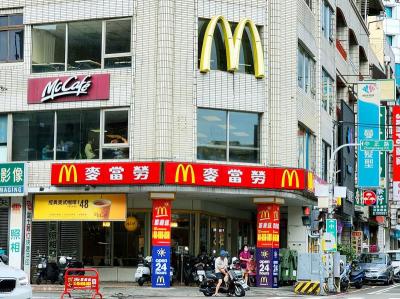
Fast food chain McDonald's is to raise prices by up to NT$5 on some products at its restaurants across Taiwan, starting on Wednesday next week, the company announced today. The prices of all extra value meals and sharing boxes are to increase by NT$5, while breakfast combos and creamy corn soup would go up by NT$3, the company said in a statement. The price of the main items of those meals, if ordered individually, would remain the same. Meanwhile, the price of a medium-sized lemon iced tea and hot cappuccino would rise by NT$3, extra dipping sauces for chicken nuggets would go up

FUKUOKA SITUATION: Japanese media reported that the pathogen is expected to be identified by the summer, while the CDC downplayed the idea that it was hMPV A “mysterious cold-like illness” reported in Japan’s Fukuoka Prefecture does not seem to be a new disease, but Japanese authorities have been asked about the situation, the Centers for Disease Control (CDC) said yesterday. The Fukuoka Prefectural Medical Association on Wednesday told a news conference that a “mystery cold” that has become a hot topic on social media is “highly likely to be caused by some kind of viral infection,” Japan’s KBC News reported. “Many people are experiencing symptoms starting with a sore throat, followed by a runny nose, phlegm and a severe cough,” KBC News reported, citing association officials. Health authorities are

Nvidia Corp CEO Jensen Huang (黃仁勳) arrived in Taiwan yesterday ahead of upcoming AI and technology events, saying he plans to meet with clients and Taiwan Semiconductor Manufacturing Co Chairman C.C. Wei (魏哲家) during his visit. After landing at Taipei Songshan Airport, Huang posed for photos with fans and handed out Yakult drinks to reporters and supporters waiting at the scene, saying he has “a lot to do” during the trip. Asked about reports that Nvidia’s planned headquarters site in Taipei’s Beitou Shilin Technology Park could break ground on May 27, Huang said that if the company holds an event, he would

Carrefour Taiwan is to begin using a new name from the start of July, but it cannot divulge the name until then, the chairman of the supermarket chain's parent company said today. President Chain Store Co chairman Lo Chih-hsien (羅智先) was asked by reporters after a shareholders' meeting to confirm whether the company has settled on a new name for the supermarket brand. In March, the government-registered name of two Carrefour Taiwan branches was quietly changed to "Le Chia Kang" (樂家康) in Chinese, raising speculation that has been selected as the name. Lo said that because of local regulations and contractual obligations, the


 RSS
RSS