


Results released on Wednesday of the Food and Drug Administration’s (FDA) inspection of nutritional supplement products containing the fungus Antrodia cinnamomea showed that eight products did not gain FDA approval before being put on sale, while 51 products were mislabeled.
FDA Southern Center section chief Lu Yun-ju (呂昀儒) said A cinnamomea is a species of fungus endemic to Taiwan and is often used to produce dietary supplements, but studies have shown that consuming a high dosage of the fungus can be toxic and increase risk of degenerative changes in cells.
The Ministry of Health and Welfare announced regulations for food products containing the fungus on July 10, 2015, stipulating that producers must submit a detailed document revealing all ingredients, the manufacturing process, product specifications and a repeated-dose 90-day oral toxicity test result for the FDA’s approval before launching their products. The regulations took effect on July 11 last year.
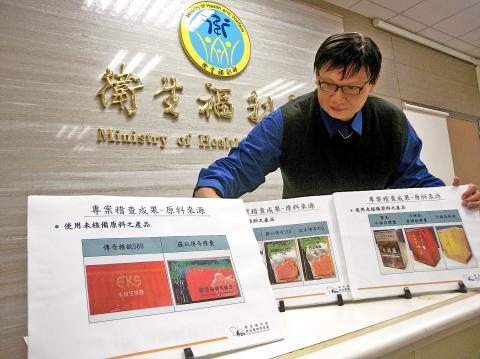
Photo: Wu Liang-yi, Taipei Times
The FDA’s inspection of 63 food companies in 16 counties and cities from November last year to last month showed that eight products from two companies — three products from Chang Gung Biotechnology Co (長庚生技) and five products from a biotechnology company called Yoyaer (耶和華以勒生技) — did not submit corresponding documents.
The products are A cinnamomea essence extract, Formosa A cinnamomea capsules and A cinnamomea essence soft capsules produced by Chang Gung, as well as five types of capsule products by Yoyaer that were sold under the brand name FKS.
FDA Southern Center director Liu Fang-ming (劉芳銘) said that 3,535 boxes and 42,510 bottles of the eight problematic products have been removed from shelves, and the companies will face fines of between NT$60,000 and NT$200 million (US$1,951 and US$6.5 million) if they continue to sell the products.
In addition, the inspection found 51 types of products containing the fungus had mislabeling problems, such as listing the nutrition facts in the wrong format, incomplete labeling of ingredients or incomplete company information.
Liu said a few companies printed pictures of the whole fungus on the product package when it only contained the mycelium — or vegetative structure — of the fungus.
As such pictures could mislead consumers, they were asked to improve their labeling and packages, he added.
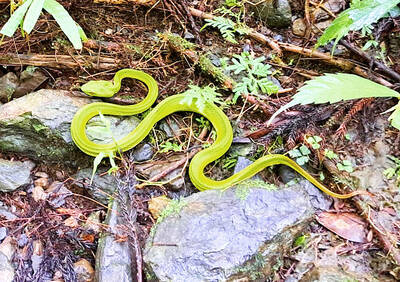
More than half of the bamboo vipers captured in Tainan in the past few years were found in the city’s Sinhua District (新化), while other districts had smaller catches or none at all. Every year, Tainan captures about 6,000 snakes which have made their way into people’s homes. Of the six major venomous snakes in Taiwan, the cobra, the many-banded krait, the brown-spotted pit viper and the bamboo viper are the most frequently captured. The high concentration of bamboo vipers captured in Sinhua District is puzzling. Tainan Agriculture Bureau Forestry and Nature Conservation Division head Chu Chien-ming (朱健明) earlier this week said that the

NAMING SPAT: The foreign ministry called on Denmark to propose an acceptable solution to the erroneous nationality used for Taiwanese on residence permits Taiwan has revoked some privileges for Danish diplomatic staff over a Danish permit that lists “Taiwan” as “China,” Eric Huang (黃鈞耀), head of the Ministry of Foreign Affairs’ Department of European Affairs, told a news conference in Taipei yesterday. Reporters asked Huang whether the Danish government had responded to the ministry’s request that it correct the nationality on Danish residence permits of Taiwanese, which has been listed as “China” since 2024. Taiwan’s representative office in Denmark continues to communicate with the Danish government, and the ministry has revoked some privileges previously granted to Danish representatives in Taiwan and would continue to review
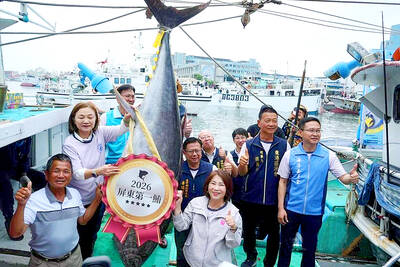
The first bluefin tuna of the season, brought to shore in Pingtung County and weighing 190kg, was yesterday auctioned for NT$10,600 (US$333.5) per kilogram, setting a record high for the local market. The auction was held at the fish market in Donggang Fishing Harbor, where the Siaoliouciou Island-registered fishing vessel Fu Yu Ching No. 2 delivered the “Pingtung First Tuna” it had caught for bidding. Bidding was intense, and the tuna was ultimately jointly purchased by a local restaurant and a local company for NT$10,600 per kilogram — NT$300 ,more than last year — for a total of NT$2.014 million. The 67-year-old skipper

China has reserved offshore airspace over the Yellow Sea and East China Sea from March 27 to May 6, issuing alerts that are usually used to warn of military exercises, although no such exercises have been announced, the Wall Street Journal (WSJ) reported on Sunday. Reserving such a large area for 40 days without explanation is an “unusual step,” as military exercises normally only last a few days, the paper said. The alerts, known as notice to air missions (NOTAMs), “are intended to inform pilots and aviation authorities of temporary airspace hazards or restrictions,” the article said. The airspace reserved in the alert


 RSS
RSS