

Restrictions are needed to keep people from abusing each another with frivolous lawsuits during divorce proceedings, women’s groups said yesterday.
“Frivolous lawsuits waste legal resources and are a form of domestic violence which should be subject to restraining orders,” said Garden of Hope Foundation executive director Chi Hui-jung (紀惠容), citing the case of Wang Min (王敏) — the former wife of Meridigen Biotech Co Ltd founder Yogi Hsuan (宣昶有) — who said she has been subjected to more than 40 lawsuits since their divorce proceedings were initiated.
The lawsuits piled up because after Hsuan lost a court case against Wang, he filed identical suits against her family members and split complaints into individual cases to maximize the number of times Wang and her family would be required to appear in court, Judicial Reform Foundation executive secretary Hsiao Yi-ming (蕭逸民) said.
“Frivolous lawsuits can be a form of stalking, because while a former spouse might not know where you live, you cannot avoid a court summons,” Modern Women’s Foundation deputy chief executive Lin Mei-hsun (林美薰) said.
“It is the same as domestic violence because it is an attempt to control and oppress a person,” she said. “Even if there is no possibility of winning a case, a person cannot work and their reputation suffers if they are issued 10 summons.”
Lin said that while judges can theoretically issue restraining orders against frivolous lawsuits, few do so and there is no mandated penalty for violations.
Introducing fines and other penalties might be possible as part of the passage of upcoming legislation on stalking and sexual harassment, she said.
Chi called for issue to be included in a national policy conference on judicial reform agenda, including mechanisms to report lawyers who assist with frivolous lawsuits.
“There is a need to require security deposits so people have to pay for the legal costs of the defendant and provide compensation if the suit fails,” she said.
Lin said that small security deposits are already required for civil cases, but not criminal cases, which comprise a large portion of frivolous suits.
“The right to litigation is protected in the Constitution and is not something that should be restricted lightly, but there are limits to any right,” Hsiao said, calling for better communication between the courts to ensure that plaintiffs do not bring identical cases to more than one court.
“Determining what lawsuits are frivolous could be troublesome and require substantial judicial time and energy, so the rules should be written,” said Democratic Progressive Party (DPP) Legislator Chou Chun-mi (周春米), a former judge.
She said that while it would be impossible to completely restrict the right to sue, there was room to discuss reasonable restrictions.
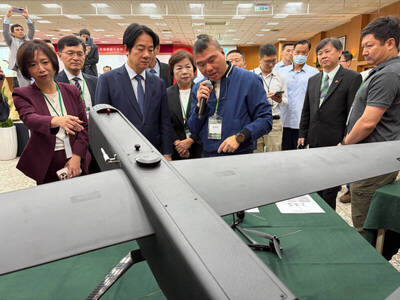
Two executives of drone supplier Jiin Ming Industry Co (錦明實業) have been detained and held incommunicado over the company's alleged use of prohibited China-made chips and camera lenses in drones supplied under recent military contracts, the Taoyuan District Prosecutors' Office said today. In a statement, prosecutors said they raided the offices of Jiin Ming — headquartered in Taoyuan — as well as those of its subsidiaries and its suppliers on Thursday last week. The raids followed a report that the company had breached its procurement contracts by putting the prohibited components into drones delivered to the military. During the raids, prosecutors summoned
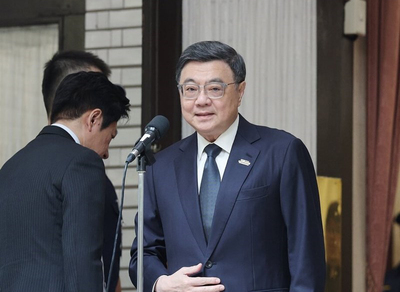
The government would continue monitoring online rumors that a pneumonic plague outbreak has spread from Russia into China and could enhance existing quarantine measures, Premier Cho Jung-tai (卓榮泰) said today. During a legislative meeting, Democratic Progressive Party Legislator Wang Ting-yu (王定宇) said rumors were circulating that the disease had spread across several Chinese provinces. He asked Cho whether the government was prepared to prevent the disease from spreading to Taiwan, given the frequent exchanges between Taiwan and China, and how concerned the government was about the alleged outbreak. The Ministry of Health and Welfare implemented border quarantine measures after briefing the Executive Yuan
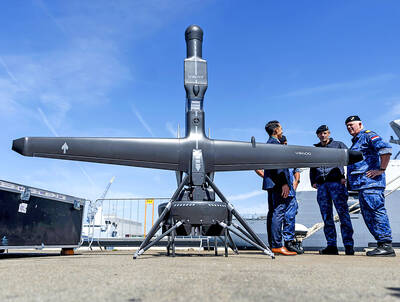
DEFENSE PROCUREMENT: Taiwan could become the largest operator of V-BAT drones outside the US once they are delivered, the Ministry of National Defense said The navy and the coast guard are acquiring 292 units of MQ-35A V-BAT vertical takeoff and landing (VTOL) surveillance drones manufactured by US-based defense technology company Shield AI, making Taiwan one of the largest buyers of the drone. The Coast Guard Administration budgeted NT$1.2 billion (US$37.1 million) to buy 12 drones, which have been delivered, Shield AI said in a report on Oct 13. The navy is planning to spend NT$36 billion under a four-year program code-named Project Yuan Xiao (遠鴞) to acquire 280 V-BAT drones, the Ministry of National Defense’s fiscal 2027 report showed. The combined procurement is expected

South Korean boy band BigBang drew 120,000 fans to three concerts at Taipei Dome from Friday through yesterday, as the band thanked them for their support over their 20-year career. The Taipei Dome concerts were part of BigBang's "2026-2027 World Tour XX: Cosmos." Friday's concert was BigBang's first performance in Taiwan in 11 years. During the encore, group leader G-Dragon (GD) shouted "I love you" in Chinese and said he was especially happy to perform in Taiwan with bandmates Taeyang and Daesung. "Taipei, I'm very grateful to you all," GD said in Chinese, asking fans to wait for the band's return. Daesung thanked


 RSS
RSS