


The Ministry of the Interior’s proposed bills to regulate the establishment of non-governmental organizations (NGO) are cosmetic, civic groups said yesterday, protesting the ministry’s refusal to hold open hearings.
More than a dozen people from the Taiwan Association for Human Rights, Taiwan Democracy Watch and several other groups protested outside the ministry’s building in Taipei, shouting slogans calling on the ministry to open up the bill drafting process and restore the right to freedom of association.
The ministry held a meeting yesterday, when it announced its plans to abolish the Civil Associations Act (人民團體法) to make way for separate laws to regulate NGOs, professional associations and political parties.
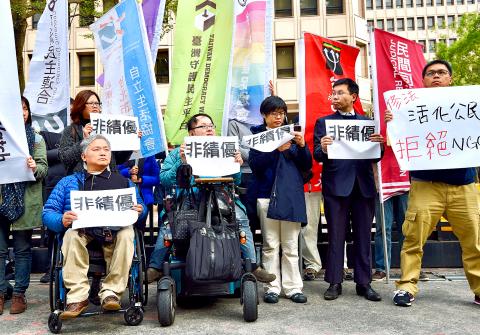
Photo: Peter Lo, Taipei Times
Only 12 NGOs were invited to the meeting, to the chagrin of other civic groups.
“There are numerous groups which have been suffering from the current law, so it is good that they are considering changes and asking for opinions, but we are bewildered as to why only groups graded as ‘excellent’ were invited,” Taiwan Association for Human Rights secretary-general Chiu E-ling (邱伊翎) said, adding that her group was rejected on grounds that a ministry review had not given it an “excellent” grade.
“Given that this law is supposed to apply to all groups, why are they not willing to listen to groups that have been silenced?” she asked.
Being registered by the ministry is crucial to civic groups because it paves the way for court designation as a legal person, allowing them to engage in open fundraising activities, she said.
The protesters also criticized the proposed bill for retaining the ministry’s right to reject applications, despite claims that the current permit system would be abolished.
“The bill still imposes a lot of restrictions on freedom of association, particularly by maintaining the ministry’s power to deny resignations and order an association to disperse. What is supposed to counteract or constrain the ministry?” Taiwan Association for Human Rights deputy chairman Weng Kuo-yan (翁國彥) said, adding that the proposed changes amounted to “walking in place.”
“Even though they are changing the name of the process for approval to application-based registration, the reality is that it is still a review-based permit system,” Taiwan Democracy Watch director Tu Yu-yin (涂予尹) said.
The amendment would simplify and streamline the application process to allow civic groups more freedom, the ministry’s cooperative and civil association preparatory office head Chen Yung-fu (陳永福) said, adding that allowing automatic registration is impractical.
“The issue is that the 46th Article of the Civil Code requires associations to receive approval from a ministry before they can become legal persons,” he said.
The ministry also sought to retain its power to deny applications so that it could ban organizations with illegal purposes, he said.
“Not inviting the protesting groups was probably an oversight on our part,” he said, adding that attendance had been restricted because of space limitation and the number of civic organizations.
“We ended up preparing seats for them, but unfortunately they were not willing to come in,” he said.
“We are not here to have the ministry let us in because we made a fuss — we are here because we believe it should hold another hearing open to all groups,” Chiu said.

More than half of the bamboo vipers captured in Tainan in the past few years were found in the city’s Sinhua District (新化), while other districts had smaller catches or none at all. Every year, Tainan captures about 6,000 snakes which have made their way into people’s homes. Of the six major venomous snakes in Taiwan, the cobra, the many-banded krait, the brown-spotted pit viper and the bamboo viper are the most frequently captured. The high concentration of bamboo vipers captured in Sinhua District is puzzling. Tainan Agriculture Bureau Forestry and Nature Conservation Division head Chu Chien-ming (朱健明) earlier this week said that the

NAMING SPAT: The foreign ministry called on Denmark to propose an acceptable solution to the erroneous nationality used for Taiwanese on residence permits Taiwan has revoked some privileges for Danish diplomatic staff over a Danish permit that lists “Taiwan” as “China,” Eric Huang (黃鈞耀), head of the Ministry of Foreign Affairs’ Department of European Affairs, told a news conference in Taipei yesterday. Reporters asked Huang whether the Danish government had responded to the ministry’s request that it correct the nationality on Danish residence permits of Taiwanese, which has been listed as “China” since 2024. Taiwan’s representative office in Denmark continues to communicate with the Danish government, and the ministry has revoked some privileges previously granted to Danish representatives in Taiwan and would continue to review

The first bluefin tuna of the season, brought to shore in Pingtung County and weighing 190kg, was yesterday auctioned for NT$10,600 (US$333.5) per kilogram, setting a record high for the local market. The auction was held at the fish market in Donggang Fishing Harbor, where the Siaoliouciou Island-registered fishing vessel Fu Yu Ching No. 2 delivered the “Pingtung First Tuna” it had caught for bidding. Bidding was intense, and the tuna was ultimately jointly purchased by a local restaurant and a local company for NT$10,600 per kilogram — NT$300 ,more than last year — for a total of NT$2.014 million. The 67-year-old skipper

China has reserved offshore airspace over the Yellow Sea and East China Sea from March 27 to May 6, issuing alerts that are usually used to warn of military exercises, although no such exercises have been announced, the Wall Street Journal (WSJ) reported on Sunday. Reserving such a large area for 40 days without explanation is an “unusual step,” as military exercises normally only last a few days, the paper said. The alerts, known as notice to air missions (NOTAMs), “are intended to inform pilots and aviation authorities of temporary airspace hazards or restrictions,” the article said. The airspace reserved in the alert


 RSS
RSS