


A Ministry of Justice agreement to abolish the Special Investigation Division (SID) is based on confidence that the amendment to the Organic Act for Courts (法院組織法) would further empower district prosecutors’ offices and the high prosecutor’s offices to the level that each office would be a literal “mini-SID,” Minister of Justice Chiu Tai-san (邱太三) said yesterday.
The ministry has agreed with Democratic Progressive Party (DPP) Legislator Tsai Yi-yu’s (蔡易餘) proposal to abolish the SID and it is expected to be phased out by October, the Legislative Yuan said.
According to Chiu, the SID had to constantly “borrow” district and high-prosecutor office staff to conduct investigations, adding that there was no need for the SID when district prosecutors are capable of handling investigations into cases of corruption.
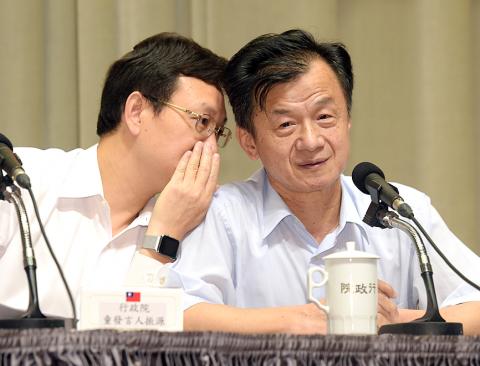
Photo: Hunag Yao-cheng, Taipei Times
The SID did not begin prosecution against high-level officials, as minster-level officials were prosecuted prior to the creation of the SID in 2007, Chiu said, adding that the division overshadows other prosecutorial units.
The public should have the same confidence in district prosecutors’ offices as they do in the SID, Chiu said.
Chiu used examples of district prosecutors’ offices and the Agency Against Corruption (AAC) investigating corruption cases in New Taipei City, the former Taoyuan County and Nantou County together.
The ministry will be instructing local prosecutors’ offices to increase efforts to combat corruption, and the draft amendments to the Organic Act for Courts submitted to the legislature will enable those offices to “borrow” staff from other branches should their expertise be required in corruption investigations, Chiu said.
Dissolving the SID should not affect the capability and efficiency of anti-corruption investigations, Chiu said, adding that he has confidence in the district prosecutors’ offices capabilities.
The SID has the power to launch investigations against the president, vice president, presidents of government branches, minister-level officials and generals.
Chiu said that the AAC was also unnecessary, but was motivated by political factors, adding that the AAC has also strained judicial relations due to overlapping jurisdictions.
However, Chinese Nationalist Party (KMT) Legislator Alicia Wang (王育敏) said the DPP was ignoring the rule of law, adding that the establishment of the SID was backed by law and should not be removed on the whim of one administration.
DPP legislators want to remove the SID because it has been responsible for many corruption investigations against former president Chen Shui-bian (陳水扁), Wang said, adding that the motion to abolish the SID is politically motivated.
DPP Legislator Huang Wei-cher (黃偉哲) said the KMT’s comments were purely political, adding that the party has been the beneficiary of the division since its establishment.
The division has investigated members of both parties and the difference is simply whether the investigation proves there is a valid case or not, Chiu said, adding that the ministry is approaching the issue from the point of what function the division serves in maintaining the rule of law.

Considering that most countries issue more than five denominations of banknotes, the central bank has decided to redesign all five denominations, the bank said as it prepares for the first major overhaul of the banknotes in more than 24 years. Central bank Governor Yang Chin-lung (楊金龍) is expected to report to the Legislative Yuan today on the bank’s operations and the redesign’s progress. The bank in a report sent to the legislature ahead of today’s meeting said it had commissioned a survey on the public’s preferences. Survey results showed that NT$100 and NT$1,000 banknotes are the most commonly used, while NT$200 and NT$2,000

The Centers for Disease Control (CDC) yesterday reported the first case of a new COVID-19 subvariant — BA.3.2 — in a 10-year-old Singaporean girl who had a fever upon arrival in Taiwan and tested positive for the disease. The girl left Taiwan on March 20 and the case did not have a direct impact on the local community, it said. The WHO added the BA.3.2 strain to its list of Variants Under Monitoring in December last year, but this was the first imported case of the COVID-19 variant in Taiwan, CDC Deputy Director-General Lin Ming-cheng (林明誠) said. The girl arrived in Taiwan on

South Korea is planning to revise its controversial electronic arrival card, a step Taiwanese officials said prompted them to hold off on planned retaliatory measures, a South Korean media report said yesterday. A Yonhap News Agency report said that the South Korean Ministry of Foreign Affairs is planning to remove the “previous departure place” and “next destination” fields from its e-arrival card system. The plan, reached after interagency consultations, is under review and aims to simplify entry procedures and align the electronic form with the paper version, a South Korean ministry official said. The fields — which appeared only on the electronic form

The Ministry of Foreign Affairs (MOFA) is suspending retaliation measures against South Korea that were set to take effect tomorrow, after Seoul said it is updating its e-arrival system, MOFA said today. The measures were to be a new round of retaliation after Taiwan on March 1 changed South Korea's designation on government-issued alien resident certificates held by South Korean nationals to "South Korea” from the "Republic of Korea," the country’s official name. The move came after months of protests to Seoul over its listing of Taiwan as "China (Taiwan)" in dropdown menus on its new online immigration entry system. MOFA last week


 RSS
RSS