


The Chinese Nationalist Party (KMT) yesterday said it does not rule out establishing a special task force to handle growing calls within the party for direct elections of chairpeople of local branches, which are seen as an attempt to weaken KMT Chairperson Hung Hsiu-chu’s (洪秀柱) power.
Speaking at an impromptu news conference in Taipei, KMT Culture and Communications Committee director Chow Chi-wai (周志偉) said KMT headquarters attaches great importance to the idea of letting the chairpeople of the party’s local branches be chosen through direct elections, rather than being designated by the party’s chairperson.
“However, whether via designation or election, the selection of local branch heads is a huge political project and a serious matter that cannot be handled lightly,” Chow said.
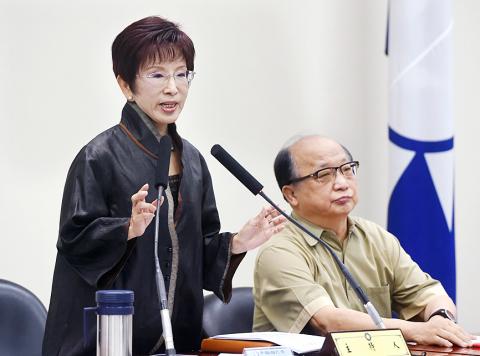
Photo: Liao Chen-huei, Taipei Times
Chow said the KMT headquarters does not rule out forming a special task force in the near future, which would likely be headed by one of the KMT vice chairmen, to work out supplementary measures to ensure that the final decision is made only after careful and thorough consideration.
Chow refused to speculate as to whether such a proposal is aimed at undermining Hung’s power.
Chow was referring to a proposal initiated by KMT Central Standing Committee member Yao Chiang-lin (姚江臨), which has reportedly received the signatures of nearly 100 party representatives and is to be submitted to a KMT national congress for deliberation next month.
Elaborating on his proposal, Yao yesterday said that the idea has been brought up periodically since former president Ma Ying-jeou (馬英九) led the KMT.
“My opinion is that in light of the KMT’s recent spate of electoral defeats, we should place more importance on democracy and the party’s ties with grassroots members,” Yao said.
Yao said chairpeople of the KMT’s local branches would only have to answer to the party leadership if it is the source of their power, but they would be obliged to listen to the opinions of KMT members if they are directly elected.

Yangmingshan National Park authorities yesterday urged visitors to respect public spaces and obey the law after a couple was caught on a camera livestream having sex at the park’s Qingtiangang (擎天崗) earlier in the day. The Shilin Police Precinct in Taipei said it has identified a suspect and his vehicle registration number, and would summon him for questioning. The case would be handled in accordance with public indecency charges, it added. The couple entered the park at about 11pm on Thursday and began fooling around by 1am yesterday, the police said, adding that the two were unaware of the park’s all-day live

A former soldier and an active-duty army officer were yesterday indicted for allegedly selling classified military training materials to a Chinese intelligence operative for a total of NT$79,440. The Taipei District Prosecutors’ Office indicted Chen Tai-yin (陳泰尹) and Lee Chun-ta (李俊達) for contravening the National Security Act (國家安全法) and the Anti-Corruption Act (貪污治罪條例). Chen left the military in September 2013 after serving alongside then-staff sergeant Lee, now an army lieutenant, at the 21st Artillery Command of the army’s Sixth Corps from 2011 to 2013, according to the indictment. Chen met a Chinese intelligence operative identified as “Wang” (王) through a friend in November

Minister of Digital Affairs Lin Yi-ching (林宜敬) yesterday cited regulatory issues and national security concerns as an expert said that Taiwan is among the few Asian regions without Starlink. Lin made the remarks on Facebook after funP Innovation Group chief executive officer Nathan Chiu (邱繼弘) on Friday said Taiwan and four other countries in Asia — China, North Korea, Afghanistan and Syria — have no access to Starlink. Starlink has become available in 166 countries worldwide, including Ukraine, Malaysia, the Philippines and Vietnam, in the six years since it became commercial, he said. While China and North Korea block Starlink, Syria is not
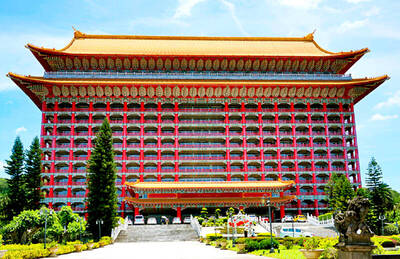
The Grand Hotel Taipei has rejected media reports claiming that the hotel had prevented CBS from broadcasting coverage of the Beijing summit between U.S. President Donald Trump and Chinese President Xi Jinping (習近平) on its premises. Media reports alleging that the hotel owner, dissatisfied with CBS’s coverage, prohibited the network from broadcasting political content on the hotel premises, are not true, the hotel said in a statement issued last night. The reports were “inconsistent with how the hotel actually handled the matter,” it said. The hotel said it received a refund request from a


 RSS
RSS