


Since a flash flood at Taiwan Taoyuan International Airport disrupted services in June, Taichung Mayor Lin Chia-lung (林佳龍) has been pushing for the airport in his city to be upgraded to an international facility, which he said would give travelers more options and help promote regional development.
The central government has promised to assess the feasibility of Lin’s proposal, while public discussions have heated up on the question of whether international flights should be diverted from Taoyuan to other airports.
The issue came to the forefront after a series of problems at Taoyuan airport, including flooding, power outages and leaks of foul-smelling water.
In a bid to capitalize on the situation, city governments have been advocating that Taichung’s Chingchuankang Airport and Kaohsiung International Airport take over some of the nation’s international traffic.
Lin has argued that having international airports in northern, central and southern Taiwan would be in line with the nation’s development trends.
He said Taichung, with its many industries and a population of 2.75 million, needs an international airport.
Upgrading Taichung airport to an international gateway would help ease congestion at Taoyuan airport, Lin said, adding that Taiwan’s airports serve nearly 50 million passengers per year.
He said his proposal was not driven by political expediency, but was rather a well-thought out strategy that would allow the northern, central and southern regions to complement each other and would help achieve balanced regional development.
The proposal is to upgrade the 1,800-hectare Taichung airport to an international gateway, taking some of the traffic that goes to Taoyuan airport, which has reached the limits of its capacity, Lin said.
His views are supported by Lee Ker-tsung (李克聰), a transportation technology and management expert, who said demand has outstripped supply at the 1,223-hectare Taoyuan airport.
If Taoyuan airport wants to maintain smooth and efficient operations of its terminals and runways, it should allow some of its flights to go to other airports, Lee said.
“With the large number of tourists that Taichung gets, it would be an ideal destination for low-cost airlines,” Lee said.
However, Taichung airport would have to make several changes, including expanding its size and improving its facilities, if it is to be upgraded to an international gateway, Lee said.
Some Taichung city councilors pointed to other issues that they said would require attention if an upgrade of Taichung airport was approved.
Taichung City Councilor Chang Fen-yu (張芬郁) said that while she supported the proposal to bring more international flights to Taichung, the city’s airport development might be constrained by factors such as inadequate apron space, narrow taxiways and an restrictions on flights between 11pm and 7am because of noise issues.
Taichung City Councilor Chiang Chao-kuo (江肇國) said better public transportation services would have to be provided between the airport and urban areas of the city, particularly in light of an apparent shift away from group tours and toward independent travel.
Taichung Transportation Bureau Director-General Wang Yi-chuan (王義川) said issues such as those are already being addressed.
As part of an effort to provide more convenient public transportation, the city government has developed a plan to build a 35.8km metro rail system that would link Taichung’s airport and seaport to urban areas, Wang said.
The proposal for the NT$64 billion (US$2.03 billion) metro rail project has been submitted to the Ministry of Transportation and Communications for review next year, he said.
The city is also working to improve its free airport shuttle service, which would allow large groups of tourists, particularly from Hong Kong, Macau, Japan and South Korea, to book shuttle services, Wang said.
Passenger traffic at Taichung airport has grown significantly over the past few years, from 1.28 million in 2010 to 2.34 million last year, while aircraft traffic has increased from 16,503 in 2010 to 26,457 last year, Taichung Deputy Mayor Lin Ling-shan (林陵三) said, adding that the city government has set a goal of 10 million passengers per year after the planned expansion.
Last year, Taichung airport added 11 new routes to its network, with the help of the city government, and now serves 37 destinations, including 26 in China, Taichung Tourism and Travel Bureau Director Chen Sheng-shan (陳盛山) said.
At present, Taichung airport cannot handle heavier international passenger or cargo capacity, as it has only 11 aprons and one runway, which accommodate both military and civilian air traffic, Chen said.
There is room for terminal and runway expansion on the western side of the airport onto a sprawling 121.71 hectares of land, Chen said.
Taichung Airport director Chang Jui-shu (張瑞澍) added that construction of a second runway has started and is expected to be completed by the end of this year, while seven overnight parking bays are to be built next year and in 2018.
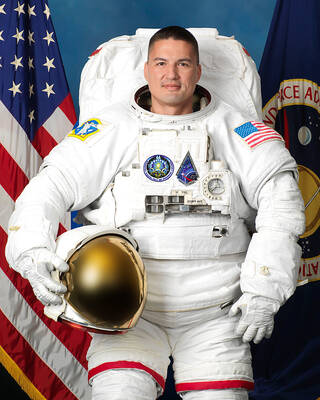
SPACE VETERAN: Kjell N. Lindgren, who helps lead NASA’s human spaceflight missions, has been on two expeditions on the ISS and has spent 311 days in space Taiwan-born US astronaut Kjell N. Lindgren is to visit Taiwan to promote technological partnerships through one of the programs organized by the US for its 250th national anniversary. Lindgren would be in Taiwan from Tuesday to Saturday next week as part of the US Bureau of Educational and Cultural Affairs’ US Speaker Program, organized to celebrate the 250th anniversary of the signing of the Declaration of Independence, the American Institute in Taiwan (AIT) said in a statement yesterday. Lindgren plans to engage with key leaders across the nation “to advance cutting-edge technological partnerships and inspire the next generation of scientists and engineers,”

UNREASONABLE SURVEILLANCE: A camera targeted on an road by a neighbor captured a man’s habitual unsignaled turn into home, netting him dozens of tickets The Taichung High Administrative Court has canceled all 45 tickets given to a man for failing to use a turn signal while driving, as it considered long-term surveillance of his privacy more problematic than the traffic violations. The man, surnamed Tseng (曾), lives in Changhua County and was reported 45 times within a month for failing to signal while driving when he turned into the alley where his residence is. The reports were filed by his neighbor, who set up security cameras that constantly monitored not only the alley but also the door and yard of Tseng’s house. The surveillance occurred from July
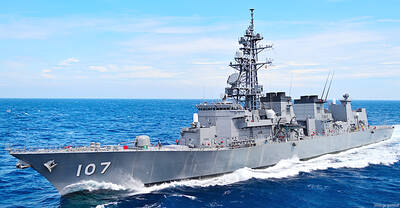
A Japan Self-Defense Forces vessel entered the Taiwan Strait yesterday, Japanese media reported. After passing through the Taiwan Strait, the Ikazuchi was to proceed to the South China Sea to take part in a joint military exercise with the US and the Philippines, the reports said. Japan Self-Defense Force vessels were first reported to have passed through the strait in September, 2024, with two further transits taking place in February and June last year, the Asahi Shimbun reported. Yesterday’s transit also marked the first time since Japanese Prime Minister Sanae Takaichi took office that a Japanese warship has been sent through the Taiwan
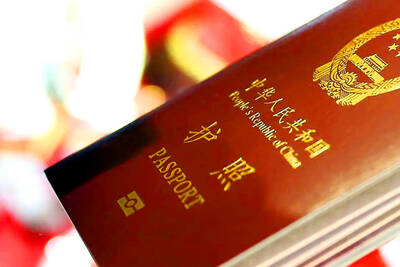
ANOTHER OPTION: The 13-year-old, whose residency status was revoked for holding a Chinese passport, could still apply for residency on humanitarian grounds, the government said The Executive Yuan has rejected an appeal from a 13-year-old Chinese student surnamed Lu (陸), whose permanent residency was revoked after immigration officers discovered he held a Chinese passport. Lu in December 2023 applied to settle in Taiwan to be with his mother, surnamed Lin (林), who is a Taiwan resident, an appeal decision released this month by the Executive Yuan showed. Lin settled in Taiwan after marrying a Taiwanese man in 2003, but the two divorced in 2011, and after marrying a Chinese man, she had Lu, the Executive Yuan’s appeals committee said. Lu’s application was approved in December 2024, and in


 RSS
RSS