


University of California, Los Angeles (UCLA) professor James Liao (廖俊智), the new head of Academia Sinica, on Monday said he felt the responsibility of “going home to help deal with problems.”
Morale at Academia Sinica, the nation’s top research institution, has sagged in recent months, as its previous president, Wong Chi-huey (翁啟惠), has been embroiled in a conflict of interest and insider trading scandal, and was eventually forced to step down last month.
In his first public appearance since being named to the post, Liao spoke at a news conference for Chinese-language media in Los Angeles about how he plans to lead the embattled institution and the responsibility that comes with the job.
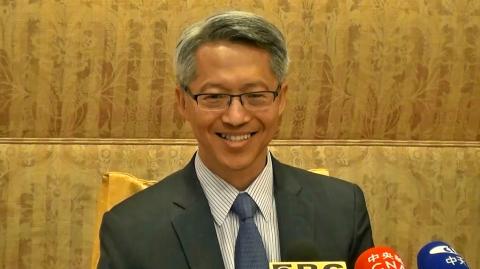
Photo: CNA
Liao said his main principle in addressing problems would be sincerity, which he said “helps solve problems more easily.”
He said he intends to step up communication with younger people and give them opportunities, and expects to talk to senior academics and listen to different views on the institution’s direction.
The screening process for finding Wong’s replacement, conducted by a panel of Academia Sinica members, was said to be fractious, with different factions backing different candidates, and Liao acknowledged that mending fences would be part of his job.
All the views, even if they reflected different approaches and understandings, were “for the good of Academia Sinica and the good of Taiwan,” Liao said, adding that he was sure that with an open mind and open exchange of views, they could gradually find a “common direction.”
Liao specializes in synthetic biology and has received awards for advances in the metabolic engineering of microorganisms to produce fuels and chemicals. He was asked if he would bring his research to Taiwan.
He said that he would not only bring the technology, but the overall research approach to Taiwan, adding that it was most important to introduce the concepts and systems as a reference for the nation.
Amid reports that he was close to the previous two Academia Sinica presidents, Nobel laureate Lee Yuan-tseh (李遠哲) and Wong, Liao said he barely knew them, having had only limited contact with them in professional settings.
Given Wong’s legal entanglements with biotechnology company OBI Pharma Inc, Liao was asked if he held shares in any companies.
Liao said he holds shares in a company that received a technology transfer from UCLA, but has no role in its operations.
No specific company was named at the news conference, but Liao is identified on the Web site of biotechnology company Easel Biotechnologies as a cofounder.
Liao was also asked about his dual Taiwanese-US citizenship, which is usually frowned upon for government officials.
He said that dual nationality was not a problem for Academia Sinica presidents based on the Nationality Act (國籍法) passed in 2006.
As for his current status, Liao said he has been given a leave of absence from UCLA to take the post in Taiwan, but is still advising some students studying for doctoral degrees at the university.
Asked if he would assume his post before July 1, he said he was not sure, because there were still several things he had to tie up at UCLA in a short amount of time.
Liao, 58, graduated from National Taiwan University and holds a doctorate from the University of Wisconsin-Madison.
He serves as chair of the Department of Chemical and Biomolecular Engineering at UCLA, and was elected to the National Academy of Engineering in 2013, the National Academy of Sciences last year and the National Academy of Inventors this year in the US.

FUKUOKA SITUATION: Japanese media reported that the pathogen is expected to be identified by the summer, while the CDC downplayed the idea that it was hMPV A “mysterious cold-like illness” reported in Japan’s Fukuoka Prefecture does not seem to be a new disease, but Japanese authorities have been asked about the situation, the Centers for Disease Control (CDC) said yesterday. The Fukuoka Prefectural Medical Association on Wednesday told a news conference that a “mystery cold” that has become a hot topic on social media is “highly likely to be caused by some kind of viral infection,” Japan’s KBC News reported. “Many people are experiencing symptoms starting with a sore throat, followed by a runny nose, phlegm and a severe cough,” KBC News reported, citing association officials. Health authorities are

Nvidia Corp CEO Jensen Huang (黃仁勳) arrived in Taiwan yesterday ahead of upcoming AI and technology events, saying he plans to meet with clients and Taiwan Semiconductor Manufacturing Co Chairman C.C. Wei (魏哲家) during his visit. After landing at Taipei Songshan Airport, Huang posed for photos with fans and handed out Yakult drinks to reporters and supporters waiting at the scene, saying he has “a lot to do” during the trip. Asked about reports that Nvidia’s planned headquarters site in Taipei’s Beitou Shilin Technology Park could break ground on May 27, Huang said that if the company holds an event, he would

The Ministry of Finance this afternoon announced the winning numbers for the March-April uniform invoice lottery. The winning number for the NT$10 million (US$318,060) special prize is 19531471, and the winning number for the NT$2 million grand prize is 85941329. Three numbers were drawn for the NT$200,000 first prize: 07225810, 20231230 and 83518781. Those with receipts matching the last seven digits of any of the first-prize numbers will win the NT$40,000 second prize, while those matching the last six digits will win the NT$10,000 third prize. Those whose receipts match the last five digits of the first-prize numbers can claim the NT$4,000 fourth prize,
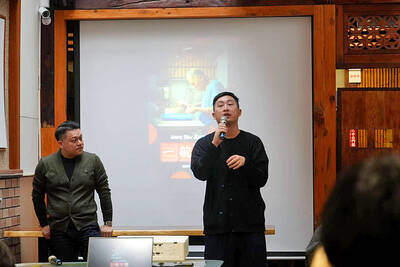
Taiwan Travelogue (臺灣漫遊錄), which earlier this week became the first Taiwanese novel to win the International Booker Prize, is to be adapted into a television series through a Taiwan-Japan coproduction, producer Chang Chen-yu (張辰漁) said yesterday. Chang, a producer at World Softest Production Film Co, wrote on Facebook that the company had been searching for projects with international appeal that retain a strong Taiwanese identity after colleagues and Japanese partners strongly recommended the novel. After reading the book, Chang said he immediately decided to pursue the screen rights. “A great story has the power to transcend time and borders, and connect countless people,”


 RSS
RSS