


Poor implementation has dampened the effect of amendments to the Labor Standards Act (勞動基準法) mandating a 40-hour work week, union activists said yesterday, calling for stronger restrictions on overtime.
A household survey conducted by the Ministry of Labor showed that since the legal work week was cut by two hours in January, average weekly work hours fell to 43.15 hours for the January-to-April period compared with 43.53 hours in December last year, Taiwan Higher Education Union department director Lin Po-yi (林柏儀) said, attributing the muted effect to lax overtime regulations.
Compared with the same period last year, average weekly working hours between January and last month fell by roughly 0.8 hours, with the new mandate affecting about 40 percent of workers, according to ministry statistics.
“What is relevant is the effect immediately before and after the new rules came into effect — and that has not been substantial,” Lin said, adding that a gradual reduction trend in work hours before the new rules came into effect made direct month-on-month comparisons with last year misleading.
Ministry plans to cut seven national holidays following implementation of the amendments have been controversial, with the Legislative Yuan last month passing a resolution requiring the ministry to reformulate plans after activists said that loopholes in the new rules would lead to an overall sacrifice of worker interests.
Lin said that while ministry proposals to mandate an additional weekly day off on top of the existing mandatory holidays would discourage employers from spreading shifts over six days, it still would not address union concerns that the overall cuts in overtime rates would prevent the new rules from leading to a substantial reduction in working hours.
“If the ministry changes rules to mandate one official day off and one vacation day each, the amount of overtime pay people would be eligible for would actually drop,” Lin said. “You cannot use a new weekly vacation day as an excuse to cut national holidays.”
As act rules mandate that workers be paid for every day of the month — including days off — overtime pay is calculated based on a 30-day work month, leading to overtime pay that is only marginally higher than workers’ regular salaries, he said.
Low labor inspection coverage, coupled with weak unions and loopholes preventing act restrictions from being applied to certain jobs would also make it difficult to force substantial reductions of national working hours, he said.
Department of Labor Standards and Equal Employment Deputy Director Huang Wei-chen (黃維琛) said that seasonal differences in the industrial work cycle mean that it is still too early to know how much of an effect the mandate has had, adding that an average of three hours of weekly overtime was within an “acceptable range.”
While the union is correct that overall overtime pay would be cut under the formula, if the seven national holiday were eliminated, the ministry would mandate an additional weekly “vacation day,” he said, adding that the ministry is considering changes to the overtime pay formula.

The military has spotted two Chinese warships operating in waters near Penghu County in the Taiwan Strait and sent its own naval and air forces to monitor the vessels, the Ministry of National Defense (MND) said. Beijing sends warships and warplanes into the waters and skies around Taiwan on an almost daily basis, drawing condemnation from Taipei. While the ministry offers daily updates on the locations of Chinese military aircraft, it only rarely gives details of where Chinese warships are operating, generally only when it detects aircraft carriers, as happened last week. A Chinese destroyer and a frigate entered waters to the southwest
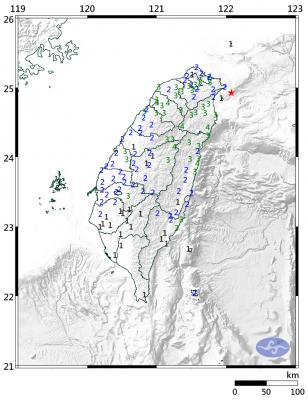
A magnitude 6.1 earthquake struck off the coast of Yilan County at 8:39pm tonight, the Central Weather Administration (CWA) said, with no immediate reports of damage or injuries. The epicenter was 38.7km east-northeast of Yilan County Hall at a focal depth of 98.3km, the CWA’s Seismological Center said. The quake’s maximum intensity, which gauges the actual physical effect of a seismic event, was a level 4 on Taiwan’s 7-tier intensity scale, the center said. That intensity level was recorded in Yilan County’s Nanao Township (南澳), Hsinchu County’s Guansi Township (關西), Nantou County’s Hehuanshan (合歡山) and Hualien County’s Yanliao (鹽寮). An intensity of 3 was

Japanese Prime Minister Sanae Takaichi’s comment last year on Tokyo’s potential reaction to a Taiwan-China conflict has forced Beijing to rewrite its invasion plans, a retired Japanese general said. Takaichi told the Diet on Nov. 7 last year that a Chinese naval blockade or military attack on Taiwan could constitute a “survival-threatening situation” for Japan, potentially allowing Tokyo to exercise its right to collective self-defense. Former Japan Ground Self-Defense Force general Kiyofumi Ogawa said in a recent speech that the remark has been interpreted as meaning Japan could intervene in the early stages of a Taiwan Strait conflict, undermining China’s previous assumptions
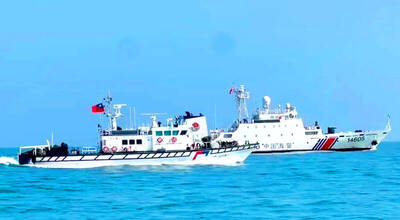
Instead of focusing solely on the threat of a full-scale military invasion, the US and its allies must prepare for a potential Chinese “quarantine” of Taiwan enforced through customs inspections, Stanford University Hoover fellow Eyck Freymann said in a Foreign Affairs article published on Wednesday. China could use various “gray zone” tactics in “reconfiguring the regional and ultimately the global economic order without a war,” said Freymann, who is also a nonresident research fellow at the US Naval War College. China might seize control of Taiwan’s links to the outside world by requiring all flights and ships entering or leaving Taiwan


 RSS
RSS