


An endangered Siberian crane which got lost and accidentally migrated to a northern Taiwan wetland in December 2014 was seen on a riverbank in northern Taiwan yesterday, birdwatchers said.
Taiwan Ecological Engineering Development Foundation deputy executive director Chiu Ming-yuan (邱銘源) said the crane was seen with three oriental white storks in New Taipei City’s Jinshan District (金山), where it has made its home.
At noon on Wednesday, the crane, nicknamed “Jinshan Little White Crane,” and the three storks were seen flying together, before they soared to a height where they were not visible to the naked eye.
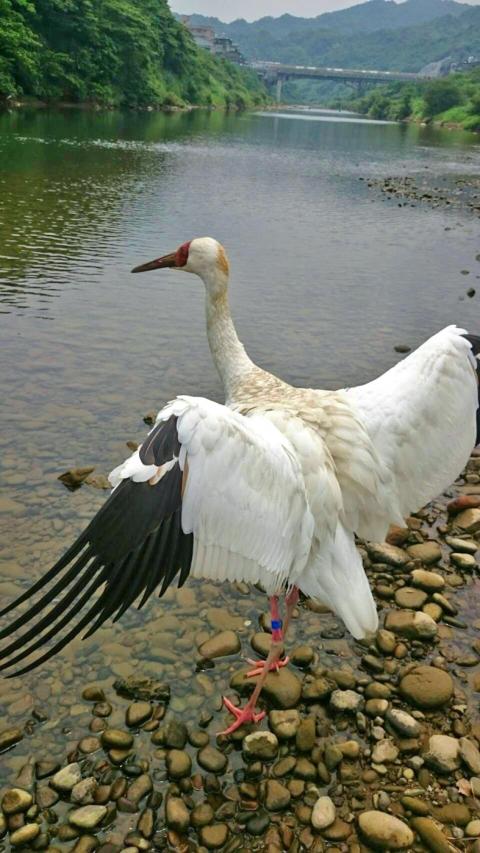
Photo courtesy of Chen Chih-ming
When last seen, the birds were flying in the direction of New Taipei City’s Yeliou District (野柳) on the northeastern coast.
Birdwatchers speculated that the crane might take advantage of the last southerly winds of the year and make the 9,600km journey home with the storks.
However, birdwatchers later reported that the four birds did not go out to sea, but stopped on a riverbank in a mountainous area of Keelung. The bird was identifiable because it has been fitted with a blue plastic ring around its left leg.
The three storks were then spotted along the Sijhih (汐止) section of the Keelung River (基隆河).
One netizen said that since the white crane is not shy of people and is said to have had close interactions with farmers and visitors, this could put its life in danger.
Another netizen expressed mixed feelings, saying that while he hopes the bird can return to Siberia, he also wants it to remain in Taiwan.
The crane, which is about two years old, arrived at Jinshan District’s Cingshuei Wetlands (清水濕地) on Dec. 13, 2014.
During its more than 500 days in Jinshan, the crane has shown a particular affinity for the rice paddies of farmer Huang Cheng-chun (黃正俊), who was prompted to change his cultivation methods and stop using pesticides.
The arrival of the bird — a species that is in danger of extinction — immediately drew attention, as it was the first time that a Siberian crane had been seen in Taiwan.

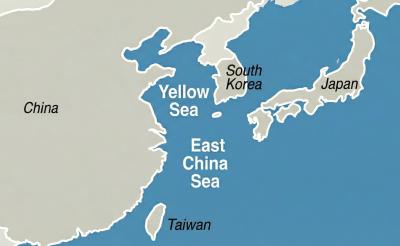
China has reserved offshore airspace in the Yellow Sea and East China Sea from March 27 to May 6, issuing alerts usually used to warn of military exercises, although no such exercises have been announced, the Wall Street Journal (WSJ) reported yesterday. Reserving such a large area for 40 days without explanation is an “unusual step,” as military exercises normally only last a few days, the paper said. These alerts, known as Notice to Air Missions (Notams), “are intended to inform pilots and aviation authorities of temporary airspace hazards or restrictions,” the article said. The airspace reserved in the alert is

NAMING SPAT: The foreign ministry called on Denmark to propose an acceptable solution to the erroneous nationality used for Taiwanese on residence permits Taiwan has revoked some privileges for Danish diplomatic staff over a Danish permit that lists “Taiwan” as “China,” Eric Huang (黃鈞耀), head of the Ministry of Foreign Affairs’ Department of European Affairs, told a news conference in Taipei yesterday. Reporters asked Huang whether the Danish government had responded to the ministry’s request that it correct the nationality on Danish residence permits of Taiwanese, which has been listed as “China” since 2024. Taiwan’s representative office in Denmark continues to communicate with the Danish government, and the ministry has revoked some privileges previously granted to Danish representatives in Taiwan and would continue to review

More than 6,000 Taiwanese students have participated in exchange programs in China over the past two years, despite the Mainland Affairs Council’s (MAC) “orange light” travel advisory, government records showed. The MAC’s publicly available registry showed that Taiwanese college and university students who went on exchange programs across the Strait numbered 3,592 and 2,966 people respectively. The National Immigration Agency data revealed that 2,296 and 2,551 Chinese students visited Taiwan for study in the same two years. A review of the Web sites of publicly-run universities and colleges showed that Taiwanese higher education institutions continued to recruit students for Chinese educational programs without

A bipartisan group of US senators has introduced a bill to enhance cooperation with Taiwan on drone development and to reduce reliance on supply chains linked to China. The proposed Blue Skies for Taiwan Act of 2026 was introduced by Republican US senators Ted Cruz and John Curtis, and Democratic US senators Jeff Merkley and Andy Kim. The legislation seeks to ease constraints on Taiwan-US cooperation in uncrewed aerial systems (UAS), including dependence on China-sourced components, limited access to capital and regulatory barriers under US export controls, a news release issued by Cruz on Wednesday said. The bill would establish a "Blue UAS


 RSS
RSS