


The Taiwan Glass Gallery in Changhua County’s Lukang Township (鹿港) not only offers visitors the opportunity to walk through a spectacular 72m glass tunnel, but it has also provided a lifeline to the region’s rubber slipper industry.
The gallery is one of Lukang’s major tourist destinations, with an average of 10,000 visitors per day.
However, its delicate exhibits — including the “Golden Tunnel,” assembled from 3,600 glass mirrors — require visitors to tread softly and wear rubber slippers — provided by the gallery.
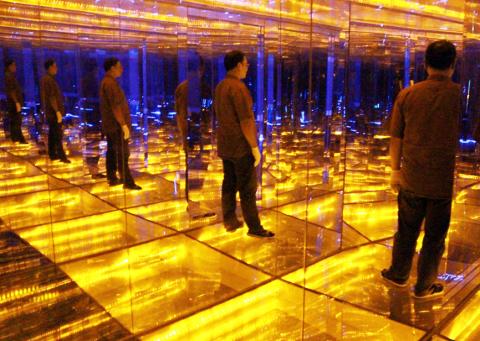
Photo: Chen Kuan-bei, Taipei Times
Taiwan Glass Gallery owner and Taiwan Mirror Glass Enterprise Co chief executive Jackson Lin (林肇睢) said the idea of helping slipper manufacturers while paying homage to the glass trade came to him when a rubber slipper factory owner asked for his help.
“About 10 years ago, Taiwanese enterprises began ‘going west’ and moving their plants to China, and those who did not have the capital got left behind,” Lin said. “One day, this man surnamed Wang (王), who runs a rubber slipper factory, came asking for my help to save his industry.”
Lin said that after some brainstorming, he realized that the Golden Tunnel often had its glass mirrors scratched or shattered by visitors’ shoes, and that he could honor Wang’s request and save on overheads if they worked together.
“So I told Wang to do some research and development on adding an anti-slipping surface, shock-absorption padding and a wear-resistant sole to slippers,” Lin said, adding that he specified the slippers should be blue and white, the traditional colors of Taiwan’s slippers.For NT$50, visitors to the Taiwan Glass Gallery can go home with a practical pair of locally made souvenir slippers, that would cost NT$65 on the market, and help manufacturing stay in the nation, Lin said.
The Golden Tunnel uses an optical illusion generated by its winnowing mirror passage to create the impression that it is suspended 30 meters in the air, Lin said, adding that other attractions include the Seven-Colored Glass Temple and many other objects fashioned from glass.

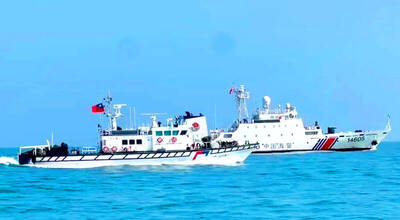
The military has spotted two Chinese warships operating in waters near Penghu County in the Taiwan Strait and sent its own naval and air forces to monitor the vessels, the Ministry of National Defense (MND) said. Beijing sends warships and warplanes into the waters and skies around Taiwan on an almost daily basis, drawing condemnation from Taipei. While the ministry offers daily updates on the locations of Chinese military aircraft, it only rarely gives details of where Chinese warships are operating, generally only when it detects aircraft carriers, as happened last week. A Chinese destroyer and a frigate entered waters to the southwest
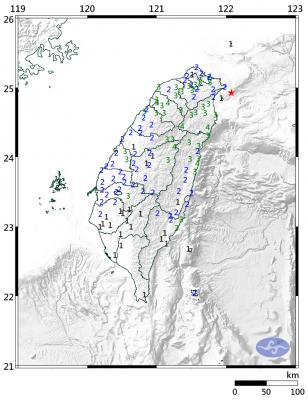
A magnitude 6.1 earthquake struck off the coast of Yilan County at 8:39pm tonight, the Central Weather Administration (CWA) said, with no immediate reports of damage or injuries. The epicenter was 38.7km east-northeast of Yilan County Hall at a focal depth of 98.3km, the CWA’s Seismological Center said. The quake’s maximum intensity, which gauges the actual physical effect of a seismic event, was a level 4 on Taiwan’s 7-tier intensity scale, the center said. That intensity level was recorded in Yilan County’s Nanao Township (南澳), Hsinchu County’s Guansi Township (關西), Nantou County’s Hehuanshan (合歡山) and Hualien County’s Yanliao (鹽寮). An intensity of 3 was

Japanese Prime Minister Sanae Takaichi’s comment last year on Tokyo’s potential reaction to a Taiwan-China conflict has forced Beijing to rewrite its invasion plans, a retired Japanese general said. Takaichi told the Diet on Nov. 7 last year that a Chinese naval blockade or military attack on Taiwan could constitute a “survival-threatening situation” for Japan, potentially allowing Tokyo to exercise its right to collective self-defense. Former Japan Ground Self-Defense Force general Kiyofumi Ogawa said in a recent speech that the remark has been interpreted as meaning Japan could intervene in the early stages of a Taiwan Strait conflict, undermining China’s previous assumptions
Instead of focusing solely on the threat of a full-scale military invasion, the US and its allies must prepare for a potential Chinese “quarantine” of Taiwan enforced through customs inspections, Stanford University Hoover fellow Eyck Freymann said in a Foreign Affairs article published on Wednesday. China could use various “gray zone” tactics in “reconfiguring the regional and ultimately the global economic order without a war,” said Freymann, who is also a nonresident research fellow at the US Naval War College. China might seize control of Taiwan’s links to the outside world by requiring all flights and ships entering or leaving Taiwan


 RSS
RSS