


Proposed self-government legislation for Aboriginal groups drew competing protests from Aboriginal activists yesterday.
Protesters from the Indigenous Youth Front faced off against a smaller group of older Aboriginal representatives led by a Chinese Nationalist Party (KMT) county councilor outside the Legislative Yuan.
The demonstrators shouted competing slogans before laying out their contrasting positions on the adequacy of the “Indigenous Self-Rule Temporary Regulations” (原住民族自治暫行條例) under consideration by the legislature.
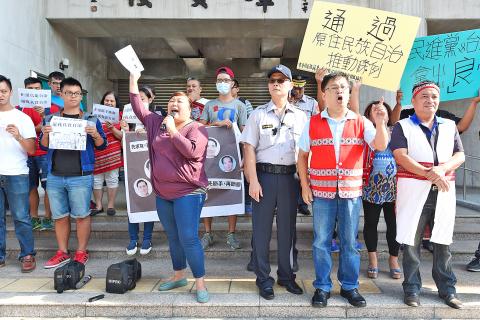
Photo: Liao Chen-huei, Taipei Times
Indigenous Youth Front protesters said that the bill would only allow for “bird cage” self-government, which they described as “crippled” and “fake.”
“This is not self-government — it is the functions of the Council of Indigenous Peoples being outsourced to villages,” Front member Savungaz Valincinan said, criticizing the law’s focus on culture and education, while failing to protect hunting rights and allow Aborigines to draft their own criminal and civil law.
“What self-rule should look like should be discussed and determined by villages,” she said. “Right now, the executive branch has pegged us into their pre-prepared frame.”
Valincinan said that the representative electoral system of government prescribed by the act would not square with the customs of all Aborigines, citing the example of the Amis, who she said traditionally divide different tribal responsibilities based on age.
In contrast to the act’s emphasis on adversarial majority rule, many Aboriginal communities favor a “collegial system” focusing on achieving an absolute consensus on major decisions, she said.
Front member Juan Chun-ta (阮俊達) said that the funding provided under the act was inadequate.
The budget for the “self-governments” to be established would be allocated directly by the Executive Yuan for the next 10 years, after which a “Self-Government Fund” worth NT$10 billion (US$306 million) would be established to fund future expenses.
“That figure is extremely small,” he said. “There is no way you can do much with that amount of revenue.”
He said that the annual budget of the Council of Indigenous Peoples is more than NT$8 billion, while the yearly budget of Chiayi City is NT$11 billion, even though its population is less than half of the nation’s Aborigines.
A group of older protesters led by KMT Hsinchu County Councilor Obay a Awi (趙一先) said that the bill would be a beginning that could lay the foundation for more substantial self-government.
Obay said that the bill was intended to help Aborigines learn the “basic motions” of self-government, rather than establishing the final framework.
He said that it would provide a source of legal authority for existing Aboriginal assemblies, while allowing their members to focus full time on drafting and discussing permanent self-government proposals.
He added that while he did not disagree with the competing protesters’ desire for broader self-government than that contained in the draft bill, he felt that their opposition was not “prudent” because there is no guarantee that a more far-reaching bill would pass if the current one were rejected.

Yangmingshan National Park authorities yesterday urged visitors to respect public spaces and obey the law after a couple was caught on a camera livestream having sex at the park’s Qingtiangang (擎天崗) earlier in the day. The Shilin Police Precinct in Taipei said it has identified a suspect and his vehicle registration number, and would summon him for questioning. The case would be handled in accordance with public indecency charges, it added. The couple entered the park at about 11pm on Thursday and began fooling around by 1am yesterday, the police said, adding that the two were unaware of the park’s all-day live

Fast food chain McDonald's is to raise prices by up to NT$5 on some products at its restaurants across Taiwan, starting on Wednesday next week, the company announced today. The prices of all extra value meals and sharing boxes are to increase by NT$5, while breakfast combos and creamy corn soup would go up by NT$3, the company said in a statement. The price of the main items of those meals, if ordered individually, would remain the same. Meanwhile, the price of a medium-sized lemon iced tea and hot cappuccino would rise by NT$3, extra dipping sauces for chicken nuggets would go up
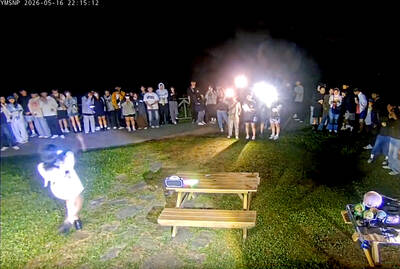
Yangmingshan National Park’s Qingtiangang (擎天崗) nature area has gone viral after a park livestream camera observed a couple in the throes of intimate congress, which was broadcast live on YouTube, drawing large late-night crowds and sparking a backlash over noise, bright lights and disruption to wildlife habitat. The area’s livestream footage appeared to show a couple engaging in sexual activity on a picnic table in the park on Friday last week, with the uncensored footage streamed publicly online. The footage quickly spread across social media, prompting a tide of visitors to travel to the site to “check in” and recreate the

Minister of Digital Affairs Lin Yi-ching (林宜敬) yesterday cited regulatory issues and national security concerns as an expert said that Taiwan is among the few Asian regions without Starlink. Lin made the remarks on Facebook after funP Innovation Group chief executive officer Nathan Chiu (邱繼弘) on Friday said Taiwan and four other countries in Asia — China, North Korea, Afghanistan and Syria — have no access to Starlink. Starlink has become available in 166 countries worldwide, including Ukraine, Malaysia, the Philippines and Vietnam, in the six years since it became commercial, he said. While China and North Korea block Starlink, Syria is not


 RSS
RSS