


“Touring beautiful Taiwan” is what pop diva Jody Chiang (江蕙) said she plans to do following her retirement from the stage.
Chiang wrapped up her 44-year career on Sunday evening with the final show in a 25-concert farewell tour that was marked by copious amounts of tears onstage and in the audience.
“The microphone in my hand was my toy when I was a child. It is the most valuable thing in my life, but after tonight it no longer belongs to me,” the 54-year-old singer said at the Kaohsiung Arena.

Photo: CNA
“There have been hardships, but also people who helped me along the way,” she said, thanking those who mentored her throughout her career.
“I believe that my parents would have been pleased to see the amount of love I received from everyone. God gave me this voice and made me the luckiest person in the world,” Chiang said before breaking down in tears.
Chiang announced on Jan. 2 that she was going to retire after staging a 16-concert farewell tour.

Photo: CNA
There was such a buying frenzy when the three-day window for ticket sales opened that fans overwhelmed the official ticketing site and convenience store ticketing kiosks, drawing widespread complaints. Chiang later announced she would add nine concerts to the tour to cope with the demand.
Her farewell tour began with a concert at the Taipei Arena on July 25.
To symbolize the end of her career, at the end of the concert on Sunday, Chiang placed one of her favorite microphones in a embellished glass casket, locked with box with a key and threw the key out into the audience.
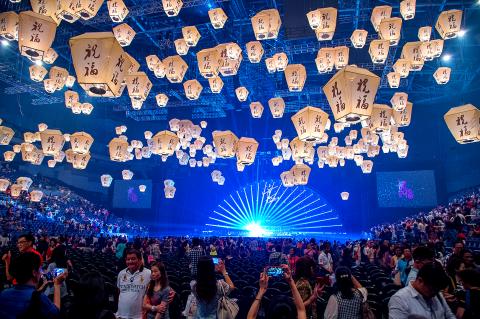
Photo: Chang Chung-i, Taipei Times
About 10,000 keys then showered the stage from the arena’s rooftop.
In a recent interview with the Liberty Times (the Taipei Times’ sister newspaper), Chiang, when asked how she fared over the 51-day span of the concerts, said it was the most confusing and tumultuous period of her career.
She said that when she made the decision to retire, it was simply to give herself a calm, quiet life, but preparing for the tour was so stressful that it left her often unable to sleep well or eat properly for most of the year.
“I did not expect my decision to have such impact,” Chiang said, referring to many fans who said their lives now felt off-kilter in the wake of her decision to retire.
The number of elderly people who made their first visit to the Taipei Arena to attend one of her farewell concerts, many of them in wheelchairs pushed by their children, had deeply moved her, Chiang said, adding that the images were burned into her memory.
“Seeing those images, I was disturbed and felt it would be hard to let go,” Chiang said, adding that she began to wonder if her decision to retire from the stage might have been too selfish.
The continuous entreaties by fans to keep singing made her feel even guiltier, she said, adding that she often could not sleep after the concerts, wondering if she had made the right decision in retiring.
However, words are like water, which cannot be taken back once thrown out, she said.
Born in 1961, Chiang began her singing career at the age of 10 by entertaining patrons at bars to supplement the earnings of her father and mother, a budaixi (布袋戲, glove theater) puppet maker and a food vendor respectively.
She released close to 60 albums and more than 800 songs, and is often credited for championing Hoklo (also known as Taiwanese) songs at a time when Mandarin pop music was the mainstream on the airwaves.
Asked what she intended to do in retirement, Chiang said that while the question had bothered her fans, it was one that she kept asking as well.
Given that 54 is a fairly young to retire, she has plenty of years ahead of her, so she initially thought about doing charity work, perhaps using some of the money from her farewell concerts to establish a public welfare fund, Chiang said.
However, she learned that establishing such a fund is complicated and time-consuming and that she would need additional funding for long-term projects, she said.
So for now she has volunteered to be a “lifetime spokesperson” for the Pxmart welfare foundation, Chiang said.
She said that as a celebrity, she was in the habit of staying at home and being extra careful whenever she left, but now that her career is ending she could go back to being just “a common person named Chiang Hui.”
Chiang said she planned to rest, and then travel around Taiwan.
Additional reporting by CNA

Considering that most countries issue more than five denominations of banknotes, the central bank has decided to redesign all five denominations, the bank said as it prepares for the first major overhaul of the banknotes in more than 24 years. Central bank Governor Yang Chin-lung (楊金龍) is expected to report to the Legislative Yuan today on the bank’s operations and the redesign’s progress. The bank in a report sent to the legislature ahead of today’s meeting said it had commissioned a survey on the public’s preferences. Survey results showed that NT$100 and NT$1,000 banknotes are the most commonly used, while NT$200 and NT$2,000

A NT$39 receipt for two bottles of tea at a FamilyMart was among the NT$10 million (US $312,969) special prize winners in the January-February uniform invoice lottery. FamilyMart said that two NT$10 million-winning receipts were issued at its stores, as well as two NT$2 million grand prizes and three NT$200,000 first prizes. The two NT$10 million receipts were issued at stores in Pingtung County and Yilan County’s Dongshan Township (冬山). One winner spent just NT$39 on two bottles of tea, while another spent NT$80 on water, tea and coffee, the company said. Meanwhile, 7-Eleven reported three NT$10 million winners — in New Taipei

The Centers for Disease Control (CDC) yesterday reported the first case of a new COVID-19 subvariant — BA.3.2 — in a 10-year-old Singaporean girl who had a fever upon arrival in Taiwan and tested positive for the disease. The girl left Taiwan on March 20 and the case did not have a direct impact on the local community, it said. The WHO added the BA.3.2 strain to its list of Variants Under Monitoring in December last year, but this was the first imported case of the COVID-19 variant in Taiwan, CDC Deputy Director-General Lin Ming-cheng (林明誠) said. The girl arrived in Taiwan on

ANNUAL EVENT: Two massive Pokemon balloons are to be set up in Daan Park, with an event zone operating from 10am to 6pm This year’s Taipei Floral Picnic is to be held at Daan Park today and tomorrow, featuring an exclusive Pokemon Go event, a themed food market, a coffee rave picnic area and stage performances, the Taipei Department of Information and Tourism said yesterday. Two massive Pokemon balloons are to be set up in the park as attractions, with an exclusive event zone operating from 10am to 6pm, it said. Participants who complete designated tasks on-site would have a chance to receive limited-edition souvenirs, it added. People could also try the newly launched game Pokemon Pokopia in the trial area, the department said. Three PokeStops are


 RSS
RSS