


The National Applied Research Laboratories (NARL) yesterday unveiled its ocean-bottom seismometer array plan, which it said would help the nation obtain more accurate data about underwater earthquakes and marine geology, while also being capable of analyzing underwater landslides to assess the risks of projects.
The seismometer, named the “YardBird” by developers, was introduced by the institution’s Taiwan Ocean Research Institute in 2010, with technical support from the Academia Sinica and National Sun Yat-sen University, and is capable of diving as deep as 5,000m below sea level, the laboratory said.
NARL assistant engineer Hsiao Yu-Hung (蕭毓宏) said the device uses Faraday’s law of induction by employing an electromagnet to transform movement into electricity that passes through a coil surrounding the magnet, allowing the seismometer to detect vibrations as light as a footstep, he said.
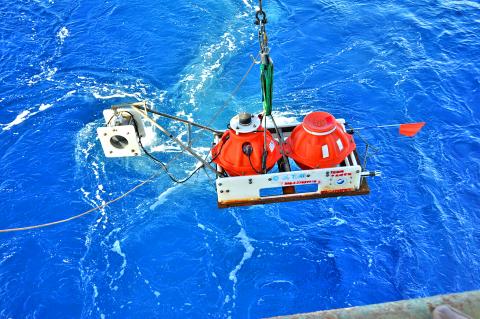
Photo: CNA
Fitted with a microseismometer balancing system — which Hsiao said is the device’s core technology and which was developed and patented in Taiwan — the machine’s sensor self-adjusts its slant so measurements are conducted perpendicular to the seabed, allowing for accurate gauging of earthquakes while minimizing the effects of underwater conditions, he said.
He said that the institution has since 2010 taken measurements with the seismometer from 28 sites in the waters surrounding the nation.
The deepest was conducted on Sept. 6, 2012, in a sea basin off Taitung County, at 4,887m below sea level, he added.
Highlighting the significance of the technology, he said Taiwan ranks No. 2 among all Asian nations in the application of ocean-bottom seismometers, second only to Japan, and that South Korea in 2011 and 2012 borrowed four devices from Taiwan for deployment off its eastern coast for six months.
Canada and China have also approached the nation to discuss possible collaborations, he said.
He said that the laboratory’s seismometer is very cost-efficient, costing about NT$900,000 (US$29,560) a unit. Entry-level ocean-bottom seismometers that can pick up frequencies only within a limited bandwidth usually cost about NT$1 million, while more capable ones can command as much as NT$3.8 million, he said.
The YardBird sits between the two, having wider bandwidth while costing less, he added.
Hsiao said that the lab plans to establish an array of ocean-bottom seismometers from waters off the nation’s northeastern shore to those near its southwestern shore to study seismic activities in the Okinawa Trough and the Manila Trench.
A fleet of 115 ocean-bottom seismometers has been proposed for the array, including five 20-unit groups of retractable seismometers intended for short-term measurements for scientific research and 15 fixed units.
With the array, the institution expects to more accurately measure the speed of shockwaves and better identify the epicenter of earthquakes, he said, adding that the system would also help reduce the risks of underwater projects being carried out in areas prone to submarine landslides.

The military has spotted two Chinese warships operating in waters near Penghu County in the Taiwan Strait and sent its own naval and air forces to monitor the vessels, the Ministry of National Defense (MND) said. Beijing sends warships and warplanes into the waters and skies around Taiwan on an almost daily basis, drawing condemnation from Taipei. While the ministry offers daily updates on the locations of Chinese military aircraft, it only rarely gives details of where Chinese warships are operating, generally only when it detects aircraft carriers, as happened last week. A Chinese destroyer and a frigate entered waters to the southwest
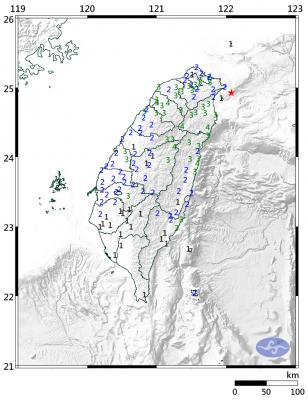
A magnitude 6.1 earthquake struck off the coast of Yilan County at 8:39pm tonight, the Central Weather Administration (CWA) said, with no immediate reports of damage or injuries. The epicenter was 38.7km east-northeast of Yilan County Hall at a focal depth of 98.3km, the CWA’s Seismological Center said. The quake’s maximum intensity, which gauges the actual physical effect of a seismic event, was a level 4 on Taiwan’s 7-tier intensity scale, the center said. That intensity level was recorded in Yilan County’s Nanao Township (南澳), Hsinchu County’s Guansi Township (關西), Nantou County’s Hehuanshan (合歡山) and Hualien County’s Yanliao (鹽寮). An intensity of 3 was

Japanese Prime Minister Sanae Takaichi’s comment last year on Tokyo’s potential reaction to a Taiwan-China conflict has forced Beijing to rewrite its invasion plans, a retired Japanese general said. Takaichi told the Diet on Nov. 7 last year that a Chinese naval blockade or military attack on Taiwan could constitute a “survival-threatening situation” for Japan, potentially allowing Tokyo to exercise its right to collective self-defense. Former Japan Ground Self-Defense Force general Kiyofumi Ogawa said in a recent speech that the remark has been interpreted as meaning Japan could intervene in the early stages of a Taiwan Strait conflict, undermining China’s previous assumptions
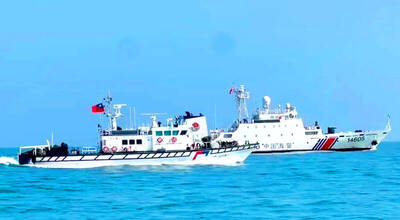
Instead of focusing solely on the threat of a full-scale military invasion, the US and its allies must prepare for a potential Chinese “quarantine” of Taiwan enforced through customs inspections, Stanford University Hoover fellow Eyck Freymann said in a Foreign Affairs article published on Wednesday. China could use various “gray zone” tactics in “reconfiguring the regional and ultimately the global economic order without a war,” said Freymann, who is also a nonresident research fellow at the US Naval War College. China might seize control of Taiwan’s links to the outside world by requiring all flights and ships entering or leaving Taiwan


 RSS
RSS