


A number of anti-smoking advocates yesterday urged the government to regulate electronic cigarettes as a tobacco product rather than a controlled drug to address rampant illegal sales of the device.
The call came one day after the WHO report called for tighter regulation of e-cigarettes, including their use in public places and outlawing tactics to lure young users.
“Electronic cigarettes are a type of cigarette, but some manufacturers market the devices as a healthier alternative to conventional tobacco, which has misled young people into thinking that it is okay to use the product,” Lin Ching-li (林清麗), director of the John Tung Foundation, the nation’s most prominent anti-smoking group, said in a telephone interview.
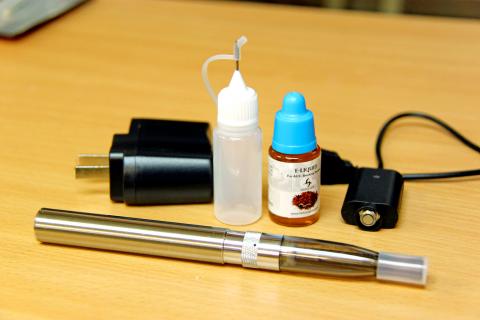
Photo: EPA
The government categorizes e-cigarettes containing nicotine as a regulated drug subject to the Pharmaceutical Affairs Act (藥事法). Due to the stringent requirements for getting a permit to manufacture or sell a drug, no e-cigarettes can be sold in Taiwan.
However, the act only targets manufacturers, importers and sellers of the device, not consumers. The illegal manufacture, import or sale of e-cigarettes is punishable by a maximum prison term of 10 years and a fine not exceeding NT$10 million (US$330,000).
Nicotine-free e-cigarettes are covered by the Tobacco Hazards Prevention Act (菸害防制法), which prohibits the unlicensed manufacture, import and sale of any “candies, snacks, toys or any other object shaped like cigarettes.” Violators could face fines ranging from NT$10,000 to NT$50,000.
Lin said categorizing e-cigarettes as a regulated drug has only prevented them from entering the country legally, because people can still purchase them online, on the street or in night markets.
Foundation chief executive officer Yao Shi-yuan (姚思遠) said the group has received 939 complaints about illegal e-cigarettes over the past five years and he urged the government to stop turning a blind eye to the problem.
“Products that contain nicotine that are not designed for medical purposes should be regulated under the same law as tobacco products. That is the only way to prevent people from selling e-cigarettes, marketing them online, or using them indoors or in public places,” Yao said.
Since the manufacturers would also be required to comply with the packaging and labeling regulations covering conventional cigarettes, people would stop thinking that e-cigarettes are safe to use, he said.
Consumers’ Foundation chairman Mark Chang (張智剛) said categorizing e-cigarettes as a tobacco product is the only way to address the problem.
Wu Ming-mei (吳明美), section head of the Food and Drug Administration’s Northern Center, said the listing of e-cigarettes as a regulated drug in 2009 was meant to prevent them from entering the country.
According to the New York Times, the WHO report expressed “grave concern” about the growing role of the tobacco industry in the e-cigarette market and said the devices should be banned from indoor use “until exhaled vapor is proven to be not harmful to bystanders.”
The report also called for regulation to ensure the products contain a standard dose of nicotine, bans on sales to minors and that fruity, candy-type flavorings be prohibited, the Times said.
Additional reporting by staff writer

Considering that most countries issue more than five denominations of banknotes, the central bank has decided to redesign all five denominations, the bank said as it prepares for the first major overhaul of the banknotes in more than 24 years. Central bank Governor Yang Chin-lung (楊金龍) is expected to report to the Legislative Yuan today on the bank’s operations and the redesign’s progress. The bank in a report sent to the legislature ahead of today’s meeting said it had commissioned a survey on the public’s preferences. Survey results showed that NT$100 and NT$1,000 banknotes are the most commonly used, while NT$200 and NT$2,000

The Centers for Disease Control (CDC) yesterday reported the first case of a new COVID-19 subvariant — BA.3.2 — in a 10-year-old Singaporean girl who had a fever upon arrival in Taiwan and tested positive for the disease. The girl left Taiwan on March 20 and the case did not have a direct impact on the local community, it said. The WHO added the BA.3.2 strain to its list of Variants Under Monitoring in December last year, but this was the first imported case of the COVID-19 variant in Taiwan, CDC Deputy Director-General Lin Ming-cheng (林明誠) said. The girl arrived in Taiwan on

ANNUAL EVENT: Two massive Pokemon balloons are to be set up in Daan Park, with an event zone operating from 10am to 6pm This year’s Taipei Floral Picnic is to be held at Daan Park today and tomorrow, featuring an exclusive Pokemon Go event, a themed food market, a coffee rave picnic area and stage performances, the Taipei Department of Information and Tourism said yesterday. Two massive Pokemon balloons are to be set up in the park as attractions, with an exclusive event zone operating from 10am to 6pm, it said. Participants who complete designated tasks on-site would have a chance to receive limited-edition souvenirs, it added. People could also try the newly launched game Pokemon Pokopia in the trial area, the department said. Three PokeStops are

South Korea is planning to revise its controversial electronic arrival card, a step Taiwanese officials said prompted them to hold off on planned retaliatory measures, a South Korean media report said yesterday. A Yonhap News Agency report said that the South Korean Ministry of Foreign Affairs is planning to remove the “previous departure place” and “next destination” fields from its e-arrival card system. The plan, reached after interagency consultations, is under review and aims to simplify entry procedures and align the electronic form with the paper version, a South Korean ministry official said. The fields — which appeared only on the electronic form


 RSS
RSS