


A young graphic illustrator has earned international recognition by becoming the first Taiwanese to have his work featured on the cover of ImagineFX magazine, a leading monthly journal devoted to science fiction, fantasy and digital art.
Yu Han-yuan (游翰元), 28, is pursuing a master of fine arts degree at the Fashion Institute of Technology in New York. He said he appreciates the honor and the chance to share his work.
The cover of next month’s issue of ImagineFX ,which is already available, features a piece by Yu — an anime-style, adolescent girl wearing elaborate headwear, a purple gown and accoutrements based on motifs from Aboriginal cultures.

Photo courtesy of Yu Han-yuan
The magazine’s cover introduces Yu as the month’s featured artist with a blurb about the feature story that says: “Magic Manga — paint art that pops, with fresh art skills from Taiwan’s Han-yuan Yu.”
On the ImagineFX Web site, it says: “Yu leads the charge. Our cover artist puts a distinctive spin on his trademark manga, adding Aboriginal costumes to create an indelible image, and he shows you how he did it in an in-depth five-page workshop.”
“It is my honor to be a featured artist, as well as the cover artist for ImagineFX. This is a first for a Taiwanese artist,” Yu said. “It is another encouragement for me, and a chance for my craft to be promoted.”
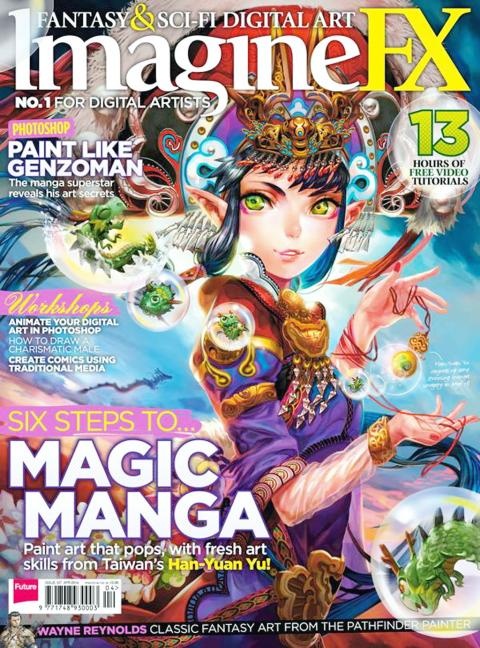
Photo courtesy of Yu Han-yuan
He uses “B.c.N.y.” as a pseudonym, and in the past his works have featured in Taiwan’s Creative Comic Collection Journal, various magazine illustrations and video game graphics.
According to Yu’s Web site, his art has been exhibited at the Morocco International Festival of Animated Film — CASANIM-Digit’Art — and also in Japan, France, New York and Los Angeles.
The UK-based ImagineFX has been in publication since 2006 and is known as the computer-graphic illustrators and digital artists’ bible.
As the news circulated, Taiwan’s digital artist communities cheered Yu’s feat, and congratulations poured in.
“It is wonderful to be recognized on the world stage,” Yu said.
“I was delighted that the magazine’s cover showed clearly that I am from Taiwan,” he added.
Yu said that the image on the cover was inspired by mythology, with baby dragons breaking out from their eggs and the sky turning from twilight to daylight in the background to express the passage of time.
An editor for the magazine described Yu’s artistic ability as “using brilliant colors, interesting compositions and dynamic gestures.”
Yu grew up in a family brimming with artistic talent and has been interested in painting since his childhood. With his academic achievements in high school, Yu said he could have been accepted into Taiwan’s top universities.
He said he followed his passion by enrolling in the Department of Information Communication’s Interactive Entertainment Technology school at Yuan Ze University in Taoyuan County.
“The leading universities are dream schools for Taiwanese students, but that was not for me... People should do what they are really interested in,” Yu said. “Creating and drawing pictures has always been a source of happiness for me. I love to express my inner thoughts through art.”
Yu said that since he was a child, Japanese manga and anime had a major influence on him and later he also developed an affection for the paintings of European masters.
The different genres inspired him to develop his unique style, he said.
“I love many cultures around the world and the artistic styles of ancient civilizations. The cultures of the Maya, Inca and Taiwanese Aborigines also captivate me. I am fascinated by the trails of human history and the cacophony of creation,” he said.
Now in his second year of studies in the US, Yu is looking ahead to stake out his future in the digital art industry.
“I want to keep on cultivating and expressing my own voice, to create a distinctive brand for myself,” he said.
“I hope for more opportunities for Taiwanese illustrators to shine on the world stage,” he added.

Yangmingshan National Park authorities yesterday urged visitors to respect public spaces and obey the law after a couple was caught on a camera livestream having sex at the park’s Qingtiangang (擎天崗) earlier in the day. The Shilin Police Precinct in Taipei said it has identified a suspect and his vehicle registration number, and would summon him for questioning. The case would be handled in accordance with public indecency charges, it added. The couple entered the park at about 11pm on Thursday and began fooling around by 1am yesterday, the police said, adding that the two were unaware of the park’s all-day live

Fast food chain McDonald's is to raise prices by up to NT$5 on some products at its restaurants across Taiwan, starting on Wednesday next week, the company announced today. The prices of all extra value meals and sharing boxes are to increase by NT$5, while breakfast combos and creamy corn soup would go up by NT$3, the company said in a statement. The price of the main items of those meals, if ordered individually, would remain the same. Meanwhile, the price of a medium-sized lemon iced tea and hot cappuccino would rise by NT$3, extra dipping sauces for chicken nuggets would go up

Yangmingshan National Park’s Qingtiangang (擎天崗) nature area has gone viral after a park livestream camera observed a couple in the throes of intimate congress, which was broadcast live on YouTube, drawing large late-night crowds and sparking a backlash over noise, bright lights and disruption to wildlife habitat. The area’s livestream footage appeared to show a couple engaging in sexual activity on a picnic table in the park on Friday last week, with the uncensored footage streamed publicly online. The footage quickly spread across social media, prompting a tide of visitors to travel to the site to “check in” and recreate the

Minister of Digital Affairs Lin Yi-ching (林宜敬) yesterday cited regulatory issues and national security concerns as an expert said that Taiwan is among the few Asian regions without Starlink. Lin made the remarks on Facebook after funP Innovation Group chief executive officer Nathan Chiu (邱繼弘) on Friday said Taiwan and four other countries in Asia — China, North Korea, Afghanistan and Syria — have no access to Starlink. Starlink has become available in 166 countries worldwide, including Ukraine, Malaysia, the Philippines and Vietnam, in the six years since it became commercial, he said. While China and North Korea block Starlink, Syria is not


 RSS
RSS