


The National Taiwan University of Arts’ Department of Architecture Art Conservation has hired a master of wood carving as an honorary associate professor to impart his skills to younger generations.
Hung Yao-hui (洪耀輝), 56, traveled all over the nation as a woodworking apprentice during the temple construction boom of the 1950s and 1960s.
His later work can be seen in Greater Tainan’s Donglung Temple, the Chenghuang Temple in Chiayi County, Yunlin County’s Jhenan Temple, the Puji Temple in Taipei’s Huayin Street and the Chingshui Zushi Temple (清水祖師廟) in New Taipei City’s Sansia District (三峽).
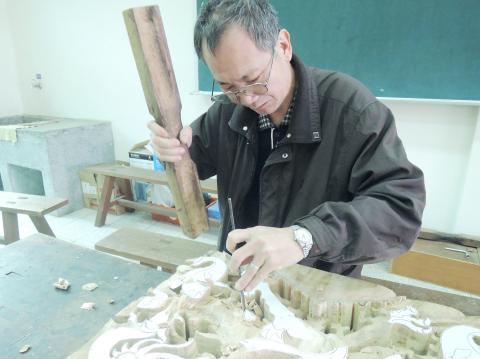
Photo: Tsai Ming-lun, Taipei Times
Born into a family of salt workers in the former Tainan County’s Beimen Township (北門), Hung said his family’s financial situation forced him to seek employment after leaving school.
After his father decided that temple carpentry was a promising career, Hung said he went up north by himself and took an apprenticeship under renowned temple architect Su Hai-ping (蘇海萍).
During the temple boom era, many people vied to study under masters and learn a skilled trade, but earning and completing such apprenticeships was extremely tough, Hung said.
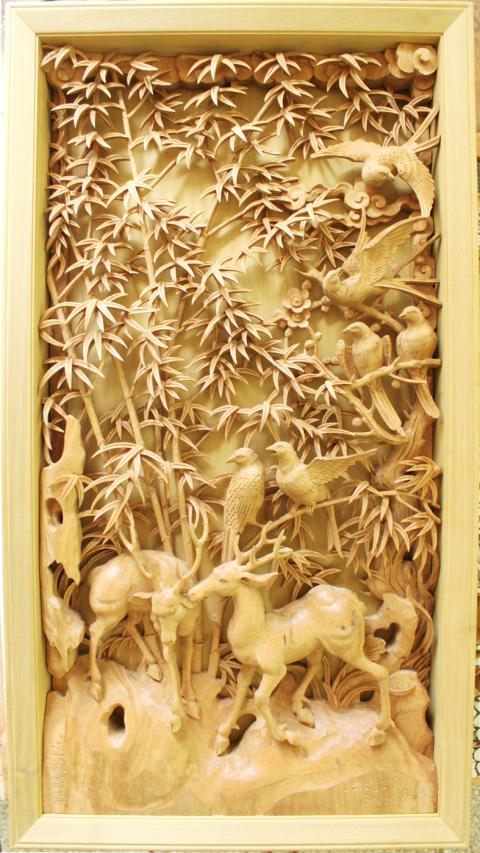
Photo provided by Hung Yao-hui
The apprentices were expected not only to learn a difficult skill, but also be at the constant beck and call of their masters, he said.
“We had to wake up early, clean and cook meals. Then we had at most four to five hours to hone our craft before we turned in at midnight, and would be severely criticized by our teachers if we made any errors,” Hung said.
Hung’s apprenticeship lasted three years and four months, during which he spent a lot of time on the road with his teacher going from project to project.
“It was a difficult time and I once ran away because it was too hard, but my father beat me severely when I returned home and forced to go back,” Hung said.
Despite the hardships he endured, the master carver said the experience shaped him into the hardworking man he is now.
When asked about what he considers to be his best work, Hung unhesitatingly named the Chingshui Zushi Temple in Sansia, citing the tremendous artistic value it gained after being renovated under renowned sculptor Lee Mei-shu (李梅樹) in 1947.
The New Taipei City temple has a long history, having been constructed during the Qing Dynasty, and the first mention of it in verifiable records dates to 1767.
“When I was hired to repair and renovate the temple — an endeavour that took from 1986 to 2001 — I was amazed at the building’s internal decor. The intricacy of the art and the craftsmanship it entailed was mesmerizing,” Hung said.
For the next 15 years, the expert craftsman devoted himself to restoring the temple and even moved his family to Sansia to facilitate his work.
The alcove housing the figurine representing the monk god Chingshui Zushi (清水祖師) for whom the temple is named, the intricately carved bulkheads, a great many of the carved wooden parts jutting out at the corners of the ceiling and many other decorations were made by Hung’s hands.
“I pay the greatest possible attention to detail when doing my carvings,” Hung said, adding that when sculpting dragons for a piece titled Overturning Earth (覆地), the detailing was easy because, since dragons are mythical creatures, they can be interpreted however the artist sees fit.
However, focusing on the minutiae is far more difficult when carving real animals, such as the octopi and lobsters that are also featured in the piece, because people would notice any mistakes to creatures they know, Hung said, adding that he had bought an octopus so he could observe a live specimen while he carved its woodmen replica.
His work at the Chingshui Zushi Temple was the main reason that Wang Ching (王慶), who heads the department of architecture art conservation at the university, to invite Hung to join his faculty staff.
Despite lamenting the lack of commitment to hard work typical of the younger generation, Hung said he accepted the job because he still harbored a glimmer of hope for the youth of today.
“All I can do is pass on my knowledge and expertise; what they do with that is up to them,” Hung said with a resigned yet hopeful air.
He suggested that the government should take a page from its Japanese counterpart and set up schools specializing in teaching students repair and maintenance.
Such schools would not only give students a way in which to provide for themselves, they would also pass down the knowledge of traditional crafts, Hung said.

Actor Darren Wang (王大陸) was sentenced to six months in prison, commutable to a fine, by the New Taipei District Court today for contravening the Personal Data Protection Act (個人資料保護法) in a case linked to an alleged draft-dodging scheme. Wang allegedly paid NT$3.6 million (US$114,380) to an illegal group to help him evade mandatory military service through falsified medical documents, prosecutors said. He transferred the funds to Chen Chih-ming (陳志明), the alleged mastermind of a draft-evasion ring, although he lost contact with him as he was already in detention on fraud charges, they said. Chen is accused of helping a

SECURITY: Starlink owner Elon Musk has taken pro-Beijing positions, and allowing pro-China companies to control Taiwan’s critical infrastructure is risky, a legislator said Starlink was reluctant to offer services in Taiwan because of the nation’s extremely high penetration rates in 4G and 5G services, the Ministry of Digital Affairs said yesterday. The ministry made the comments at a meeting of the legislature’s Transportation Committee, which reviewed amendments to Article 36 of the Telecommunications Management Act (電信管理法). Article 36 bans foreigners from holding more than 49 percent of shares in public telecommunications networks, while shares foreigners directly and indirectly hold are also capped at 60 percent of the total, unless specified otherwise by law. The amendments, sponsored by Chinese Nationalist Party (KMT) Legislator Ko

UNREASONABLE SURVEILLANCE: A camera targeted on an road by a neighbor captured a man’s habitual unsignaled turn into home, netting him dozens of tickets The Taichung High Administrative Court has canceled all 45 tickets given to a man for failing to use a turn signal while driving, as it considered long-term surveillance of his privacy more problematic than the traffic violations. The man, surnamed Tseng (曾), lives in Changhua County and was reported 45 times within a month for failing to signal while driving when he turned into the alley where his residence is. The reports were filed by his neighbor, who set up security cameras that constantly monitored not only the alley but also the door and yard of Tseng’s house. The surveillance occurred from July

‘SAME OLD TRICK’: Even if Beijing resumes individual travel to Taiwan, it would only benefit Chinese tourism companies, the Economic Democracy Union convener said China’s 10 new “incentives” are “sugar-coated poison,” an official said yesterday, adding that Taiwanese businesses see them clearly for what they are, but that Beijing would inevitably find some local collaborators to try to drums up support. The official, speaking on condition of anonymity, made the remark ahead of a news conference the General Chamber of Commerce is to hold today. The event, titled “Industry Perspectives on China’s Recent Pro-Taiwan Policies,” is expected to include representatives from industry associations — such as those in travel, hotels, food and agriculture — to request the government cooperate with China’s new measures, people familiar with


 RSS
RSS