


A group of National Taiwan University (NTU) students have put the spirit of Japan’s Shokuiku food education program into practice by transforming the roof of a school building into a real-life version of FarmVille, a social networking game that simulates farming.
Worried by a report that showed that Japanese children were developing poor eating habits, Tokyo enacted the Basic Law on Shokuiku in 2005 aiming to instil the importance of balanced nutrition and food safety among the public — especially among young people — by promoting food education in schools, at home and in the community.
One of the initiative’s guiding principles is to promote locally grown produce, which is what the university students were aiming to do when they struck upon the idea of turning the 60 ping (198m2) roof of an NTU building into a garden.
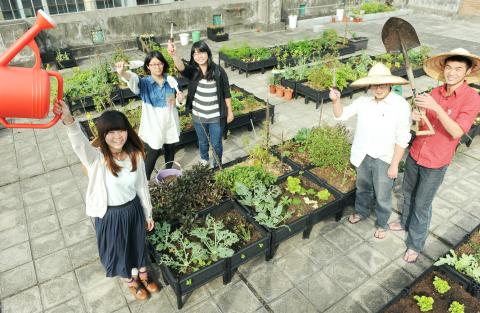
Photo: Wang Min-wei, Taipei Times
The garden has turned out to be a huge success and more than 30 kinds of pesticide-free fruits and vegetables are now being cultivated there.
The idea came to the students when they were put into a group during a class in an elective course titled Innovation and Design of Socio-economic Organizations and tasked with finding a solution to the social problem they cared about the most, said Hsiao Yu-hsin (蕭玉欣), one of the student farmers.
“My classmates and I were most concerned about Taipei’s housing problem, so we asked ourselves: ‘What other purposes can a home serve other than providing a place for its owners to sleep and take showers? Is it feasible to utilize a community’s resources to satisfy the needs of its residents, such as by building a community vegetable garden … or a daycare center?’” Hsiao said.
Hsiao said the group’s interest in the issue was so intense that it did not wane after the course ended and led to them establishing a student club called Jiajiajiu (傢傢久) in an effort to make their ideas reality.
Thanks to a subsidy provided by My Little Wild Campus (大學小革命), a talent cultivation scheme administered by the Ministry of Education, the students were able to execute their plan without having to worry about money.
“When we first started to garden, we thought growing vegetables and fruit would be a piece of cake … but it turns out that even the way in which you water the plants matters significantly,” said Yang Chun-ming (楊淳名), who serves as chief executive of the farming project.
Yang said they got so desperate they even tried out some easy-to-grow crops recommended for beginner gardeners, but even those did not grow fast enough to outpace the pests that consumed them.
Despite the bumpy start, the students continued to devote more time and energy to attending to their garden.
They transferred the plants to elevated planters to prevent them from succumbing to heat and enriched the soil with organic supplements and by covering it with dried leaves.
The group said they made it a point to not use any sort of chemical pesticides.
After they started seeing results, the students began encouraging their junior peers to roll up their sleeves and join in their endeavor.
The NTU group also promoted their Shokuiku-inspired project at a nearby community by offering weekly gardening classes to local residents, who then created a vegetable garden of their own on the roof of their community center.
Hsiao said their short-term goal is to solve two major problems afflicting large cities: insufficient green spaces and declining human-to-human interaction.
“Our long-term plan is to plant a seed in people’s minds that will bring them closer to the soil and help them see the predicaments facing the nation’s agricultural industry so that hopefully, one day, they make better choices when shopping for food,” she said.

The military has spotted two Chinese warships operating in waters near Penghu County in the Taiwan Strait and sent its own naval and air forces to monitor the vessels, the Ministry of National Defense (MND) said. Beijing sends warships and warplanes into the waters and skies around Taiwan on an almost daily basis, drawing condemnation from Taipei. While the ministry offers daily updates on the locations of Chinese military aircraft, it only rarely gives details of where Chinese warships are operating, generally only when it detects aircraft carriers, as happened last week. A Chinese destroyer and a frigate entered waters to the southwest
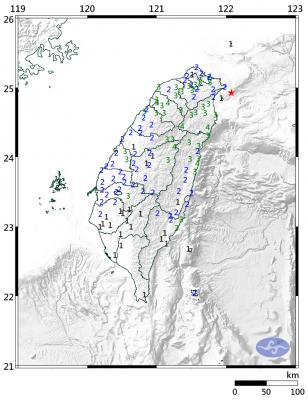
A magnitude 6.1 earthquake struck off the coast of Yilan County at 8:39pm tonight, the Central Weather Administration (CWA) said, with no immediate reports of damage or injuries. The epicenter was 38.7km east-northeast of Yilan County Hall at a focal depth of 98.3km, the CWA’s Seismological Center said. The quake’s maximum intensity, which gauges the actual physical effect of a seismic event, was a level 4 on Taiwan’s 7-tier intensity scale, the center said. That intensity level was recorded in Yilan County’s Nanao Township (南澳), Hsinchu County’s Guansi Township (關西), Nantou County’s Hehuanshan (合歡山) and Hualien County’s Yanliao (鹽寮). An intensity of 3 was

Japanese Prime Minister Sanae Takaichi’s comment last year on Tokyo’s potential reaction to a Taiwan-China conflict has forced Beijing to rewrite its invasion plans, a retired Japanese general said. Takaichi told the Diet on Nov. 7 last year that a Chinese naval blockade or military attack on Taiwan could constitute a “survival-threatening situation” for Japan, potentially allowing Tokyo to exercise its right to collective self-defense. Former Japan Ground Self-Defense Force general Kiyofumi Ogawa said in a recent speech that the remark has been interpreted as meaning Japan could intervene in the early stages of a Taiwan Strait conflict, undermining China’s previous assumptions
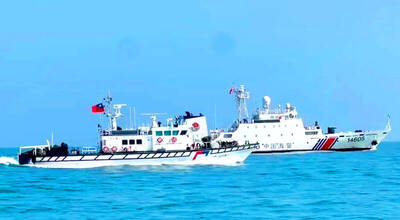
Instead of focusing solely on the threat of a full-scale military invasion, the US and its allies must prepare for a potential Chinese “quarantine” of Taiwan enforced through customs inspections, Stanford University Hoover fellow Eyck Freymann said in a Foreign Affairs article published on Wednesday. China could use various “gray zone” tactics in “reconfiguring the regional and ultimately the global economic order without a war,” said Freymann, who is also a nonresident research fellow at the US Naval War College. China might seize control of Taiwan’s links to the outside world by requiring all flights and ships entering or leaving Taiwan


 RSS
RSS