


A few kilometers off the Chinese coast, Beijing has appointed a Taiwanese citizen as deputy chief of an experimental “common homeland” that is an unusually forward overture to Taipei.
Pingtan island is physically China’s closest spot to Taiwan, and is now also being transformed into its nearest approximation of a unified country, as part of Beijing’s long-held dream to reclaim Taiwan, which it considers a rogue province.
New towers crowd the shoreline and the glow of construction sites fills the night, while Taiwanese are being invited to serve in the government, drive Taiwanese-licensed cars and open Taiwanese currency bank accounts.
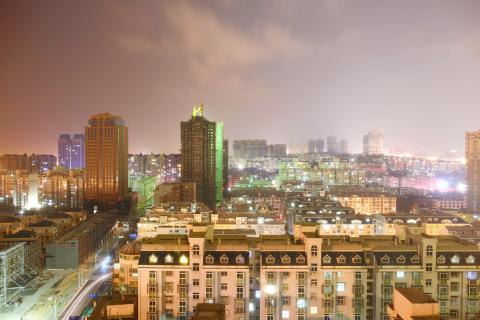
Photo: AFP
However, the economic potential of the “experimental zone” has yet to be proved, and with Beijing setting the rules, its hints at political integration may well be rebuffed.
“It’s basically the Chinese creating what they see as what future integration would look like — without really much input from Taiwan,” said Bonnie Glaser, a senior adviser at the US-based Center for Strategic and International Studies.
“It may help some individual Taiwan companies make some money, but I don’t think it’s going to promote the political goals that they seek,” she added.
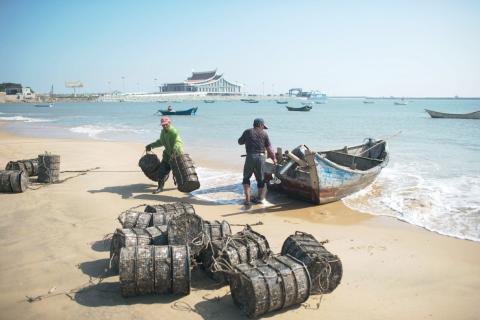
Photo: AFP
“The political symbolism in all of this is seen as potentially threatening to Taiwan,” Glaser added.
For decades the threat of conflict loomed, with both sides of the Taiwan Strait claiming to represent the whole of China. Beijing has described unification as a “historical mission,” to be imposed by force if necessary.
At the same time, a “one country, two systems” model is on offer, similar to the arrangements with Hong Kong, the former British colony turned semi-autonomous Chinese territory.
Beijing has sought warmer ties in recent years and on Tuesday Taiwan’s Mainland Affairs Council (MAC) Minister Wang Yu-chi (王郁琦) will visit China in the two sides’ first official contact in six decades.
Meanwhile authorities have also sought to attract Taiwanese — along with their investment and knowhow — with generous subsidies and fasttrack business services.
Pingtan goes further, with Beijing promising it will be “jointly planned, jointly developed, jointly operated, jointly managed and jointly profiting.”
The project has been allocated at least 250 billion yuan (US$41 billion) since it was approved in 2009 — when it was an outcrop of humble fisheries that did not even have a bridge connecting it to the mainland.
Now shiny brochures promise an island bursting with gleaming skyscrapers, leafy villas and Asia’s largest private museum.
The MAC in 2012 distanced itself from the project and its claim to be a “joint” effort, but Beijing is pressing ahead, recruiting Taiwanese to fill deputy posts across the local government, in what University of Nottingham lecturer Lee Chun-yi called both “a symbolic step and an effort to absorb outside experience.”
A 50-year-old finance expert, named Liang Qinlong, has been appointed deputy head of the zone’s management committee, an official told reporters.
Liang said he could not give interviews due to sensitivities with Taipei. Pingtan’s economy grew 16 percent in the first half of last year, and as of November, 129 Taiwan-funded businesses had set up shop, China’s China Daily reported.
“The State Council has an overall policy of offering lots of benefits to Taiwanese and we are very happy to see those being gradually put into place,” said Shuie Chin Te, a 50-year-old Taiwanese businessman who recently recruited his son-in-law to join him on the island.
Still, Pingtan must prove it can become more than an overgrown construction site.
A new port has been built to receive ferries from Taiwan, but daily services have yet to begin.
A Taiwanese restaurateur surnamed Chang (張), sitting in an empty food court, said he was losing patience after nearly three years of bad business.
“Beijing is really promoting this, they want to make it even better than Hong Kong or Shanghai, so the opportunities are limitless — but the policies are coming too slowly,” he said.
Meanwhile the onslaught of development has made winners and losers of the original islanders.
Some complained that construction work went to non-local crews brought in by developers, while living costs had spiked, and a fisherman surnamed Chen (陳) said their seaside houses were being torn down.
“There have been no benefits at all,” he said.
Yet 28-year-old art entrepreneur Lin Ping said business prospects had soared and the new bridge and roads had slashed travel times.
“If it weren’t for Taiwan, Pingtan wouldn’t be all that it is today,” he said. “As for promoting reunification, that’s hard to say.”
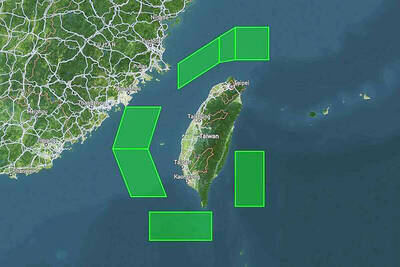
The disruption of 941 flights in and out of Taiwan due to China’s large-scale military exercises was no accident, but rather the result of a “quasi-blockade” used to simulate creating the air and sea routes needed for an amphibious landing, a military expert said. The disruptions occurred on Tuesday and lasted about 10 hours as China conducted live-fire drills in the Taiwan Strait. The Civil Aviation Administration (CAA) said the exercises affected 857 international flights and 84 domestic flights, affecting more than 100,000 travelers. Su Tzu-yun (蘇紫雲), a research fellow at the government-sponsored Institute for National Defense and Security Research, said the air
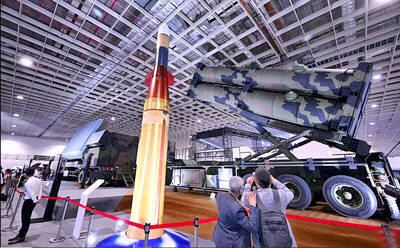
Taiwan is to commence mass production of the Tien Kung (天弓, “Sky Bow”) III, IV and V missiles by the second quarter of this year if the legislature approves the government’s NT$1.25 trillion (US$39.78 billion) special defense budget, an official said yesterday. Commenting on condition of anonymity, a defense official with knowledge of the matter said that the advanced systems are expected to provide crucial capabilities against ballistic and cruise missiles for the proposed “T-Dome,” an advanced, multi-layered air defense network. The Tien Kung III is an air defense missile with a maximum interception altitude of 35km. The Tien Kung IV and V
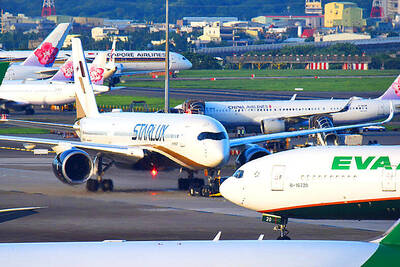
Trips for more than 100,000 international and domestic air travelers could be disrupted as China launches a military exercise around Taiwan today, Taiwan’s Civil Aviation Administration (CAA) said yesterday. The exercise could affect nearly 900 flights scheduled to enter the Taipei Flight Information Region (FIR) during the exercise window, it added. A notice issued by the Chinese Civil Aviation Administration showed there would be seven temporary zones around the Taiwan Strait which would be used for live-fire exercises, lasting from 8am to 6pm today. All aircraft are prohibited from entering during exercise, it says. Taipei FIR has 14 international air routes and
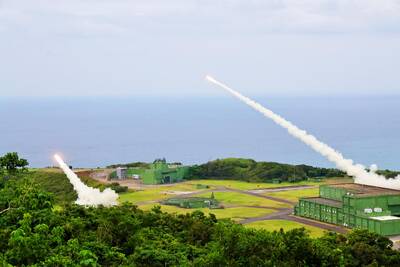
Taiwan lacks effective and cost-efficient armaments to intercept rockets, making the planned “T-Dome” interception system necessary, two experts said on Tuesday. The concerns were raised after China’s military fired two waves of rockets during live-fire drills around Taiwan on Tuesday, part of two-day exercises code-named “Justice Mission 2025.” The first wave involved 17 rockets launched at 9am from Pingtan in China’s Fujian Province, according to Lieutenant General Hsieh Jih-sheng (謝日升) of the Office of the Deputy Chief of the General Staff for Intelligence at the Ministry of National Defense. Those rockets landed 70 nautical miles (129.6km) northeast of Keelung without flying over Taiwan,


 RSS
RSS