


People living near Taiwan Taoyuan International Airport yesterday accused the government of rushing the review process for the Taoyuan Aerotropolis project, which they said was ill-conceived and had not incorporated any suggestions from civic groups.
The project covers an area of 6,859 hectares, of which 3,073 hectares are to be expropriated from private land owners.
The Taoyuan Aerotropolis Self-Help Association yesterday again questioned the necessity and public benefit of the forced expropriation plan, and called on lawmakers to freeze the project’s budget in today’s legislative session.
At a joint press conference in Taipei, Taipei National University of the Arts assistant professor Lu Wen-chung (呂文忠) showed a photograph taken by a surveillance camera of his late father, Lu A-yun (呂阿雲) — an 83-year-old farmer who killed himself by drinking pesticide on Nov. 9 — and said his father committed suicide because he could not bear the thought of being forced to leave his land and property.
Taiwan Rural Front spokesperson Tsai Pei-hui (蔡培慧) said that after the elderly farmer gave up his life to protest against the project, the Ministry of the Interior’s Construction and Planning Agency proceeded by holding 11 ad hoc specialist review meetings in 15 days — with very few committee members attending the meetings — as an apparent attempt to swiftly approve the project.
Questioning the necessity of expropriating their land when the aerotropolis’ new runway will not be designed and submitted for an environmental impact assessment until 2022, Taoyuan Educational Trade Union representative Peng Ju-yu (彭如玉) said that the Ministry of Transportation and Communications in 1999 expropriated 176 hectares of private land in Taoyuan’s Dayuan Township (大園) for the Taoyuan Air Services Zone program, but the planned park area is still deserted.
“A wrong investment may be worse than corruption,” Democratic Progressive Party Legislator Tien Chiu-chin (田秋堇) said at the press conference, urging her colleagues at the legislature to freeze funding for the project until the government can clarify questions about its public benefits and necessity.

Yangmingshan National Park authorities yesterday urged visitors to respect public spaces and obey the law after a couple was caught on a camera livestream having sex at the park’s Qingtiangang (擎天崗) earlier in the day. The Shilin Police Precinct in Taipei said it has identified a suspect and his vehicle registration number, and would summon him for questioning. The case would be handled in accordance with public indecency charges, it added. The couple entered the park at about 11pm on Thursday and began fooling around by 1am yesterday, the police said, adding that the two were unaware of the park’s all-day live

Fast food chain McDonald's is to raise prices by up to NT$5 on some products at its restaurants across Taiwan, starting on Wednesday next week, the company announced today. The prices of all extra value meals and sharing boxes are to increase by NT$5, while breakfast combos and creamy corn soup would go up by NT$3, the company said in a statement. The price of the main items of those meals, if ordered individually, would remain the same. Meanwhile, the price of a medium-sized lemon iced tea and hot cappuccino would rise by NT$3, extra dipping sauces for chicken nuggets would go up
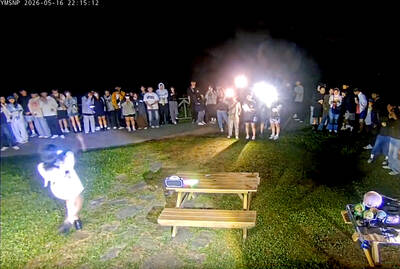
Yangmingshan National Park’s Qingtiangang (擎天崗) nature area has gone viral after a park livestream camera observed a couple in the throes of intimate congress, which was broadcast live on YouTube, drawing large late-night crowds and sparking a backlash over noise, bright lights and disruption to wildlife habitat. The area’s livestream footage appeared to show a couple engaging in sexual activity on a picnic table in the park on Friday last week, with the uncensored footage streamed publicly online. The footage quickly spread across social media, prompting a tide of visitors to travel to the site to “check in” and recreate the

Minister of Digital Affairs Lin Yi-ching (林宜敬) yesterday cited regulatory issues and national security concerns as an expert said that Taiwan is among the few Asian regions without Starlink. Lin made the remarks on Facebook after funP Innovation Group chief executive officer Nathan Chiu (邱繼弘) on Friday said Taiwan and four other countries in Asia — China, North Korea, Afghanistan and Syria — have no access to Starlink. Starlink has become available in 166 countries worldwide, including Ukraine, Malaysia, the Philippines and Vietnam, in the six years since it became commercial, he said. While China and North Korea block Starlink, Syria is not


 RSS
RSS