


The unruly and aggressive behaviors of Chinese tourists have again raised the ire of Taiwanese, as the Anping Fort (安平古堡) and Tainan Confucian Temple in Greater Tainan reportedly came under assault during the recent peak season in travel during China’s National Day holiday last week.
Witnesses said the Chinese tourists were seen smoking and spitting on the ground inside the Anping Fort, which is classified as a grade-one national historic site.
In doing so, they were openly flouting the site’s posted rules of conduct and instructions from the tour guides, while tarnishing its condition, which is already declining due to centuries of weathering and erosion.
The almost 400-year-old remains of the fort begun by the Dutch in 1624 and completed in 1633 is suffering from willful degradation by visitors from across the Taiwan Strait.
According to witnesses, Chinese tourists were seen poking and digging with their fingers at the worn mortar and concrete walls of the fort in recent weeks.
“There were quite a number of them doing this. When the volunteer workers at the fort came to give warnings and remind them of the regulations, it was like the wind going in one ear and out of the other ear. They totally ignored the warnings and even gathered friends together in a small group to poke and dig at the age-old walls,” one witness said.
When told of this situation, Greater Tainan Cultural Affairs Bureau Director Yeh Tse-shan (葉澤山) said certain behavior by Chinese tourists have violated the Cultural Heritage Preservation Act (文化資產保存法).
“However, the Anping Fort site has a wide area and it is too large to hire enough guards to look after every spot,” he said.
“People have suggested erecting barriers in front of the old walls to block off incursion by visitors. After a review, we decided against it, due to concerns that the barriers might also damage the site. The current plan is to request the tour guides and volunteer workers to help out on enforcement and demonstration of the regulations,” he said.
The Tainan Confucius Temple also was the scene of an ugly incident involving Chinese tourists in recent days, while two British academics were in Greater Tainan to attend a conference.
The academics had Lu Fang-hui (廬芳惠), a certified tour guide with many years of experience, explaining the history and cultural information on their visit to the attractions around Tainan.
Lu said she and her British clients were rudely interrupted by a group of Chinese tourists, who rushed into the temple. She said they were speaking loudly in Chinese dialects.
Because the Chinese were hampering her effort to share the historical information, Lu said she asked the Chinese tour group to lower their voices.
“After I approached them and returned to my clients, suddenly about five of the Chinese men ran up to confront me in an aggressive manner,” Lu said. “They were men of about 60 years old who questioned my line of work and then accused me of interfering when they were taking photographs.”
As she did not want to leave a bad impression with the British academics, Lu said she decided not to argue with the Chinese.
“However, these men were not satisfied, and they went further with their hostile attitude and raised more complaints,” she said.
Lu added that the men pointed at her in anger, saying: “We spent money here, so why should we keep our voices down?”


UPGRADE: The Kang Ding-class frigate is replacing its Chaparall missiles with Tien Chien II and Hua Yang VLS, which would provide it with long-range, 360° air defense Taiwan plans to produce 1,200 to 1,376 Hai Chien II missiles (海劍二, Sea Sword II) — also known as TC-2N — to serve as the standard air defense system of the navy’s surface combatant fleet, a source said yesterday. Last week, the Hai Chien II, the naval version of the Tien Kung II missile (天劍二, Sky Sword II), completed a live-fire test in waters off the National Chungshan Institute of Science and Technology’s Jiupeng facility (九鵬) in Pingtung County’s Manjhou Township (滿州). The MIM72 Chaparral and other dated air defense missiles that currently arm Taiwanese ships have inadequate range to combat Chinese

REASONS FOR TRAVEL: An assistant professor said that proposed amendments to penalize drivers if they used drugs overseas would not deter people from traveling People who operate a motor vehicle under the influence of marijuana would have their driver’s license revoked, even if they used the substance while overseas, the Ministry of Transportation and Communications said yesterday, citing proposed amendments to the Road Traffic Management and Penalty Act (道路交通管理處罰條例). The amendments would also authorize the government to revoke the licenses of people determined to have used Category 1 or Category 2 narcotics, even if they were not operating a vehicle while under the influence of drugs, as well as ban them from taking the license test for three years, the ministry said. People aged 18 or
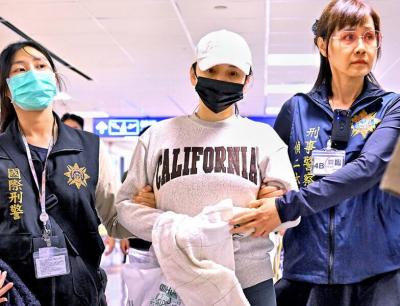
Johanne Liou (劉喬安), a Taiwanese woman who shot to unwanted fame during the Sunflower movement protests in 2014, returned to Taiwan last night after being deported from the US. She is to stand trial in Taiwan for charges involving embezzlement, fraud and drug crimes. The Criminal Investigation Bureau (CIB) said it took her into custody at Taiwan Taoyuan International Airport and would first question her before transferring her to the New Taipei District Prosecutors’ Office. She was arrested upon disembarking a flight from San Francisco that landed shortly before 7pm. Liou absconded to the US in 2019 after jumping bail

Shih Hsin University President Chen Ching-he (陳清河) yesterday issued a public apology for comments made in his commencement speech last week, stating that he has asked the school to suspend his duties and halt his wages for two months as a show of contrition. At the commencement ceremony on May 30, Chen said, “If you don’t manage your time well, or your own emotions, or your health, then I am telling every one of you — put a quick end to ‘you,’ because the world has no need for ‘you.’” The comments have sparked significant controversy online, and Chen through an open


 RSS
RSS