


When an artist is trying to make their name in the art world, they have to seize any opportunity they come across, which is just how Su Chia-hsien (蘇家賢) became a successful 3D street artist under the moniker, Tu Lung (圖龍).
Before gaining recognition, Su worked in a series of art-related jobs, but felt unfulfilled as an artist. His career path took a turn in 2010 when acclaimed US artist Kurt Wenner, the inventor of 3D pavement art, came to Taiwan to demonstrate the art form.
Wenner painted a large piece called Ocean Dragon Palace (海洋龍宮) at Glory Pier in the then-Kaohsiung City. The interplay of virtual images produced a dazzling impact that made a lasting impression on Su, who up until then had been practicing conventional painting for nearly three decades.
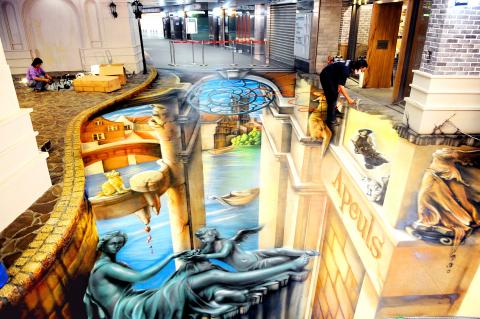
Photo: Chang Chung-yi, Taipei Times
“I had followed the progression of 3D pavement art movement on the Internet and wanted to give it a try. Seeing Wenner’s work triggered a passion inside me and I decided to master 3D pavement painting,” he said.
Three years later, Tu Lung is being touted as the top 3D street artist in the Chinese-speaking world.
At first, Su practiced painting with an air spray gun on wooden floors. As he gained proficiency in this technique, he realized he needed larger places on which to paint as the limited amount of wooden floor space was constraining his creativity.
“At the time, when people spoke about 3D art, everyone felt it was solely the domain of foreigners. People asked me: ‘Can a local artist produce something really interesting and creative in this format?’ which is a doubt I understood, but wanted to disprove,” he said.
Su’s big break came when a friend introduced him to officials from the Fongshan Senior High School in Greater Kaohsiung, who were willing to provide him with the canvas space he needed to produce the nation’s first locally made 3D artwork.
After two weeks of hard work, Tu Lung’s first 3D painting was complete and gave him the breakthrough he needed to gain renown as an artist. He chose nature as the theme of the piece, titled Crustal Fractures in the Arctic (北極極地層破裂), to call attention to environmental issues.
He was then commissioned to create another piece at Kaohsiung’s Pier 2 Art Center, which was followed by Taiwan Night Market Life (台灣夜市人生) at the Taiwan Taoyuan International Airport and a commercial work titled The Bathing Goddess (女神之浴).
His other 3D artworks are on display at the Greater Kaohsiung MRT’s Formosa Boulevard Station, Taipei 101 and in the romantic comedy film The Rooftop (天台).
“Producing 3D art is not very difficult. The hardest part is doing the first sketch. You need to conceptualize the idea for the piece within a strong, logical framework, so you can link all the points, lines and surfaces,” Su said.
When working on a project, Su said he paints while stooping down over the piece or lying flat on the ground, standing up at frequent intervals to check the 3D effect. The constant stooping and standing up has hurt his knees, which he jokingly said was an “occupational hazard in this line of work.”
Looking back, Su said that his journey to become a top 3D artist was facilitated by favorable circumstances, but he added that if he had not already acquired decades of experience painting, he would not have been able to seize the opportunity when it arose.
Su said he was grateful to his parents for supporting him as he pursued painting and backing his decision to study art design in high school.
After graduating from high school, Su completed his mandatory military service and headed to Taipei to look for work.
“At the time, I was young, full of ambition and self-confidence. I got a job designing and producing large lighting fixtures, and also designed studio sets for a popular TV program for which I later became the studio production manager,” Su said.
“I also worked at a design firm, producing paintings, which at times we had to work on for days and nights on end. However, although all these jobs were creative and involved art, I didn’t feel that I was progressing as an artist,” he added.
As time went on, Su had to face the harsh reality that it is difficult to be successful and make a decent living in Taipei, so he chose to return to his hometown. However, he found that there were also few employment opportunities there, so for more than a year, he made his living as street artist, doing sketches for tourists, so he could pay the rent.
Yet this turned out to be a blessing in disguise because since Su did not give up painting, “I was able to get into 3D street art when it was introduced in Taiwan,” he said.
Despite his success, Su has encountered some obstacles as well.
“One time, I did not receive payment for a piece because the person who commissioned it turned out to be a fraudster. I was also rejected when I applied for a government subsidy under a program that supports artists because I did not have an advanced academic degree,” he said.
No matter what difficulty he faced, Su persists in pursuing his passion for art. His favorite topics for his pieces are country landscapes and everyday life, which he says are authentic reflections of Taiwanese culture.
When asked whether he is very busy now that fame has boosted demand for his work, Su said recognition has given him the luxury of turning down commercial projects.
“Yes, I can make good money from such projects, but a lot of these types of clients have got a plan and layout already in mind and just want me to fill in the blanks. I can earn a decent income creating what I want and that’s all I ever wanted,” he said.
“In the past, I took on a few commercial projects to support myself and help further my career, but now, I just want to create as many pieces as I can to hold my first solo exhibition,” Su said.
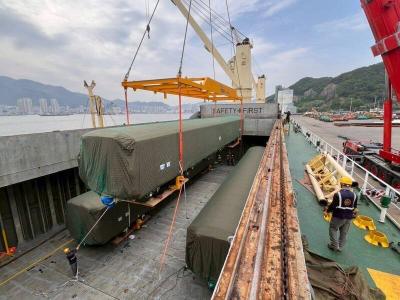
The first of 10 new high-capacity trains purchased from South Korea’s Hyundai Rotem arrived at the Port of Taipei yesterday to meet the demands of an expanding metro network, Taipei Rapid Transit Corp (TRTC) said yesterday. The train completed a three-day, 1,200km voyage from the Port of Masan in South Korea, the company said. Costing NT$590 million (US$18.79 million) each, the new six-carriage trains feature a redesigned interior based on "human-centric" transportation concepts, TRTC said. The design utilizes continuous longitudinal seating to widen the aisles and optimize passenger flow, while also upgrading passenger information displays and driving control systems for a more comfortable

Instead of focusing solely on the threat of a full-scale military invasion, the US and its allies must prepare for a potential Chinese “quarantine” of Taiwan enforced through customs inspections, Stanford University Hoover fellow Eyck Freymann said in a Foreign Affairs article published on Wednesday. China could use various “gray zone” tactics in “reconfiguring the regional and ultimately the global economic order without a war,” said Freymann, who is also a nonresident research fellow at the US Naval War College. China might seize control of Taiwan’s links to the outside world by requiring all flights and ships entering or leaving Taiwan
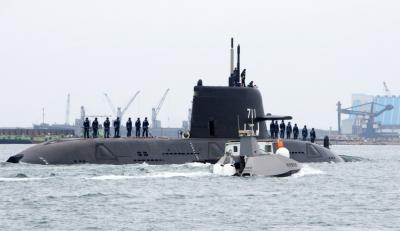
Taiwan's first indigenous defense submarine, the SS-711 Hai Kun (海鯤, or Narwhal), departed for its 13th sea trial at 7am today, marking its seventh submerged test, with delivery to the navy scheduled for July. The outing also marked its first sea deployment since President William Lai (賴清德) boarded the submarine for an inspection on March 19, drawing a crowd of military enthusiasts who gathered to show support. The submarine this morning departed port accompanied by CSBC Corp’s Endeavor Manta (奮進魔鬼魚號) uncrewed surface vessel and a navy M109 assault boat. Amid public interest in key milestones such as torpedo-launching operations and overnight submerged trials,
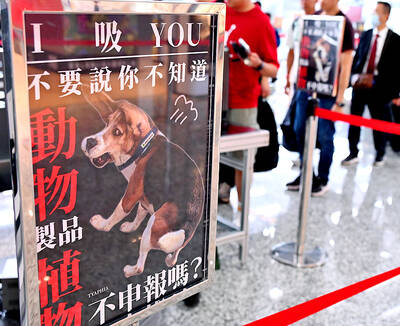
Quarantine awareness posters at Taiwan Taoyuan International Airport have gone viral for their use of wordplay. Issued by the airport branch of the Animal and Plant Health Inspection Agency, the posters feature sniffer dogs making a range of facial expressions, paired with advisory messages built around homophones. “We update the messages for holidays and campaign needs, periodically refreshing materials to attract people’s attention,” quarantine officials said. “The aim is to use the dogs’ appeal to draw focus to quarantine regulations.” A Japanese traveler visiting Taiwan has posted a photo on X of a poster showing a quarantine dog with a


 RSS
RSS