


A Greater Taichung man’s contention that the nation’s most common bills in circulation contain a printing error that has gone unnoticed for decades has sparked a heated debate.
Huang Pai-tsun (黃百村), a bedding merchant, said that the Chinese character for “one” (yi, 壹) on all NT$100 and NT$1,000 banknotes is incorrect.
The upper part of the character yi should be shi (士, scholar), with the top horizontal stroke longer than the bottom one, Huang said.
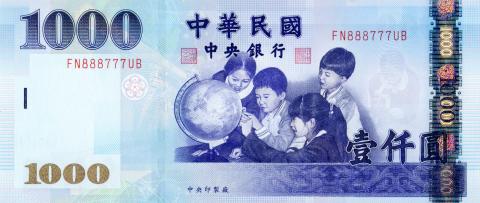
Photo: Lin Liang-che, Taipei Times
However, the banknotes in circulation have it wrong, he said, with the character written as tu (土, land or earth), which has a top horizontal stroke that is shorter than the bottom one.
Huang said he has double-checked with standard Chinese dictionaries and computer word processors and verified that the banknotes contain a misprint.
However, an official from the central bank’s currency issuance department denied that it was a misprint.
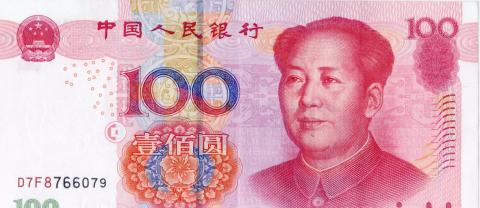
Photo: Lin Liang-che, Taipei Times
“There is no mistake in the Chinese character on the bills,” the official said.
Officials from the central bank’s Central Engraving and Printing Plant added that the printed characters on the currency bills were designed specifically for aesthetic purposes and to guard against counterfeiting, and, as such, differ from the regular written form.
“All printed characters on the bills were uniquely designed. If they were the same as those printed by a computer, then the bills would be easy to counterfeit,” an official said.
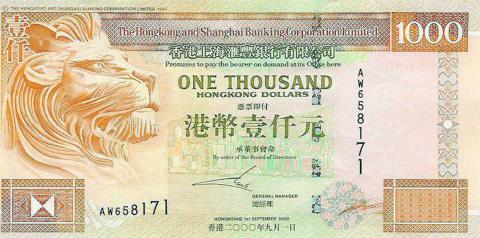
Photo: Lin Liang-che, Taipei Times
Yang Meng-chu (楊孟珠), a Chinese-language teacher at a senior-high school in Greater Taichung, is unconvinced, saying she thinks the central bank is wrong.
According to the Kangxi Dictionary (康熙字典), the root character for yi is shi; the central bank has therefore made a blunder by misprinting the root character as tu, Yang said.
A look at banknotes containing the character yi in China, Hong Kong and Macau show that they are printed with the root character shi.
“The Taiwanese government has always stressed that we are a country that uses the traditional Chinese system of writing. We should therefore be careful to follow the proper form,” Huang said.
“The central bank has made an error on the circulating bills. This has become an international joke. As China, Hong Kong and Macau all use the correct Han Chinese form, I want to see the central bank rectify the error at once. We should not allow this mistake to continue,” he added.
Money collector Yang Chuan-ming (楊川明) appeared to support Huang’s findings, saying he had made a careful study of all banknotes issued from the Japanese colonial era to the period right after World War II and found that all were written in the proper form.
“However, the [print] on the bills issued by the Chinese Nationalist Party (KMT) government starting from 1949 were all changed to tu,” he said.
In 1949, the KMT government had to deal with several crises, including soaring inflation and social unrest, and had to undertake a major fiscal restructuring, Yang Chuan-ming said.
“That was the time the KMT government mandated the conversion of one New Taiwan dollar for every 40,000 old Taiwan dollars. It was the start of the New Taiwan currency, with the issuance of NT$0.01, NT$0.10 and NT$100,” he said.
“From then on, the yi character on currency bills almost all had the wrong root on top. Very few bills got it right since then,” he said.

FUKUOKA SITUATION: Japanese media reported that the pathogen is expected to be identified by the summer, while the CDC downplayed the idea that it was hMPV A “mysterious cold-like illness” reported in Japan’s Fukuoka Prefecture does not seem to be a new disease, but Japanese authorities have been asked about the situation, the Centers for Disease Control (CDC) said yesterday. The Fukuoka Prefectural Medical Association on Wednesday told a news conference that a “mystery cold” that has become a hot topic on social media is “highly likely to be caused by some kind of viral infection,” Japan’s KBC News reported. “Many people are experiencing symptoms starting with a sore throat, followed by a runny nose, phlegm and a severe cough,” KBC News reported, citing association officials. Health authorities are

Nvidia Corp CEO Jensen Huang (黃仁勳) arrived in Taiwan yesterday ahead of upcoming AI and technology events, saying he plans to meet with clients and Taiwan Semiconductor Manufacturing Co Chairman C.C. Wei (魏哲家) during his visit. After landing at Taipei Songshan Airport, Huang posed for photos with fans and handed out Yakult drinks to reporters and supporters waiting at the scene, saying he has “a lot to do” during the trip. Asked about reports that Nvidia’s planned headquarters site in Taipei’s Beitou Shilin Technology Park could break ground on May 27, Huang said that if the company holds an event, he would

The Ministry of Finance this afternoon announced the winning numbers for the March-April uniform invoice lottery. The winning number for the NT$10 million (US$318,060) special prize is 19531471, and the winning number for the NT$2 million grand prize is 85941329. Three numbers were drawn for the NT$200,000 first prize: 07225810, 20231230 and 83518781. Those with receipts matching the last seven digits of any of the first-prize numbers will win the NT$40,000 second prize, while those matching the last six digits will win the NT$10,000 third prize. Those whose receipts match the last five digits of the first-prize numbers can claim the NT$4,000 fourth prize,
Taiwan Travelogue (臺灣漫遊錄), which earlier this week became the first Taiwanese novel to win the International Booker Prize, is to be adapted into a television series through a Taiwan-Japan coproduction, producer Chang Chen-yu (張辰漁) said yesterday. Chang, a producer at World Softest Production Film Co, wrote on Facebook that the company had been searching for projects with international appeal that retain a strong Taiwanese identity after colleagues and Japanese partners strongly recommended the novel. After reading the book, Chang said he immediately decided to pursue the screen rights. “A great story has the power to transcend time and borders, and connect countless people,”


 RSS
RSS