


The Ministry of Culture yesterday announced four more nominees to serve on the board of the Public Television Service (PTS), which has not been able to convene for more than a year because of problems filling the board seats.
The nominees are former minister without portfolio Ovid Tseng (曾志朗), Acer founder Stan Shih (施振榮), former Government Information Office minister Shao Yu-ming (邵玉銘) and former DaAi TV director Eric Yao (姚仁祿).
Minister of Culture Lung Ying-tai (龍應台) said that the nominees were heavyweights in the fields of education, technology and communication, adding that they were well-equipped to lead PTS’ development.
According to the Public Television Act (公視法), the PTS board of directors must consist of 17 to 21 members.
The government has failed to meet the minimum requirement regarding the number of directors four times, and only 13 candidates have been approved so far.
The ministry said that Shih is a prominent figure in the technology sector, adding that it hoped that he could turn PTS into a leader in the nation’s broadcasting industry in the era of digital convergence.
It said that Tseng has devoted himself to the education system as former minister of education and former vice president of Academia Sinica.
Tseng has been a leading advocate of making educational opportunities available to residents in remote areas, it said.
In addition, he launched a reading initiative for children, and promoted science education for everyone, the ministry said.
With Tseng’s extensive experience as an administrator as well as an educator, the PTS would better reflect the concerns of the public, the ministry added.
Shao was an important figure in the formation of PTS, the ministry said, saying that he had recruited Cloud Gate Dance Theater founder Lin Hwa-min (林懷民), poet Yu Kwang-chung (余光中) and other heavyweights in the cultural and communication industries to help establish the nation’s first public television system.
Yao helped set up the DaAi TV network and his professional insight would help PTS become a pioneer in the broadcasting sector, the ministry said.
The ministry said that the review session for four nominees is scheduled for Tuesday next week.
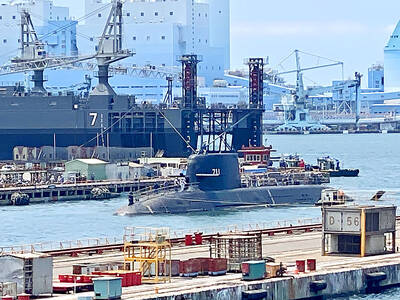
AGING: While Japan has 22 submarines, Taiwan only operates four, two of which were commissioned by the US in 1945 and 1946, and transferred to Taiwan in 1973 Taiwan would need at least 12 submarines to reach modern fleet capabilities, CSBC Corp, Taiwan chairman Chen Cheng-hung (陳政宏) said in an interview broadcast on Friday, citing a US assessment. CSBC is testing the nation’s first indigenous defense submarine, the Hai Kun (海鯤, Narwhal), which is scheduled to be delivered to the navy next month or in July. The Hai Kun has completed torpedo-firing tests and is scheduled to undergo overnight sea trials, Chen said on an SET TV military affairs program. Taiwan would require at least 12 submarines to establish a modern submarine force after assessing the nation’s operational environment and defense
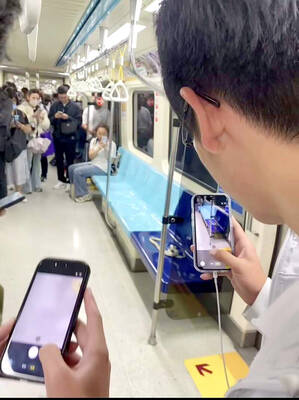
A white king snake that frightened passengers and caused a stir on a Taipei MRT train on Friday evening has been claimed by its owner, who would be fined, Taipei Rapid Transit Corp (TRTC) said yesterday. A person on Threads posted that he thought he was lucky to find an empty row of seats on Friday after boarding a train on the Bannan (Blue) Line, only to spot a white snake with black stripes after sitting down. Startled, he jumped up, he wrote, describing the encounter as “terrifying.” “Taipei’s rat control plan: Release snakes on the metro,” one person wrote in reply, referring
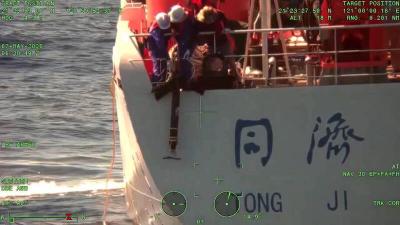
The coast guard today said that it had disrupted "illegal" operations by a Chinese research ship in waters close to the nation and driven it away, part of what Taipei sees a provocative pattern of China's stepped up maritime activities. The coast guard said that it on Thursday last week detected the Chinese ship Tongji (同濟號), which was commissioned only last year, 29 nautical miles (54km) southeast of the southern tip of Taiwan, although just outside restricted waters. The ship was observed lowering ropes into the water, suspected to be the deployment of scientific instruments for "illegal" survey operations, and the coast
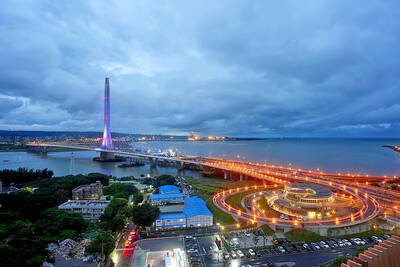
An inauguration ceremony was held yesterday for the Danjiang Bridge, the world’s longest single-mast asymmetric cable-stayed bridge, ahead of its official opening to traffic on Tuesday, marking a major milestone after nearly three decades of planning and construction. At the ceremony in New Taipei City attended by President William Lai (賴清德), Premier Cho Jung-tai (卓榮泰), Minister of Transportation and Communications Chen Shih-kai (陳世凱) and New Taipei City Mayor Hou Yu-ih (侯友宜), the bridge was hailed as both an engineering landmark and a long-awaited regional transport link connecting Tamsui (淡水) and Bali (八里)


 RSS
RSS