


A High Court ruling on Tuesday in the Wang Hao (王昊) case caused consternation among the family of the two-year-old child, who died from brutal physical abuse, and on the Internet.
Wang’s mother, Pan Mei-fang (潘美芳), had taken him to live with Liu Chin-lung (劉金龍), a man with a long narcotics record, as the child’s father, Wang Chang-kuo (王昌國), was in prison on drug charges.
Wang Hao was lured to the residence of a friend of Liu’s, where he was kept from Oct. 11 to Nov. 1, 2011, during which time he was subjected to physical abuse during what the defendants, Liu and three friends, Chou Chien-hui (周建輝), Hsu Kuan-hsiung (許冠雄) and Cheng Sheng-feng (鄭盛峰) — who all had previous criminal records — claimed were measures to keep him quiet.
The list of abuse included the use of a hammer to break the bridge of Wang Hao’s nose as well as his limbs, using needle-nose pliers to rip off his nails, branding the soles of his feet with red-hot iron nails, as well as forcing him to imbibe, or forcibly injecting him with, amphetamines and heroin.
The initial ruling by the Taipei District Court, after Pan sued Liu and the other defendants, gave Liu the death sentence, Chou life imprisonment, Hsu 13 years in prison and Cheng 14 years in prison on murder charges, forceful coercion of a minor by forcefully injecting Wang with class A drugs and illegally selling drugs.
To justify the sentence the district court said it found it difficult to understand how the defendants used abusive measures — which it said bordered on or constituted torture — to keep a two-year-old child quiet.
However, the High Court said this week that although the actions of the four defendants were horrendous, Liu had instructed the others to send Wang to the hospital after discovering that Wang had overdosed on drugs and had apologized to Wang’s aunt in court.
Saying this showed that the suspects had not entirely lost their consciences, the court reduced Liu’s sentence to 30 years in jail, while Chou was given 20 years and Hsu nine. Cheng’s sentence remained unchanged at 14 years.
The ruling can be appealed.
Wang Hao’s family members, child rights organizations and some netizens found the ruling unacceptable, calling it a judicial farce.
Wang Hao’s aunt, Wang Wei-chun (王薇君), said the “judicial system in Taiwan is dead.”
Wang Wei-chun said that when she heard that Liu would no longer face the death penalty, she was so shocked she fell to the ground in court.
She later vowed that even if it took a decade or two, she would keep appealing the case until justice was served for her nephew.
Wang Wei-chun, who also served as chief executive of the Taiwan Children’s Rights Association, said Wang Hao had been tortured to death.
“Torture is even crueler than giving someone a clean death,” Wang Wei-chun said, adding that if the courts were willing to treat criminals of such caliber so lightly, there was reason to worry about the future of children’s rights in Taiwan.
A criminal apologizing at the last minute in a court hearing is not a sincere apology, it is only an attempt to escape the death penalty, Wang Wei-chun said.
White Rose Social Care Association chief executive Liang Yu-fang (梁毓芳) said the High Court’s basis for sentence reduction was erroneous and absurd.
The collegiate bench said Liu demonstrated a last wisp of morality in taking Wang Hao to hospital, but the defendants had simply abandoned Wang Hao at the hospital, and, more importantly, the toddler died before reaching the hospital, Liang said.
“It’s as if the court is saying that if a potential murderer were to dismember a victim then take the dismembered parts to the hospital, he or she would still have some humanity and morality in them,” Liang said.
Children Welfare League Foundation executive director Chen Li-ju (陳麗如) said she could not understand the grounds on which the second ruling was reached.
“It’s a bad example for any future ruling in similar cases and it’s incredibly unfair to children who die from abuse,” Chen said.
Many netizens were extremely critical of the ruling.
A netizen going by the handle “koyuri” said: “No wonder there are more and more cases of child abuse in Taiwan; these judges should all go to hell for making the decisions they have made,” adding that perhaps the judges’ views on the case would change if their children had also been subject to the same treatment Wang Hao had received.
Additional reporting by Hsieh Wen-hua and Wu Sheng-ju

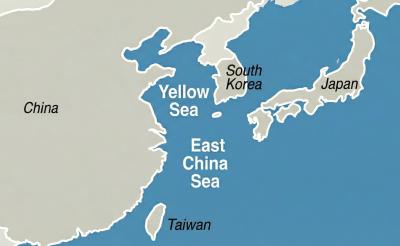
China has reserved offshore airspace in the Yellow Sea and East China Sea from March 27 to May 6, issuing alerts usually used to warn of military exercises, although no such exercises have been announced, the Wall Street Journal (WSJ) reported yesterday. Reserving such a large area for 40 days without explanation is an “unusual step,” as military exercises normally only last a few days, the paper said. These alerts, known as Notice to Air Missions (Notams), “are intended to inform pilots and aviation authorities of temporary airspace hazards or restrictions,” the article said. The airspace reserved in the alert is

South Korea is planning to revise its controversial electronic arrival card, a step Taiwanese officials said prompted them to hold off on planned retaliatory measures, a South Korean media report said yesterday. A Yonhap News Agency report said that the South Korean Ministry of Foreign Affairs is planning to remove the “previous departure place” and “next destination” fields from its e-arrival card system. The plan, reached after interagency consultations, is under review and aims to simplify entry procedures and align the electronic form with the paper version, a South Korean ministry official said. The fields — which appeared only on the electronic form

A bipartisan group of US senators has introduced a bill to enhance cooperation with Taiwan on drone development and to reduce reliance on supply chains linked to China. The proposed Blue Skies for Taiwan Act of 2026 was introduced by Republican US senators Ted Cruz and John Curtis, and Democratic US senators Jeff Merkley and Andy Kim. The legislation seeks to ease constraints on Taiwan-US cooperation in uncrewed aerial systems (UAS), including dependence on China-sourced components, limited access to capital and regulatory barriers under US export controls, a news release issued by Cruz on Wednesday said. The bill would establish a "Blue UAS
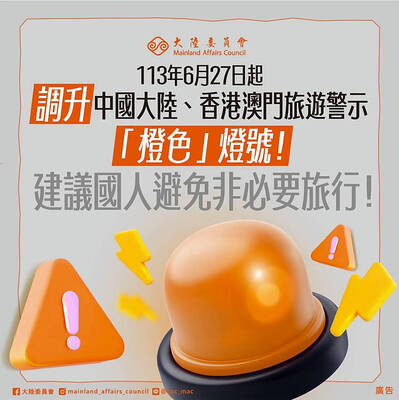
More than 6,000 Taiwanese students have participated in exchange programs in China over the past two years, despite the Mainland Affairs Council’s (MAC) “orange light” travel advisory, government records showed. The MAC’s publicly available registry showed that Taiwanese college and university students who went on exchange programs across the Strait numbered 3,592 and 2,966 people respectively. The National Immigration Agency data revealed that 2,296 and 2,551 Chinese students visited Taiwan for study in the same two years. A review of the Web sites of publicly-run universities and colleges showed that Taiwanese higher education institutions continued to recruit students for Chinese educational programs without


 RSS
RSS