


“I know how important it is to have the guidance of a voice in the darkness,” said Yang Yi-wen (楊怡雯), formerly an assistant manager in a hotel’s service department, who, at the age of 35, suffered detached retinas due to complications arising from diabetes.
Within half a year, she went from having good vision to living in darkness.
For the past seven years, she says she was consumed by sadness, but has now come around and is helping to make recordings of books with a group of volunteers.
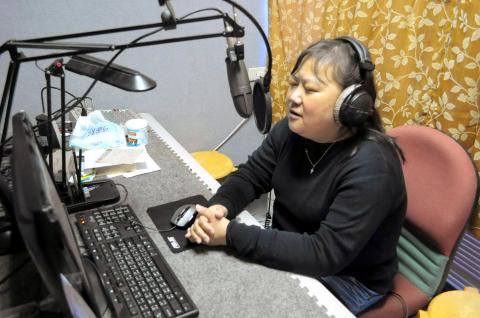
Photo: Chiu Shao-wen, Taipei Times
Yang is one of a group of volunteers taking part in a project sponsored by the Taiwan Digital Talking Books Association to produce a series of audio books for the visually impaired.
Visitors to the association’s Web site (www.tdtb.org) can visit the section “Spiritual Garden” (心靈園地), and hear essays recorded by the volunteers, which are accompanied by soothing background music.
Yang said her journey has not always been an easy one.
“When I started to lose my vision, many friends helped me. However, nobody understood the fear I felt in a world of darkness. At that time, I did not have contact with other blind people, nor with the welfare groups helping the visually impaired, because I did not want to become like them,” she said.
Yang said that for those who lose their eyesight in mid-life, the biggest barrier to overcome is one’s own “denial, and being unable to accept oneself.”
After living in denial for seven years, she said she eventually could not stand it any longer, so she went out of her way to seek social support.
Yang recalled that as she began to learn how to use computer equipment and the Braille system for Chinese characters, she felt like a baby learning to walk for the first time.
After being able to reconnect with society and regain many of her previous abilities, Yang said that now, looking back, she regretted that she did not start her “new life” sooner.
Yang uses a computer designed for the visually impaired to make recordings and produce audio books.
She inputs the text from a book, puts on headphones and listens to the computer voice read one sentence back to her, then she reads and records the sentence out loud.
Aside from recording the uplifting short stories, volunteers produce digital talking books from recommended publications.
The list includes books such as Farewell to My Life (生命告別之旅) by the late Cardinal Paul Shan (單國璽), Let the Sunshine Light Up Your Heart (讓陽光灑在心上) by Lee Wei-wen (李偉文) and Love Staying Life in Africa (愛呆人生) by Lien Chia-en (連加恩).
For some of the audio books, the association said it has secured the copyright and they can be sold on the market, and these are also suitable for elderly people with eyesight problems.
The association said it recently received a request from a visually imparied person wishing to hear the biography of late Apple Inc founder Steve Jobs. So the volunteers are now recording the book’s text, it said.
One of the volunteers is Wen Feng (溫風). The 57-year-old retired teacher was afflicted with cancer twice.
When she was sick and bedridden, family and friends came and prayed for her, for which she said she is very grateful, and has never forgotten the experience.
Since then, she has understood the values contained in the idiom “Utilize your limited lifetime to contribute the most with your talent,” she said.
“Making sound recordings was a dream from my childhood. I never thought this could be fulfilled at this stage of my life. Because I have varied life experience, when reading the books, I can project emotions for the various characters,” Wen said.
Wang Li-yu (王麗玉), another volunteer, is a housewife who joined the project a year ago.
With the idea of “sharing good things in life with good friends,” Wang said she selects her own books and does her own voice recordings, and has now completed eight talking books.
She said it is like reading books for her children at home.
“We want people to hear the good stuff contained in these books and to reflect on their lives. If we can touch some people or inspire them, then all the work has been worthwhile,” she said.

UNREASONABLE SURVEILLANCE: A camera targeted on an road by a neighbor captured a man’s habitual unsignaled turn into home, netting him dozens of tickets The Taichung High Administrative Court has canceled all 45 tickets given to a man for failing to use a turn signal while driving, as it considered long-term surveillance of his privacy more problematic than the traffic violations. The man, surnamed Tseng (曾), lives in Changhua County and was reported 45 times within a month for failing to signal while driving when he turned into the alley where his residence is. The reports were filed by his neighbor, who set up security cameras that constantly monitored not only the alley but also the door and yard of Tseng’s house. The surveillance occurred from July

Actor Darren Wang (王大陸) was sentenced to six months in prison, commutable to a fine, by the New Taipei District Court today for contravening the Personal Data Protection Act (個人資料保護法) in a case linked to an alleged draft-dodging scheme. Wang allegedly paid NT$3.6 million (US$114,380) to an illegal group to help him evade mandatory military service through falsified medical documents, prosecutors said. He transferred the funds to Chen Chih-ming (陳志明), the alleged mastermind of a draft-evasion ring, although he lost contact with him as he was already in detention on fraud charges, they said. Chen is accused of helping a

SECURITY: Starlink owner Elon Musk has taken pro-Beijing positions, and allowing pro-China companies to control Taiwan’s critical infrastructure is risky, a legislator said Starlink was reluctant to offer services in Taiwan because of the nation’s extremely high penetration rates in 4G and 5G services, the Ministry of Digital Affairs said yesterday. The ministry made the comments at a meeting of the legislature’s Transportation Committee, which reviewed amendments to Article 36 of the Telecommunications Management Act (電信管理法). Article 36 bans foreigners from holding more than 49 percent of shares in public telecommunications networks, while shares foreigners directly and indirectly hold are also capped at 60 percent of the total, unless specified otherwise by law. The amendments, sponsored by Chinese Nationalist Party (KMT) Legislator Ko

A Japan Self-Defense Forces vessel entered the Taiwan Strait yesterday, Japanese media reported. After passing through the Taiwan Strait, the Ikazuchi was to proceed to the South China Sea to take part in a joint military exercise with the US and the Philippines, the reports said. Japan Self-Defense Force vessels were first reported to have passed through the strait in September, 2024, with two further transits taking place in February and June last year, the Asahi Shimbun reported. Yesterday’s transit also marked the first time since Japanese Prime Minister Sanae Takaichi took office that a Japanese warship has been sent through the Taiwan


 RSS
RSS