


A stalwart of the persimmon processing industry for more than three decades, 55-year-old Liu Li-chien (劉理鑑) from Hsinchu County has brought new life to a traditional industry that has been battered by low-priced products smuggled in from China.
When the industry was still in its heyday, dried persimmons could fetch between NT$150 and NT$220 per catty (0.6kg), with the highest price of NT$350 a catty recorded at a night market in Greater Kaohsiung.
However, things took a turn for the worse about 28 years ago, when the Taiwanese persimmon sector was crippled by an incursion of smuggled persimmons from China, which brought down the price of locally grown persimmons to a record low of NT$100 per catty.
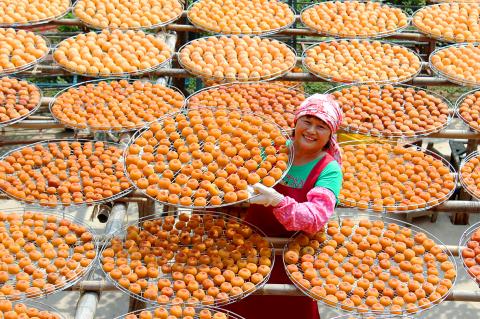
Photo: Huang Mei-chu, Taipei Times
Before Chinese smuggling became rampant, a middleman had offered to provide Liu with low-cost Chinese persimmons for NT$23 a catty, an opportunity that seemed too good to turn down.
Despite the temptation, Liu, proprietor of Hsinchu-based Wei Wei Jia Tourist Orchard, flatly rejected the offer out of conscience and an insistence on quality.
“Only one out of four Chinese persimmons do not taste astringent. As my mother always said, one should only make honest money,” Liu said. “Besides, peddling Chinese persimmons would help only my own business. What should Taiwanese persimmon farmers do then?”
The manufacture of dried persimmons is contingent on “the mercy of the weather,” he said.
In the best-case scenario, the northerly wind blowing from September to December would be strong and dry enough — acting as a “natural drying machine” — to accelerate the drying process of the golden fruits.
However, in most cases, manufacturers have to brave freezing temperatures to undertake a series of drying steps in an effort to prevent batches of laboriously harvested persimmons from perishing.
Born into a persimmon farming family, Liu started helping out with the family business at the age of five. In 1980, he and his father invented a drying machine to mimic the strong autumn wind.
Their brainchild, which could dry persimmons into a beautiful golden-yellow color, was soon copied by other orchard owners. The prevalence of the machine not only made the production of persimmon cakes far more time-efficient, but also launched an “industrial revolution” in the industry.
However, as Liu’s persimmon cakes have to be first dried, then roasted during a rainy day — a time-consuming processing method that gives the fruits a chewy taste, but also a less appealing appearance — his orchard started losing ground to other competitors that only used the drying machine.
Between 1987 and 1993, Liu’s business went from bad to worse in the face of fierce competition from both Taiwanese and Chinese persimmons.
At his worst, Liu earned less than NT$2,000 in retail revenue for an entire season, compared with the average quarterly profit of more than NT$1 million earned by other dried persimmon producers.
If not for the loyal support of a handful of wholesalers, including Chen Lien-tsai (陳連財) and Chan Yi-kuo (詹益國), who have been placing stable orders for Liu’s persimmon products for a long time, he might have given up.
Liu saw a silver lining when photography instructor Wu Ying-feng (吳應鳳), who was captivated by Wei Wei Jia’s traditional processing factory, started leading students to photograph the farm and factory each year.
Through the Internet, a group of women clad in headscarfs printed with Hakka traditional floral patterns, holding bamboo sieves filled with semi-dried persimmons while turning them, became the iconic image of Liu’s orchard, earning them the name “persimmon cake grandmas” (柿餅婆婆).
Another opportunity for Liu emerged nine years ago when an outsourcing contractor hired by the Ministry of Economic Affairs visited the orchard.
The delegation was surprised to discover a wooden beam that had been dyed brown by the persimmon juice left on the hands of Liu’s mother — a finding that blazed the trail for the development of persimmon dye in Taiwan and led to the establishment of the Hsinchu County Persimmon Dye Cultural Association.
Long regarded as a waste product, persimmons’ reddish-orange skin is rich in natural tannic acid and collagen, and dye extracted from it has good color fastness and can create a leather-like quality.
The beam was named the “Memorial Column of Parents” (懷親柱) and is now on display at Liu’s tourist orchard.

FUKUOKA SITUATION: Japanese media reported that the pathogen is expected to be identified by the summer, while the CDC downplayed the idea that it was hMPV A “mysterious cold-like illness” reported in Japan’s Fukuoka Prefecture does not seem to be a new disease, but Japanese authorities have been asked about the situation, the Centers for Disease Control (CDC) said yesterday. The Fukuoka Prefectural Medical Association on Wednesday told a news conference that a “mystery cold” that has become a hot topic on social media is “highly likely to be caused by some kind of viral infection,” Japan’s KBC News reported. “Many people are experiencing symptoms starting with a sore throat, followed by a runny nose, phlegm and a severe cough,” KBC News reported, citing association officials. Health authorities are

Nvidia Corp CEO Jensen Huang (黃仁勳) arrived in Taiwan yesterday ahead of upcoming AI and technology events, saying he plans to meet with clients and Taiwan Semiconductor Manufacturing Co Chairman C.C. Wei (魏哲家) during his visit. After landing at Taipei Songshan Airport, Huang posed for photos with fans and handed out Yakult drinks to reporters and supporters waiting at the scene, saying he has “a lot to do” during the trip. Asked about reports that Nvidia’s planned headquarters site in Taipei’s Beitou Shilin Technology Park could break ground on May 27, Huang said that if the company holds an event, he would

The Ministry of Finance this afternoon announced the winning numbers for the March-April uniform invoice lottery. The winning number for the NT$10 million (US$318,060) special prize is 19531471, and the winning number for the NT$2 million grand prize is 85941329. Three numbers were drawn for the NT$200,000 first prize: 07225810, 20231230 and 83518781. Those with receipts matching the last seven digits of any of the first-prize numbers will win the NT$40,000 second prize, while those matching the last six digits will win the NT$10,000 third prize. Those whose receipts match the last five digits of the first-prize numbers can claim the NT$4,000 fourth prize,
Taiwan Travelogue (臺灣漫遊錄), which earlier this week became the first Taiwanese novel to win the International Booker Prize, is to be adapted into a television series through a Taiwan-Japan coproduction, producer Chang Chen-yu (張辰漁) said yesterday. Chang, a producer at World Softest Production Film Co, wrote on Facebook that the company had been searching for projects with international appeal that retain a strong Taiwanese identity after colleagues and Japanese partners strongly recommended the novel. After reading the book, Chang said he immediately decided to pursue the screen rights. “A great story has the power to transcend time and borders, and connect countless people,”


 RSS
RSS