


It seems that in real life birds do occasionally act like their animal counterparts in the popular game Angry Birds and crash into glass window panes. Unfortunately for the birds, they cannot break through the glass as easily as their game equivalents, and often the birds end up on the ground, dazed, bleeding or dead.
This recently happened at the National Pingtung Senior High School in Pingtung County, which has seen brown shrikes fly into the classroom, crashing against windows and dropping to the ground several times this week.
The Lai Yi High School in Pingtung County has also observed this behavior among the Indian scops owl, a protected bird species.
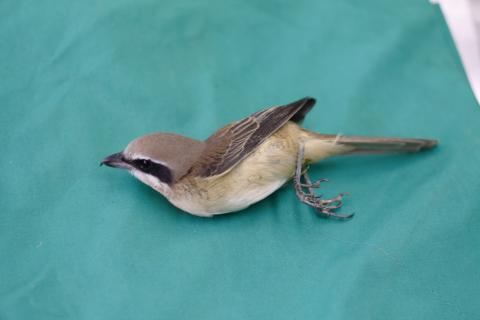
Photo: Chiu Chih-jou, Taipei Times
According to Pingtung Wild Birds Society chief executive Hsiao En-pei (蕭恩沛), it was usually birds more commonly seen in the region which fly into buildings.
However, Hsiao said that the shrike was currently in migration season, while the scops owls are often seen in the mountainous region in which Lai Yi Township (來義) is located.
According to Hsiao, it is possible that the birds crash into the windows because they are misled by squeaky clean glass windows, or are unable to redirect their course fast enough because of the speed they are flying at.
Commenting on the injured birds sent to the Pintung Wild Birds Society, Hsiao said that after his group has treated the birds it would keep them until they have fully recovered, adding that the society intends to release the birds into areas where they belong.
The scops is recovering well and should be released soon, but the brown shrike is not doing so well, Hsiao said, adding that the shrike has been unable to stand up since it was taken into care.
“We’re going to place it under continuous observation,” Hsiao said.
According to Hsiao, the Pingtung Wild Birds Society treats about 100 injured birds each year, with cases ranging from baby birds that have fallen out of their nests due to strong winds through to racing pigeons and birds that have flown into electricity poles.
Birds injured after flying into buildings account for about 10 percent of all injured birds, Hsiao said, adding that timely treatment given can aid the bird’s recovery.

The military has spotted two Chinese warships operating in waters near Penghu County in the Taiwan Strait and sent its own naval and air forces to monitor the vessels, the Ministry of National Defense (MND) said. Beijing sends warships and warplanes into the waters and skies around Taiwan on an almost daily basis, drawing condemnation from Taipei. While the ministry offers daily updates on the locations of Chinese military aircraft, it only rarely gives details of where Chinese warships are operating, generally only when it detects aircraft carriers, as happened last week. A Chinese destroyer and a frigate entered waters to the southwest

A magnitude 6.1 earthquake struck off the coast of Yilan County at 8:39pm tonight, the Central Weather Administration (CWA) said, with no immediate reports of damage or injuries. The epicenter was 38.7km east-northeast of Yilan County Hall at a focal depth of 98.3km, the CWA’s Seismological Center said. The quake’s maximum intensity, which gauges the actual physical effect of a seismic event, was a level 4 on Taiwan’s 7-tier intensity scale, the center said. That intensity level was recorded in Yilan County’s Nanao Township (南澳), Hsinchu County’s Guansi Township (關西), Nantou County’s Hehuanshan (合歡山) and Hualien County’s Yanliao (鹽寮). An intensity of 3 was

Japanese Prime Minister Sanae Takaichi’s comment last year on Tokyo’s potential reaction to a Taiwan-China conflict has forced Beijing to rewrite its invasion plans, a retired Japanese general said. Takaichi told the Diet on Nov. 7 last year that a Chinese naval blockade or military attack on Taiwan could constitute a “survival-threatening situation” for Japan, potentially allowing Tokyo to exercise its right to collective self-defense. Former Japan Ground Self-Defense Force general Kiyofumi Ogawa said in a recent speech that the remark has been interpreted as meaning Japan could intervene in the early stages of a Taiwan Strait conflict, undermining China’s previous assumptions
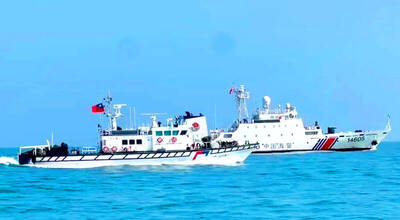
Instead of focusing solely on the threat of a full-scale military invasion, the US and its allies must prepare for a potential Chinese “quarantine” of Taiwan enforced through customs inspections, Stanford University Hoover fellow Eyck Freymann said in a Foreign Affairs article published on Wednesday. China could use various “gray zone” tactics in “reconfiguring the regional and ultimately the global economic order without a war,” said Freymann, who is also a nonresident research fellow at the US Naval War College. China might seize control of Taiwan’s links to the outside world by requiring all flights and ships entering or leaving Taiwan


 RSS
RSS