


Before there were trendy toys such as Barbie dolls or games consoles, whipping tops were among the most popular toys in Taiwan. While few youngsters play with the twirling devices nowadays, a Taiwanese craftsman from Taoyuan County’s Dasi Township (大溪) keeps the traditional craft alive.
Yang Chin-fu (楊金福), 73, is among a small number of craftsmen in Taiwan who still handcrafts wooden spinning tops. He has run a small business producing these tops for nearly 30 years.
Centuries ago, many carpenters in Dasi taught their children how to make whipping tops — this is how the craft was kept alive in the township in northern Taiwan.
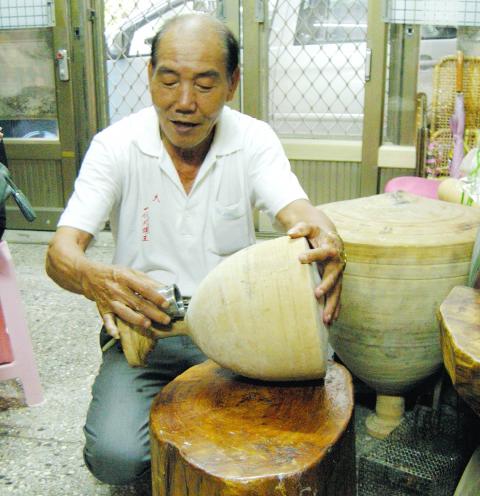
Photo: CNA
Unlike many other places in Taiwan, residents in Dasi have continued to play with these toys. The preservation of “an old-town atmosphere in Dasi” makes it possible for the residents to maintain the centuries-old activity, local culture historian Huang Chien-yi (黃建義) said.
Unlike in Japan, where spinning tops are made from wood and iron, Taiwanese craftsmen produce tops made solely of wood, according to experts.
As a child, Yang carved small chunks of wood into whipping tops to play with. Later he became a taxi driver, but still made tops as a side job.
Yang said he is a self-taught spinning top carver. Over the years, he has made tops in a variety of sizes, ranging from tops as small as a fist, to large ones which weigh up to 70kg.
“It’s an interesting craft,” Yang said, adding he has obtained a sense of achievement from people recognizing the quality of his products.
At the age of 45, he turned his hobby into a side business.
Yang, also a master of spinning the tops, said he was encouraged to begin the business by friends who would gather to play with the ones he had made.
“They said the tops I made were quite good to play with,” Yang added.
The key to making a whipping top, Yang said, is to first find the central point of each piece of wood. This is to ensure the balance of the top so that it will spin steadily, he said.
Yang can produce tops with diameters ranging from 10cm to 60cm.
It is difficult to make tops from big chunks of wood and create a beautiful shape, according to Huang.
“However, Yang can do it,” said Huang, who has also been playing with whipping tops since his childhood.
He said the craftsman has played an integral part in “preserving the art of making spinning tops.”
Yang’s works can be found in some stores on the old street in Dasi, a tourist attraction famed for its Baroque-style architecture dating from when Taiwan was a Japanese colony from 1895 to 1945.
The old street is where local residents gather to play with the tops, Huang said.
Meanwhile, Yang’s products have been distributed around Taiwan, with some exported to Japan and the US.
His customers range from university students in southern Taiwan to schools in Dasi. For example, Mei-Hwa Elementary School has bought a number of tops to teach students how use these toys, as part of efforts to preserve local folk culture.
About five years ago, a Japanese television crew traveled to Dasi to visit Yang.
Besides making whipping tops for the Japanese team, Yang, who can also spin tops in various sizes, said he taught them how to use the toys.
Neither a whipping top smaller than a thumb nor a top weighing more than 40kg is too hard for Yang to spin.
However, orders for whipping tops have decreased in recent years. Sometimes Yang has to wait a couple of months to get an order, he said.
However, his passion for the traditional handcraft has not been dampened.
“When I receive an order, I will do it,” Yang said.
The craftsman also expressed regret over the fact that very few Taiwanese children play with spinning tops nowadays. They go for computer games instead, he added.
“I’ve encouraged children in Dasi to play with spinning tops,” Yang said. “Some have listened to my words.”

Taiwanese can file complaints with the Tourism Administration to report travel agencies if their activities caused termination of a person’s citizenship, Mainland Affairs Council Minister Chiu Chui-cheng (邱垂正) said yesterday, after a podcaster highlighted a case in which a person’s citizenship was canceled for receiving a single-use Chinese passport to enter Russia. The council is aware of incidents in which people who signed up through Chinese travel agencies for tours of Russia were told they could obtain Russian visas and fast-track border clearance, Chiu told reporters on the sidelines of an event in Taipei. However, the travel agencies actually applied

Japanese footwear brand Onitsuka Tiger today issued a public apology and said it has suspended an employee amid allegations that the staff member discriminated against a Vietnamese customer at its Taipei 101 store. Posting on the social media platform Threads yesterday, a user said that an employee at the store said that “those shoes are very expensive” when her friend, who is a migrant worker from Vietnam, asked for assistance. The employee then ignored her until she asked again, to which she replied: "We don't have a size 37." The post had amassed nearly 26,000 likes and 916 comments as of this

New measures aimed at making Taiwan more attractive to foreign professionals came into effect this month, the National Development Council said yesterday. Among the changes, international students at Taiwanese universities would be able to work in Taiwan without a work permit in the two years after they graduate, explainer materials provided by the council said. In addition, foreign nationals who graduated from one of the world’s top 200 universities within the past five years can also apply for a two-year open work permit. Previously, those graduates would have needed to apply for a work permit using point-based criteria or have a Taiwanese company

The Shilin District Prosecutors’ Office yesterday indicted two Taiwanese and issued a wanted notice for Pete Liu (劉作虎), founder of Shenzhen-based smartphone manufacturer OnePlus Technology Co (萬普拉斯科技), for allegedly contravening the Act Governing Relations Between the People of the Taiwan Area and the Mainland Area (臺灣地區與大陸地區人民關係條例) by poaching 70 engineers in Taiwan. Liu allegedly traveled to Taiwan at the end of 2014 and met with a Taiwanese man surnamed Lin (林) to discuss establishing a mobile software research and development (R&D) team in Taiwan, prosecutors said. Without approval from the government, Lin, following Liu’s instructions, recruited more than 70 software


 RSS
RSS