


A documentary about the reconstruction of a village that was devastated by Typhoon Morakot in 2009 has been released to coincide with the third anniversary of the disaster.
The film follows the story of three tea farmers in Taihe Village (太和) in Chiayi County’s Mei-shan Township (梅山) and how the storm changed their lives.
When Morakot hit on Aug. 8, 2009, it triggered the worst flooding in the country in 50 years. It also toppled dozens of houses and ruined vital infrastructure in the mountainous village of Taihe, where most residents relied on tea farming to make a living.
After the disaster, tea farmers Kuo Chun-nan (郭俊男), Chien Chia-wen (簡嘉文) and Yeh Jen-shou (葉人壽) — the focus of the film — began to rethink their relationship with nature.
Deeply affected by the devastation of the land, they adopted greener farming practices, including not using chemical fertilizers to grow tea.
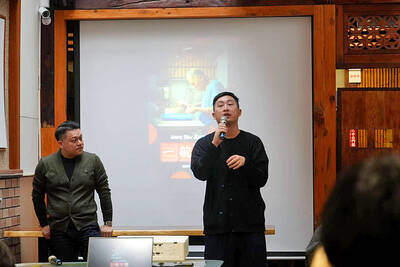
“We decided to just go the natural way,” Kuo said at a press conference in Taipei on Monday.
“Natural farming,” which means no fertilizers, makes the tea plants stronger, said Chien, whose family has been in the tea-farming business for about 30 years.
Although natural farming methods result in a lower crop yield, it is the right thing to do, the three farmers said.
They also encouraged other farmers to plant trees on their farms to protect the environment.
Many people have negative impressions about tea farming because it usually means cutting down trees, which affects water conservation and also increases the chances of mudslides during heavy rains.
Morakot caused serious damage in Taihe, but it also raised greater awareness about conservation, the filmmakers said.
The reconstruction process involved more than structures and the land, film director Wu Ping-hai (吳平海) said.
“What’s more important is the reconstruction of values,” he added.

FUKUOKA SITUATION: Japanese media reported that the pathogen is expected to be identified by the summer, while the CDC downplayed the idea that it was hMPV A “mysterious cold-like illness” reported in Japan’s Fukuoka Prefecture does not seem to be a new disease, but Japanese authorities have been asked about the situation, the Centers for Disease Control (CDC) said yesterday. The Fukuoka Prefectural Medical Association on Wednesday told a news conference that a “mystery cold” that has become a hot topic on social media is “highly likely to be caused by some kind of viral infection,” Japan’s KBC News reported. “Many people are experiencing symptoms starting with a sore throat, followed by a runny nose, phlegm and a severe cough,” KBC News reported, citing association officials. Health authorities are

Nvidia Corp CEO Jensen Huang (黃仁勳) arrived in Taiwan yesterday ahead of upcoming AI and technology events, saying he plans to meet with clients and Taiwan Semiconductor Manufacturing Co Chairman C.C. Wei (魏哲家) during his visit. After landing at Taipei Songshan Airport, Huang posed for photos with fans and handed out Yakult drinks to reporters and supporters waiting at the scene, saying he has “a lot to do” during the trip. Asked about reports that Nvidia’s planned headquarters site in Taipei’s Beitou Shilin Technology Park could break ground on May 27, Huang said that if the company holds an event, he would

The Ministry of Finance this afternoon announced the winning numbers for the March-April uniform invoice lottery. The winning number for the NT$10 million (US$318,060) special prize is 19531471, and the winning number for the NT$2 million grand prize is 85941329. Three numbers were drawn for the NT$200,000 first prize: 07225810, 20231230 and 83518781. Those with receipts matching the last seven digits of any of the first-prize numbers will win the NT$40,000 second prize, while those matching the last six digits will win the NT$10,000 third prize. Those whose receipts match the last five digits of the first-prize numbers can claim the NT$4,000 fourth prize,
Taiwan Travelogue (臺灣漫遊錄), which earlier this week became the first Taiwanese novel to win the International Booker Prize, is to be adapted into a television series through a Taiwan-Japan coproduction, producer Chang Chen-yu (張辰漁) said yesterday. Chang, a producer at World Softest Production Film Co, wrote on Facebook that the company had been searching for projects with international appeal that retain a strong Taiwanese identity after colleagues and Japanese partners strongly recommended the novel. After reading the book, Chang said he immediately decided to pursue the screen rights. “A great story has the power to transcend time and borders, and connect countless people,”


 RSS
RSS